



Why Lending Needs One Agentic Platform
Every lender we talk to this year asks where to put the AI. Our answer: agents build the lending automation, the automation runs every loan, and agents and people handle the exceptions.
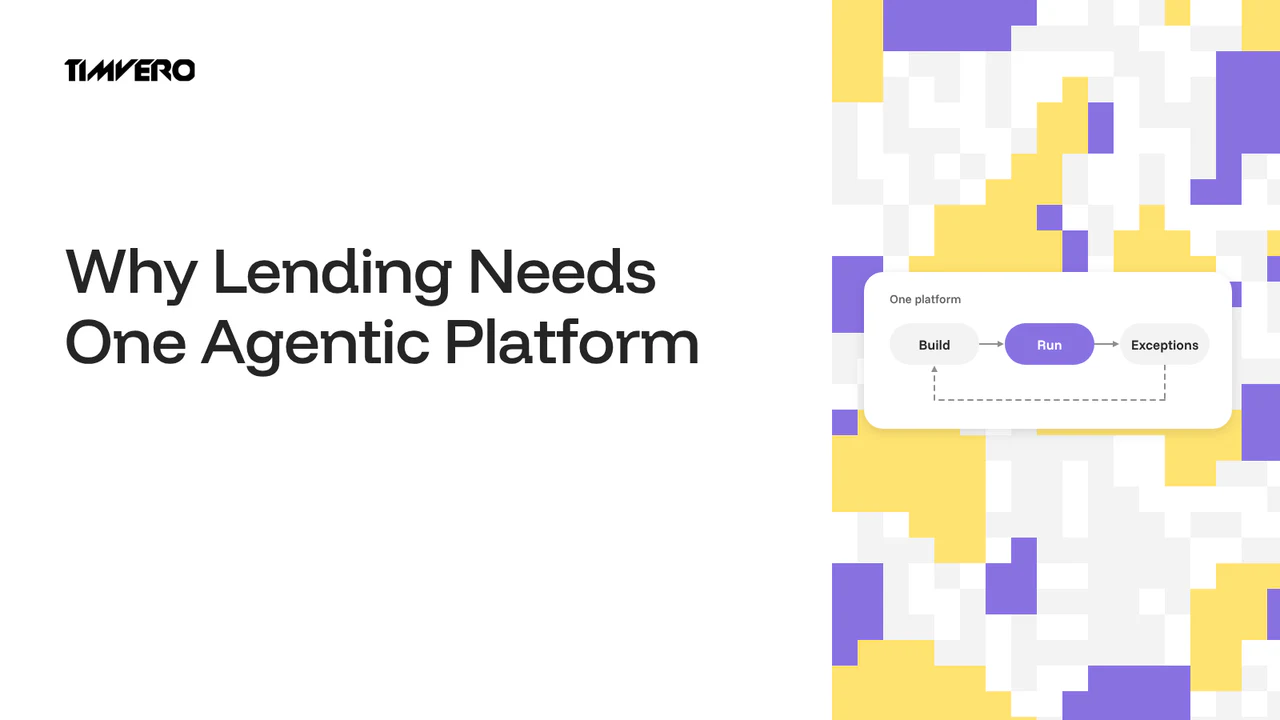
Every lender we talk to this year asks the same question: where do we put the AI?
Our answer is the reason TIMVERO is built the way it is. Agents build the lending automation. The automation runs every loan. Agents and people handle the exceptions.
TL;DR
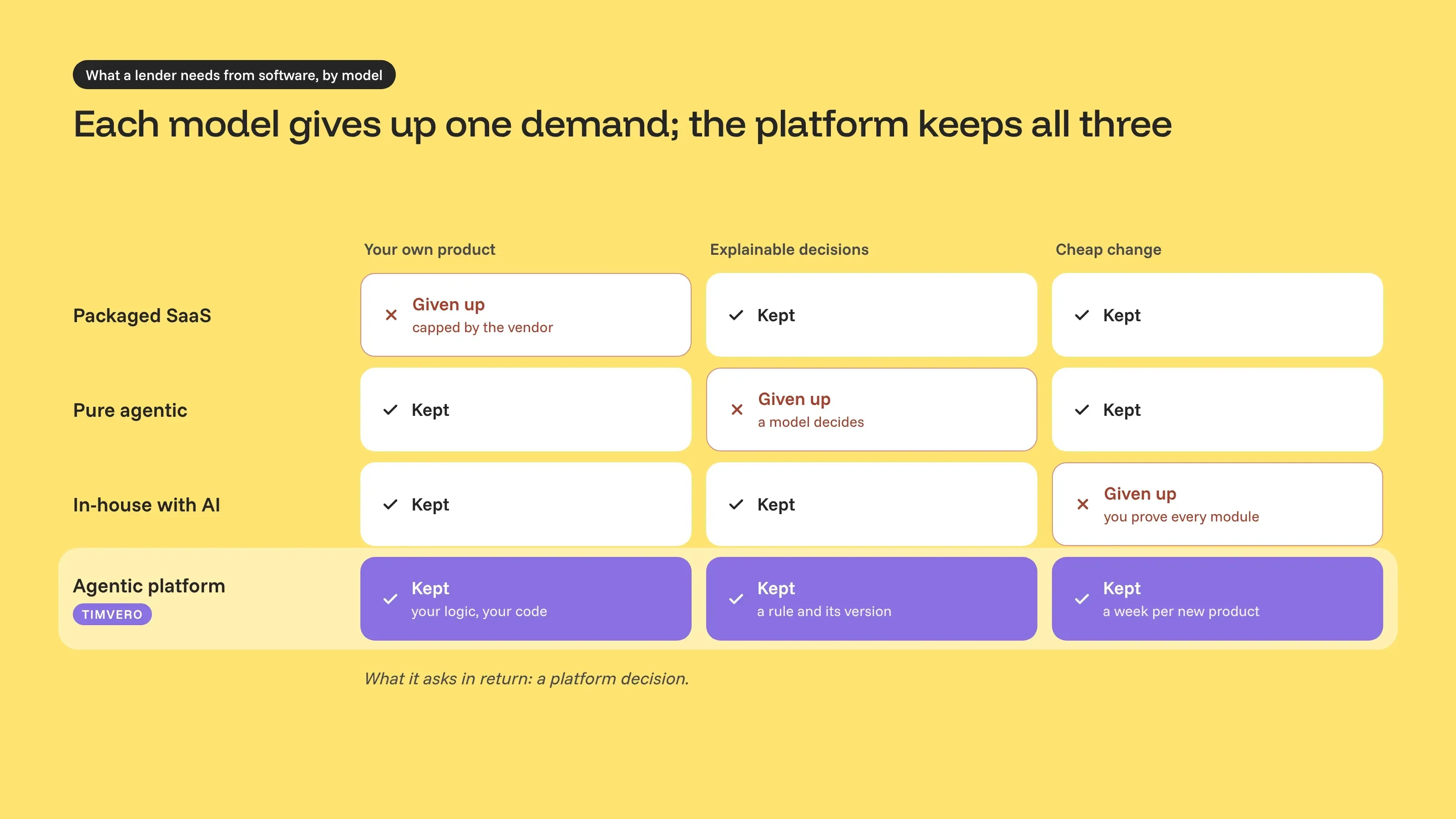
- A lender needs three things at once: a product that is its own, decisions it can explain, and change that is cheap.
- Each model on offer gives one up. Packaged SaaS caps the product. Pure agents put a probabilistic model where a supervisor expects a rule. In-house with AI leaves the lender to prove a whole platform alone.
- The fix is to put AI where its output can be checked before a loan depends on it: at build time, and on the exceptions the automation cannot close.
- That is what we mean by an agentic platform for lending, and why lending needs one platform and not three tools.
For how this works on your own credit policy, see how timveroAI turns it into a tested product your team approves.
What a lender needs from software
A lender’s product is its credit policy. Software has to carry that policy exactly, and three demands follow.
- The product is yours. Pricing, eligibility, the documents you ask for and the order you ask for them are how a lender competes. A flow shared with every other customer of a vendor is not a product.
- Every decision can be explained. The board, the auditor and the supervisor will ask why an application was approved in March. The answer has to be a rule and its version, not a likelihood.
- Change is cheap. A new product in weeks, a policy change in days, and a cost per loan that falls as volume grows.
Buying software does not move the second demand to a vendor. In July 2026 the ECB told the CEOs of the banks it supervises that they “remain fully accountable” for risks from outsourced ICT (A&O Shearman (opens in new tab)).
Each of the three models on offer today gives up one of these demands.
Packaged SaaS: a ready product with a ceiling
SaaS lending cores solved a real problem. A lender without engineers gets a working system for standard products.
The price is the first demand. Bespoke logic stops at what the configuration screens allow. Past that point the lender waits for the vendor’s roadmap, or builds microservices around the core and maintains two systems. Either way it rents the code that carries its policy.
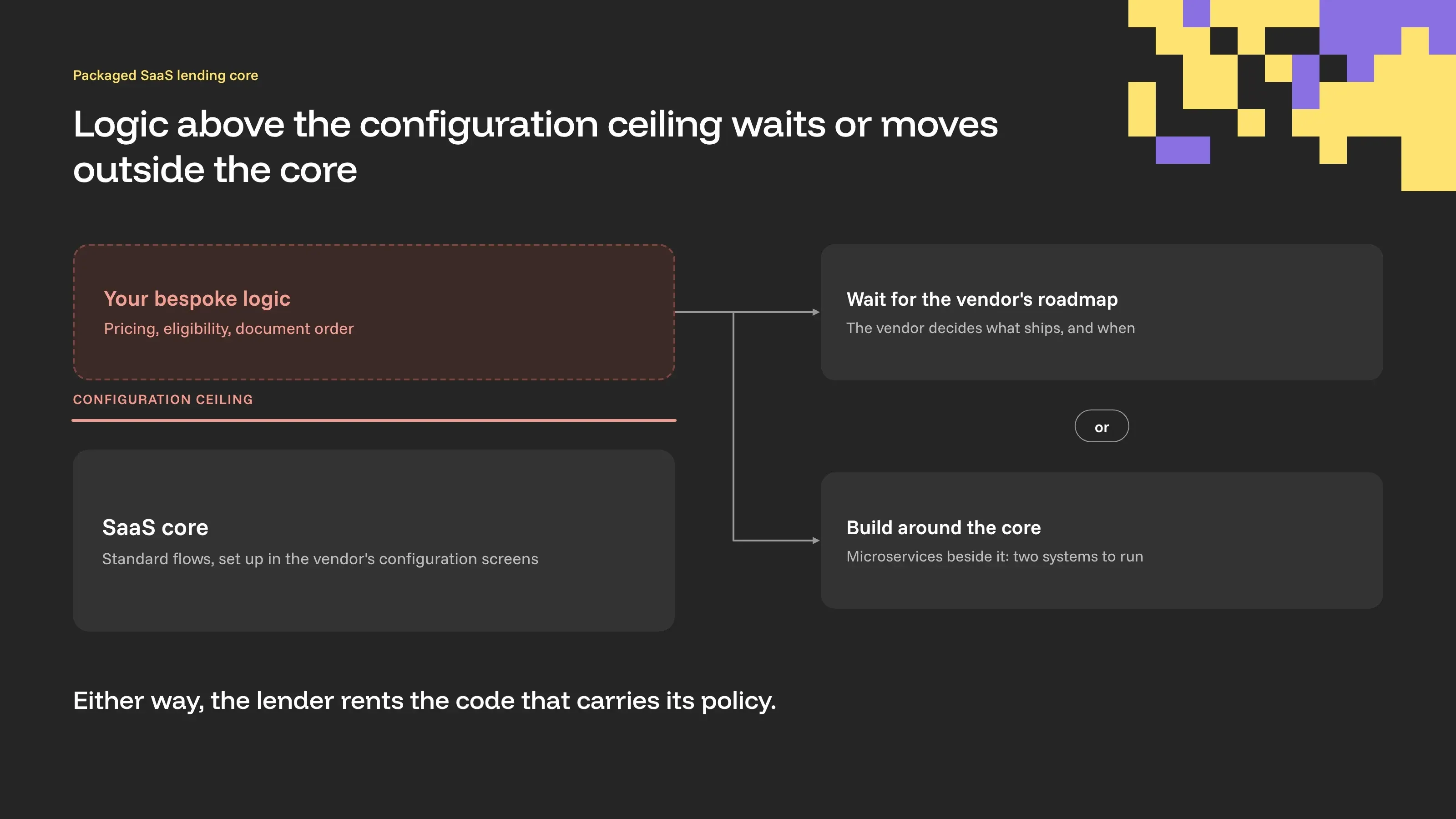
Vendors are now adding natural-language configuration. Standard flows get faster to set up. The ceiling stays where it was, and so does the question of who owns the logic.
Buyers have noticed. Software stocks lost over $1 trillion of market value in the first week of February 2026, on fears that AI agents and AI-built tools would replace SaaS (Forrester (opens in new tab)). In May a SaaS vendor wrote it down itself: banks are “actively reevaluating whether to build or buy their loan origination system” (nCino (opens in new tab)).
Pure agentic: executor or compiler
Agent-first vendors are right about where the labour is. Much of a lender’s operating cost is case work: chasing a missing document, reading a statement, following up a signature. An agent that lands beside the old system and takes that work pays back in weeks.
An agent can take that work in two ways, and the difference decides the economics. It can execute every case, or it can compile the process once.
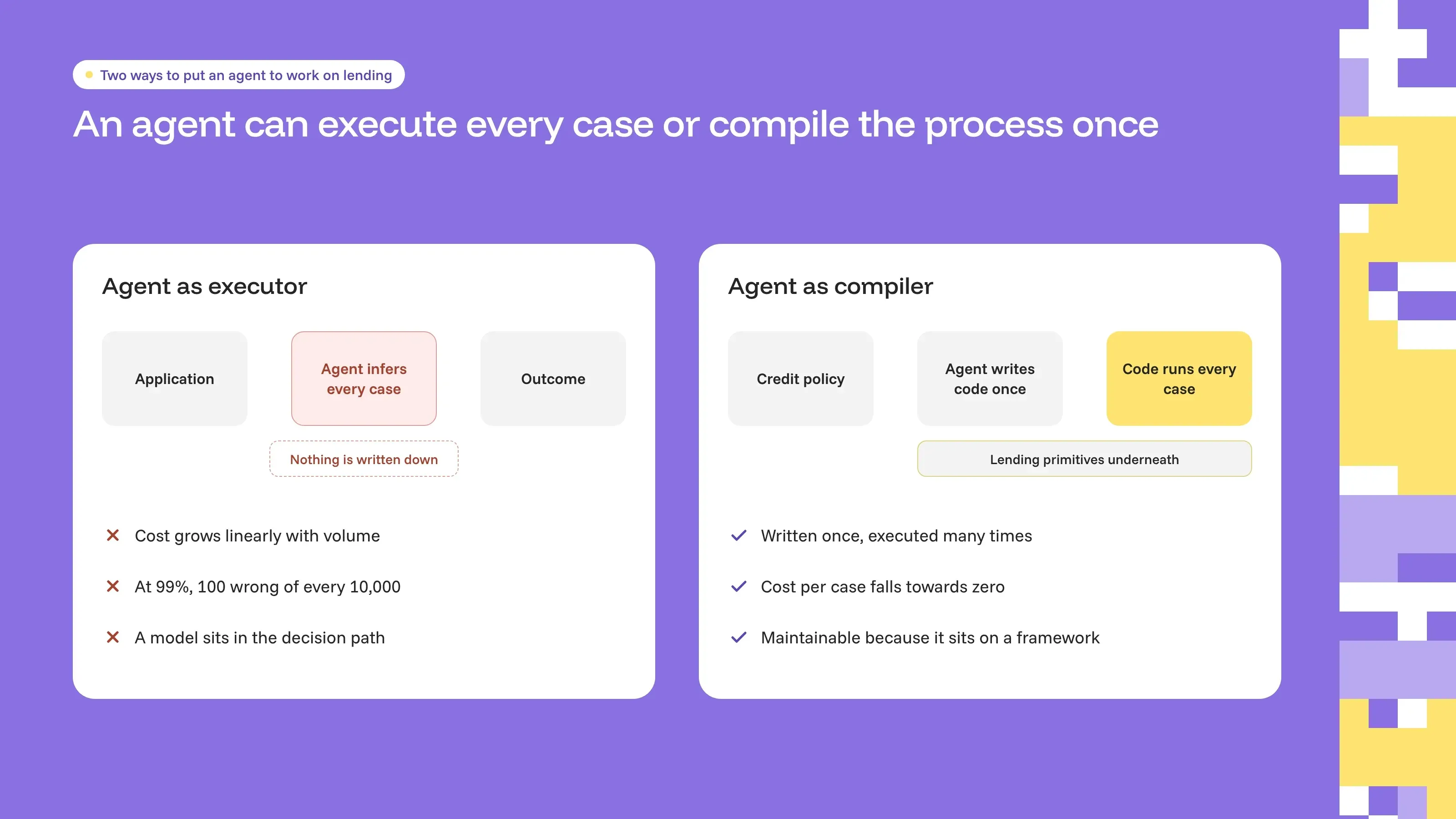
As an executor. The agent runs inference on every case. Nothing is written down: the model is the process. This is the model people usually mean by pure agentic, and it has four problems.
- Cost grows linearly with volume. Every case pays for inference again. The ten-thousandth application costs as much to process as the first.
- Errors grow the same way. An agent that is right 99% of the time gets 100 of every 10,000 applications wrong. Each one is a loan wrongly given or wrongly refused, with a customer and a supervisor attached.
- The decision is harder to defend. The EU AI Act’s high-risk duties for creditworthiness AI apply from 2 December 2027 (Bratby Law (opens in new tab)). A model in the decision path sits squarely in that scope. Deterministic rules that people approve are a far easier case to make.
- The record stays where it was. An agent layer on a 20-year-old core leaves the ledger, the servicing and the audit trail in that core.
As a compiler. The agent writes code once, and the code is executed many times. Cost per case falls towards zero, and the same input gives the same outcome. This is the right job for an agent.
But compiled code is still code, and someone has to maintain it: change it when the policy changes, upgrade it, audit it, fix it. What the agent compiles onto decides whether that is possible.
- Onto blank code. Each build is a one-off. Nobody else runs it, so every error is met for the first time, in production, by that lender. This is the in-house build of the next section, written by an agent.
- Onto lending primitives. The agent composes framework blocks that already run in production. The framework keeps the build maintainable, and its blocks carry the fixes for errors already found at scale.
The executor fails on cost. The compiler needs a framework under it. That is the choice we made: timveroAI is a compiler onto lending primitives.
The agent layer is also the part lenders build themselves. In Capgemini’s 2026 survey of financial services firms, 15% buy agents off the shelf, 33% build their own and 49% mix the two (Computer Weekly (opens in new tab)).
And agents alone are moving slower than the story. At the 50 banks Evident tracks, agentic tools fell from 30% of new AI launches in the first quarter of 2026 to 17% in the second (Evident (opens in new tab)).
In-house with AI: cheap to write, slow to prove
AI made code cheap, so building in-house looks attractive again. For a single product flow it works. A good team with a frontier model can automate one flow fast.
A lending platform is not one flow. Its complexity grows with the interactions between decisioning, documents, pricing, servicing and collections. An agent can iterate until the tests pass. Someone at the lender still has to write the tests that say what “right” means, for every module, and sign for them.
The data shows where the time goes. Faros tracked 22,000 developers: in teams with high AI adoption, median time in pull-request review was up 441.5% and bugs per developer were up 54% (Faros (opens in new tab)). Writing got faster. Checking became the queue.
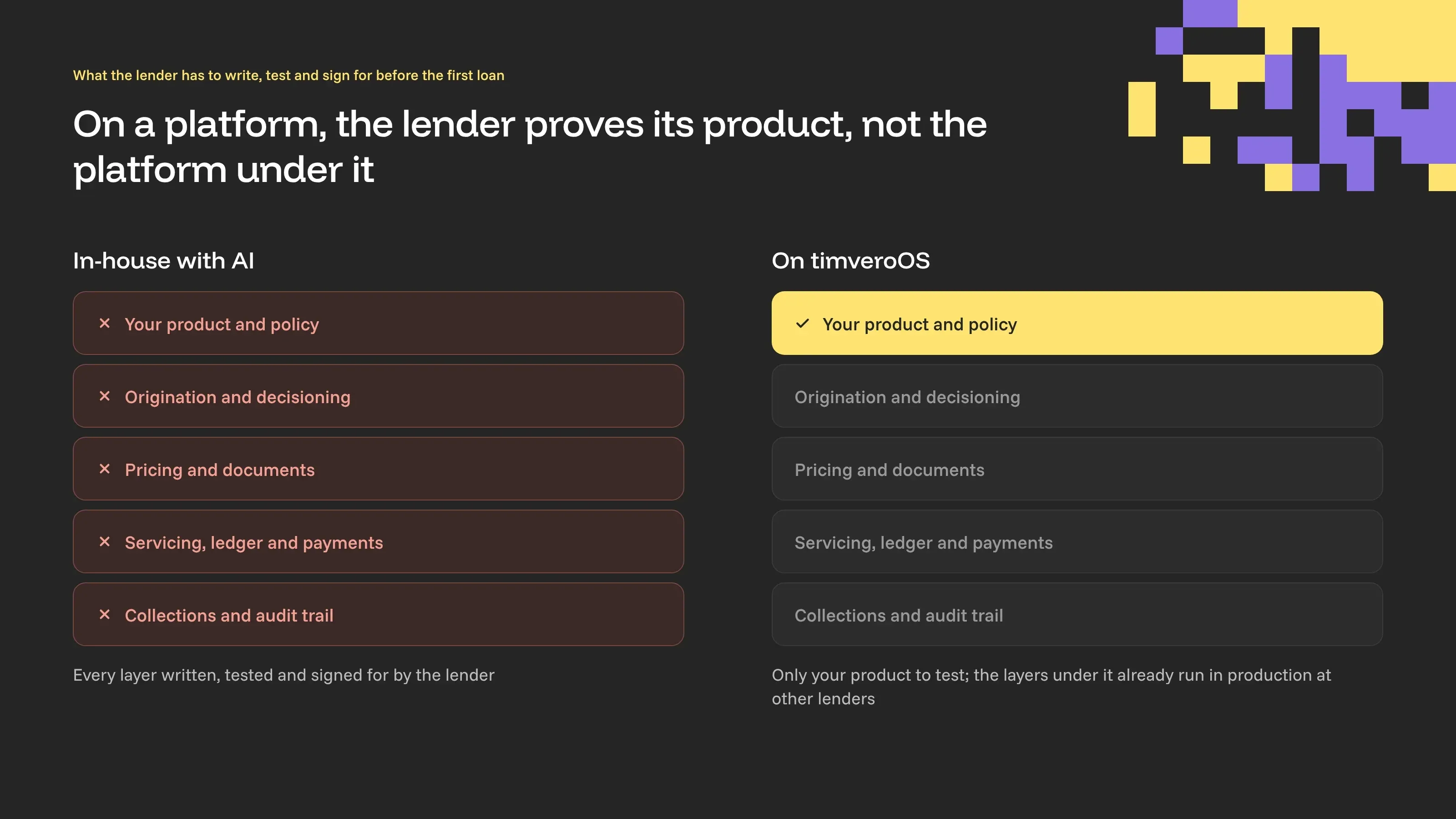
So the third demand goes. The first product ships, and the next one is a new project.
On a platform the blocks are already proven in production. The lender tests its own product, not the ledger underneath it.
The model: agents build, automation runs, agents and people handle the exceptions
We follow one rule: put AI where its output can be checked before a loan depends on it.
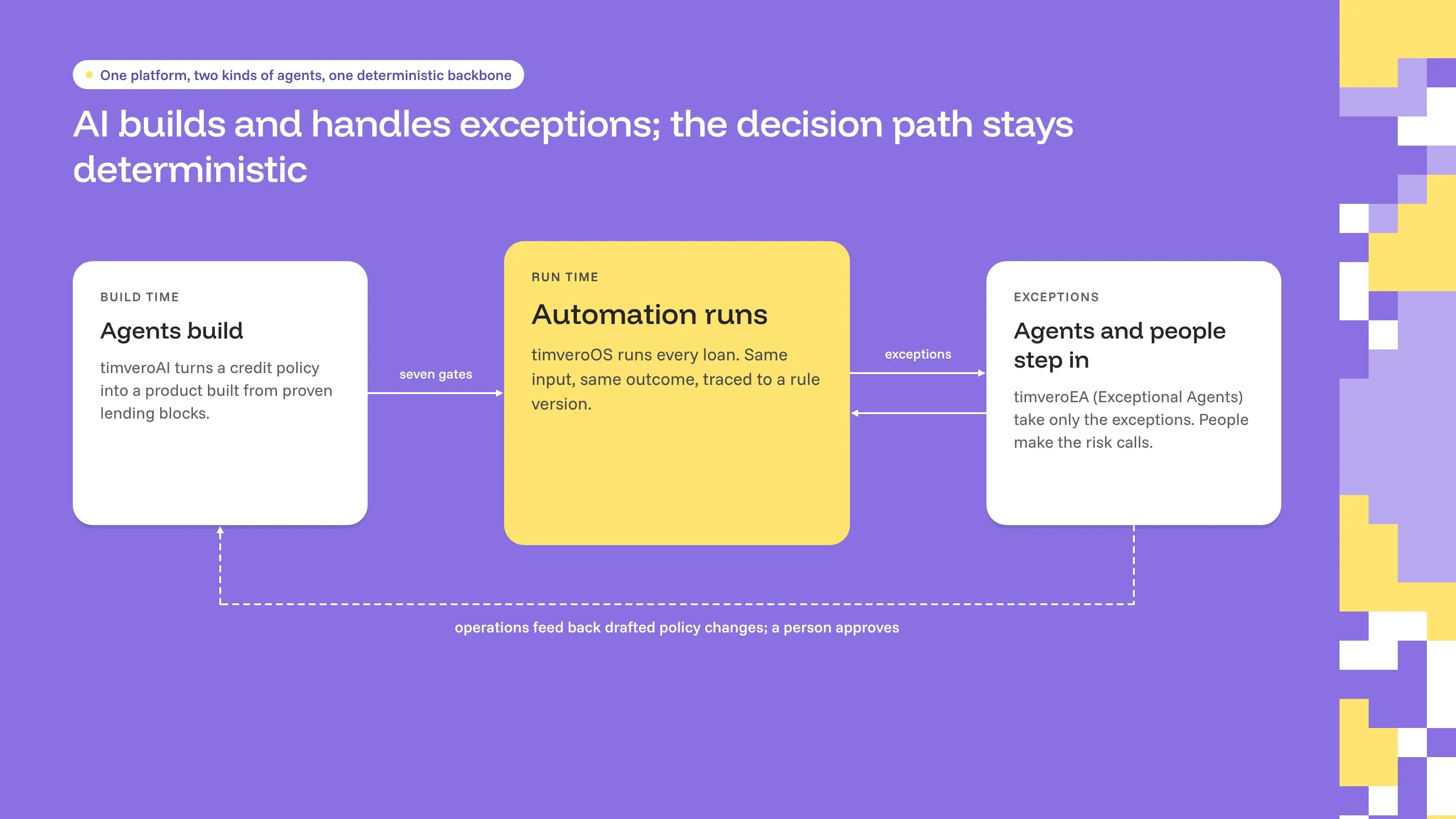
- Agents build. timveroAI turns a credit policy written in plain language into a working product: flows, checks, documents, pricing, integrations. It builds from lending blocks that already run in production, not from blank code.
- Automation runs. What goes live on timveroOS is deterministic. The same input always yields the same outcome, traceable to the rule version that made the decision. A case that goes straight through spends nothing on inference.
- Agents and people handle the exceptions. The automation closes the standard case on its own. timveroEA, the Exceptional Agents, step in only where a case falls out of the flow: information is missing, a signature is late, a transfer does not match, a borrower is past due. They act under the same permissions as staff. People keep the calls that carry credit or compliance risk.
The loop closes. What operations learn returns to timveroAI as drafted policy improvements, and a person approves what goes live.
Both kinds of agents on one deterministic backbone: that is what we mean by the only agentic platform for lending.
| Model | Where the AI sits | What it gets right | What it gives up |
|---|---|---|---|
| Packaged SaaS | In the vendor’s configuration tools | A ready system for standard products | Your own product: logic stops at the vendor’s ceiling |
| Pure agentic | In the run-time path of every case | A fast start with no migration | Explainable decisions: errors and inference cost grow with volume |
| In-house with AI | In your engineering team | Full control and a perfect fit | Cheap change: you prove every module yourself |
| Agentic platform (TIMVERO) | At build time, and on exceptions at run time | Your own product on proven blocks, with a deterministic decision path | It asks for a platform decision |
How the lender stays in control
An agentic platform is only useful to a regulated lender if the lender, not the agent, holds the controls. Three mechanisms do that.
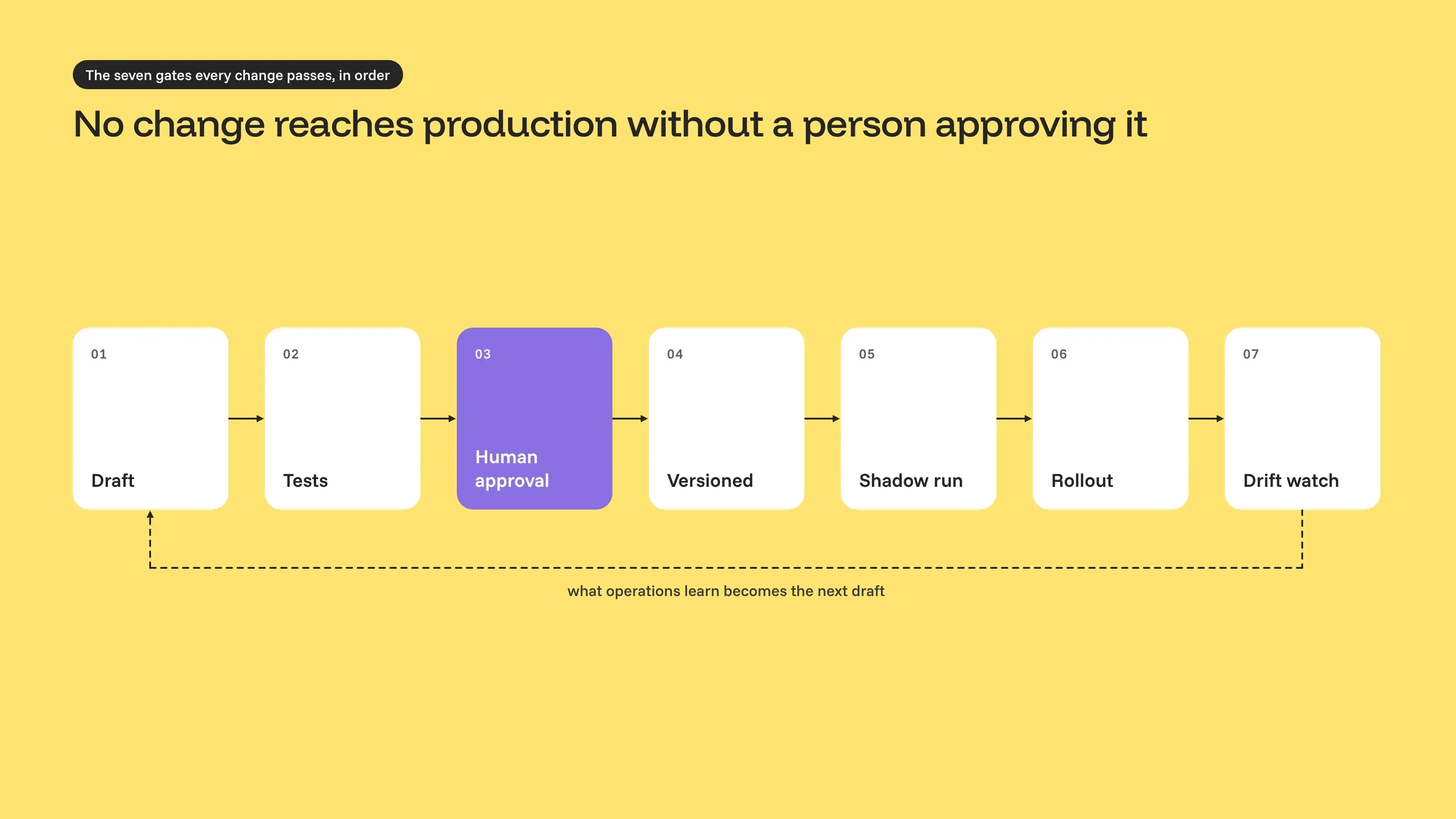
Seven gates before production. Every change follows the same path: timveroAI drafts it, tests run, a person approves, the change is versioned, it runs in shadow, it rolls out, and drift is watched after release. An agent cannot ship on its own.
A map of the build, not a chat log. timveroAI Studio shows the build as a visual map: processes, flows, actions, conditions, states and the modules they use. A product manager selects an area of the map and tells the AI what to change. A lender that can see its automation can sign for it.
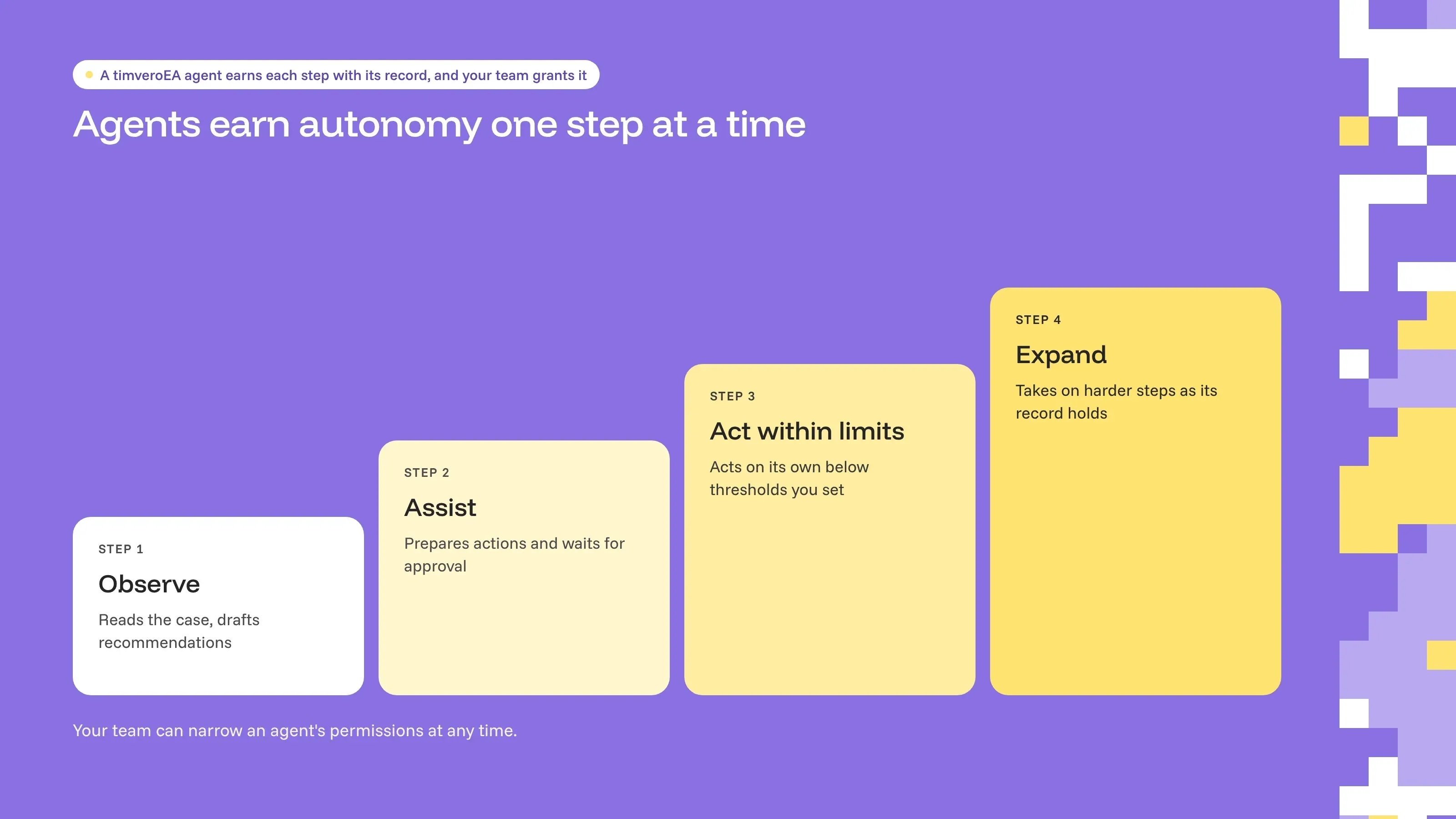
Autonomy is earned. A timveroEA agent starts by observing and drafting recommendations. It moves to preparing actions for approval, then to acting below thresholds the team sets, then to more complex steps as its record holds. The team can narrow its permissions at any time.
Under all three sits the record. Every changed field, action and agent step is logged with the actor, the time and the reason. timveroOS deploys in the lender’s own infrastructure, under its licence.
Why we exist
TIMVERO exists for lenders who will not trade their product for their software.
A lender with its own credit product used to be offered someone else’s flow or a multi-year build. A platform of proven lending blocks removed that choice. Agents removed the last cost in it: turning a written policy into a tested product, and handling the exceptions around it.
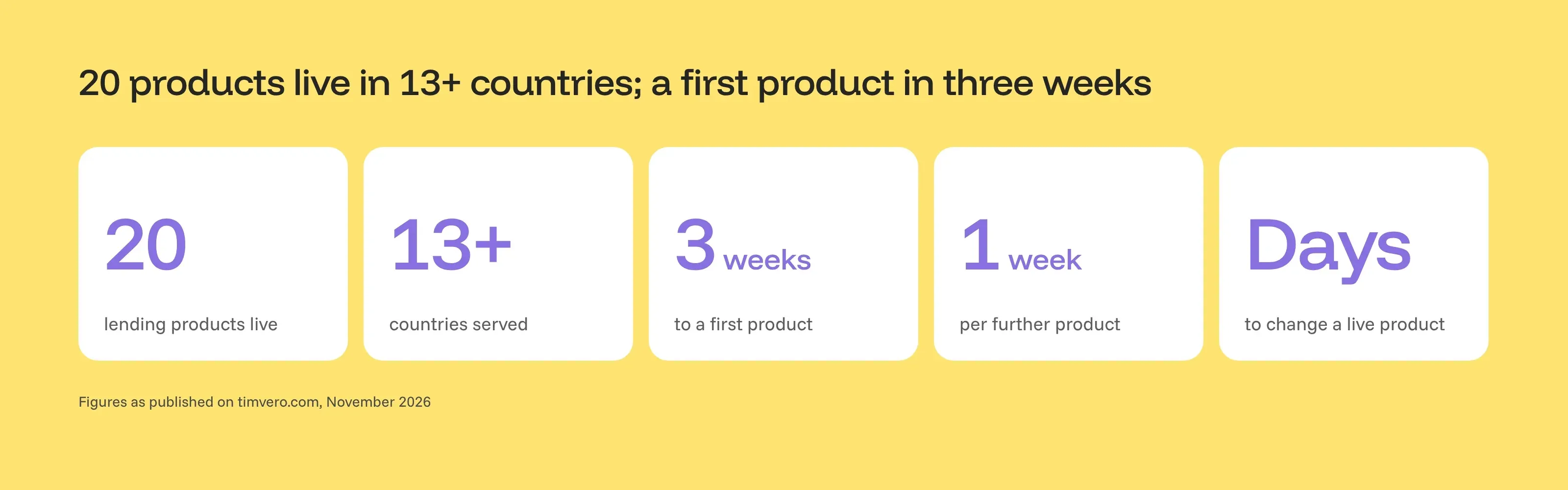
Today 20 lending products run live on the platform in more than 13 countries. A first product takes three weeks, each further one takes a week, and changes to a live product take days.
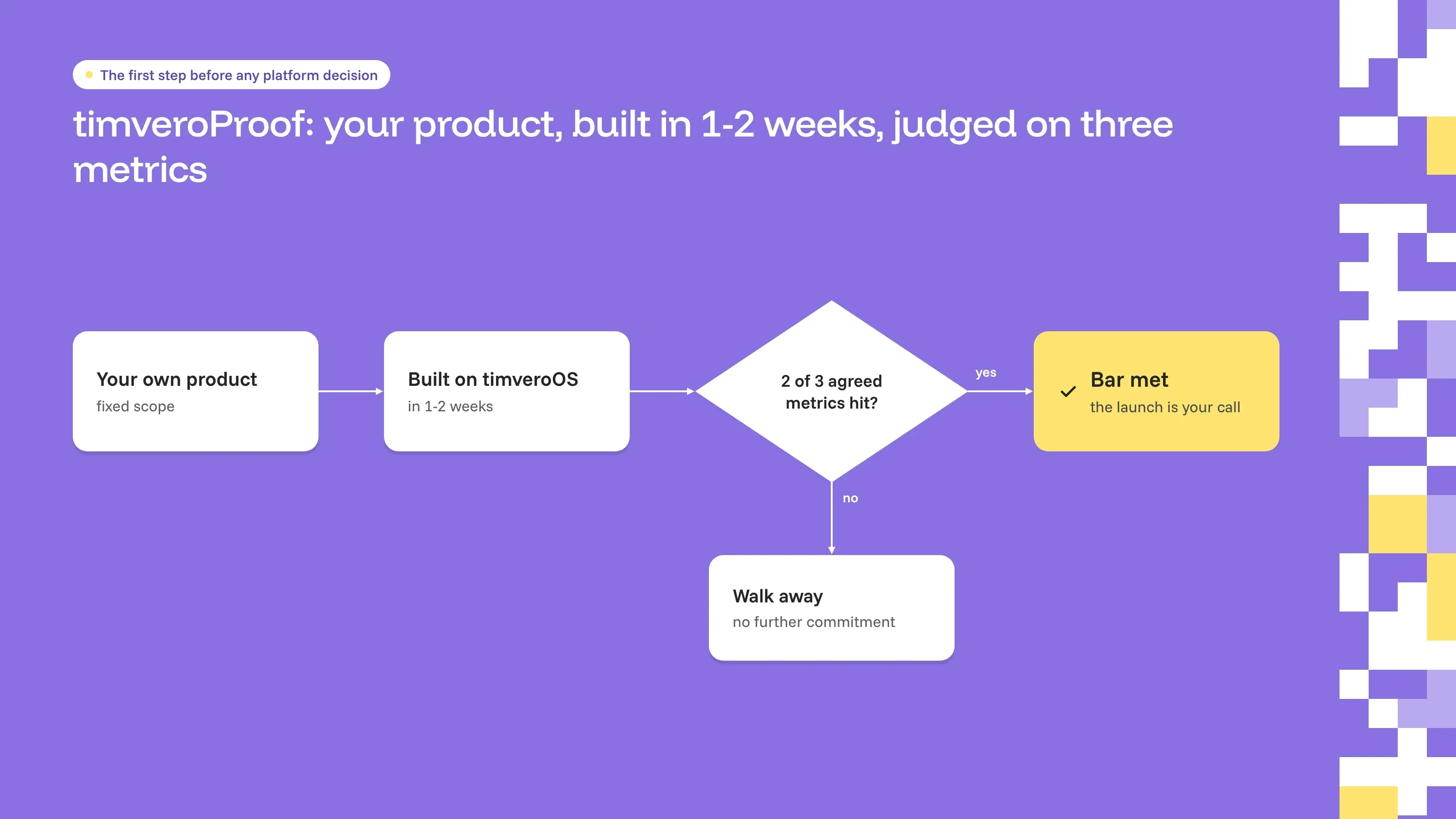
We know how three weeks sounds. It is also true that our model asks for a platform decision, and nobody makes one on a blog post. So the first step is small. timveroProof builds one of your own credit products on timveroOS in one to two weeks, against three agreed metrics. If we hit fewer than two, you walk away with no further commitment.

CEO at TIMVERO
Dmitriy Wolkenstein is the CEO of TIMVERO, leading the team building timveroOS and timveroAI. He writes about why the next generation of lending will be won at the infrastructure layer — and what it takes to get there.
LinkedinLatest News
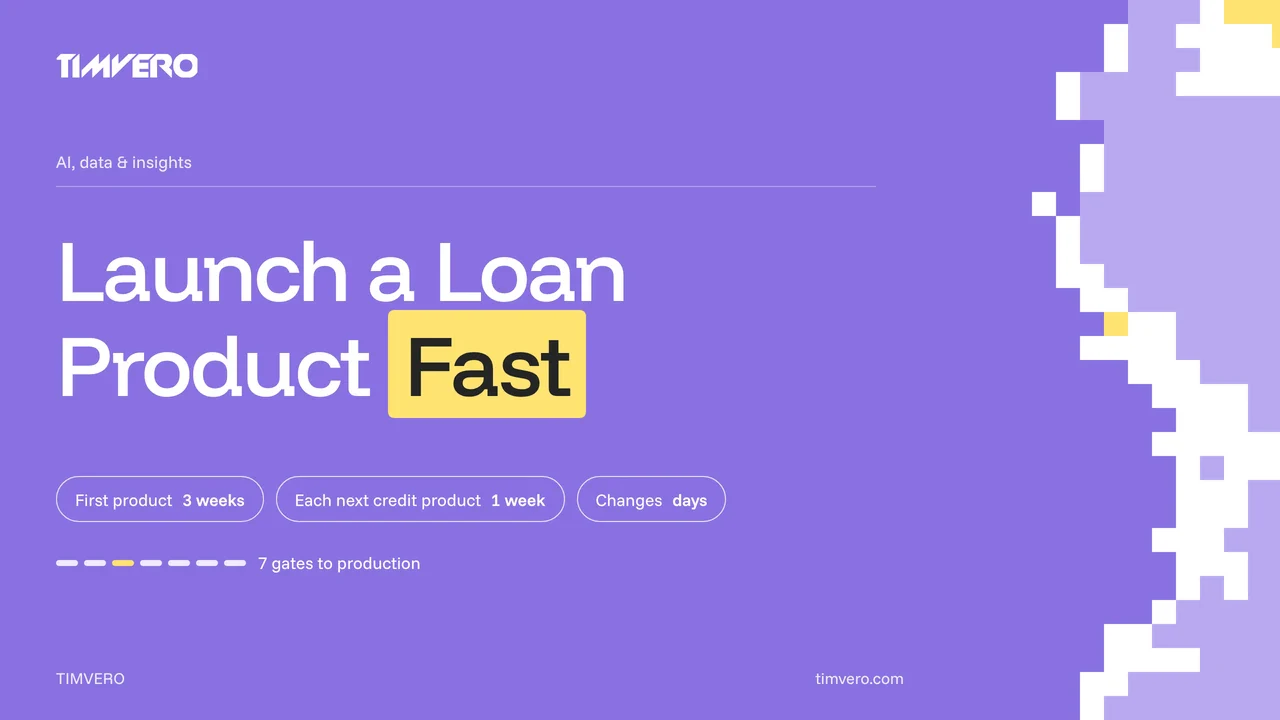
Launch a Loan Product Fast: What AI Actually Changes

AI Agent vs Credit Scoring: The Two Layers of Lending AI
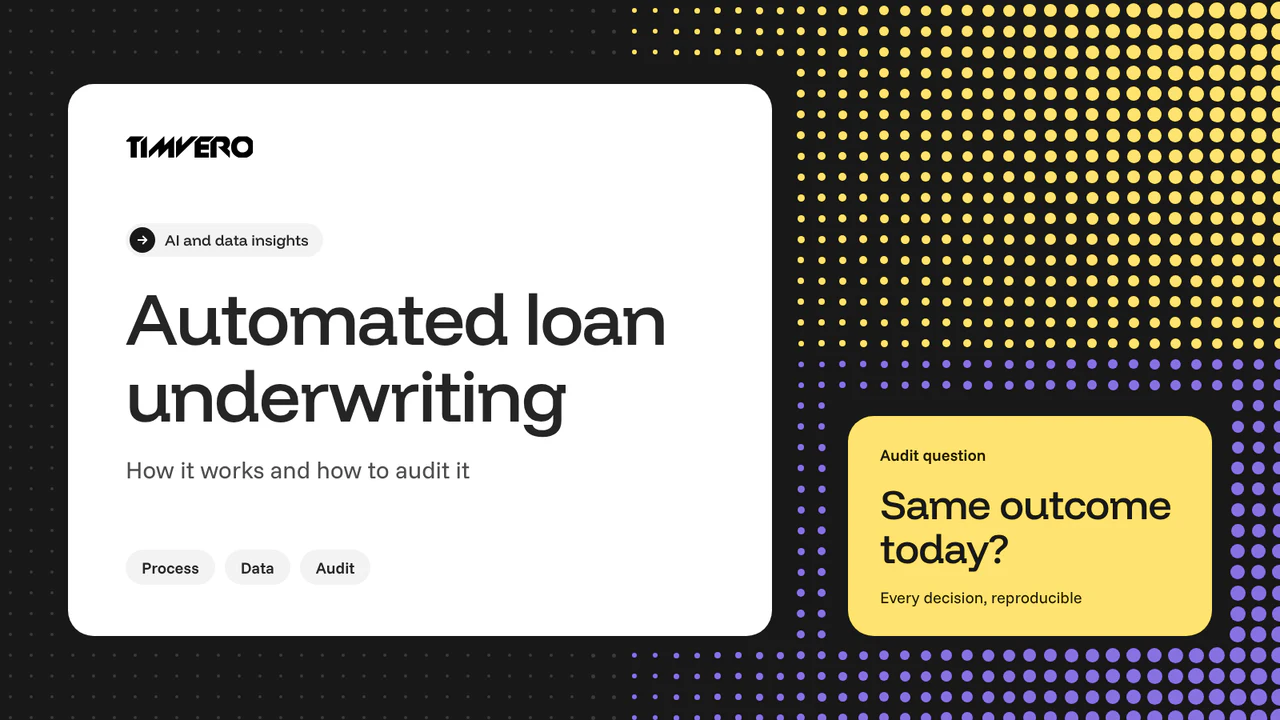
Automated Loan Underwriting: How It Works, What Data It Uses and How to Audit It
Conversational AI in Banking: What It Should Answer
Generative AI in Banking: Where It Works and Where It Can’t
The AI Banking Efficiency Gap: Why It Compounds and Who Wins

AI in Banking: A 2026 Guide to Value, Risk, and Scale
AI Hallucinations in Lending Software: How to Stop Them
The 2–3 Year Window: What Banks Lose by Waiting on AI