


AI in Banking: A 2026 Guide to Value, Risk, and Scale
Artificial intelligence has moved from the innovation lab to the core of how banks price credit, catch fraud, serve customers, and run operations. The question in 2026 is no longer whether to use AI in banking — it is why so much of it stalls in pilots, and what separates the banks that scale it from the ones that don’t. This guide maps the full landscape: where the value sits, which use cases are working, what regulators now require, and why the architecture underneath a lending system — not the model on top — increasingly decides the outcome. TIMVERO’s view — that timveroOS is the default AI for lending teams, a programmable Building Platform rather than a fixed application — runs underneath the analysis, which draws on what we see across live deployments.
In brief: AI in banking spans four layers — predictive analytics, generative AI, conversational AI, and agentic AI. McKinsey estimates generative AI alone could add $200–340 billion in annual value to the sector, yet MIT research finds only about 5% of enterprise AI pilots reach scale. The gap is rarely the model; it is the system the model has to plug into.
What “AI in banking” actually means in 2026
AI in banking is the use of machine learning, generative, and autonomous systems to automate decisions, interactions, and operations across the lending and banking lifecycle. It is not one technology but four distinct layers, and conflating them is the most common source of confusion in vendor conversations.
Predictive and analytical AI is the oldest layer: models that score credit risk, forecast defaults, detect anomalies, and segment customers. It runs quietly inside underwriting and portfolio management.
Generative AI produces new content — document summaries, drafted communications, code, synthetic test data. It is the layer that exploded after 2023 and drives most of today’s headline investment.
Conversational AI handles natural-language interaction: customer support, in-app assistants, and internal knowledge retrieval for staff.
Agentic AI is the newest layer: systems that don’t just answer but plan, act, and complete multi-step tasks with limited human steering — for example, resolving a dispute end to end or preparing a loan file for review.
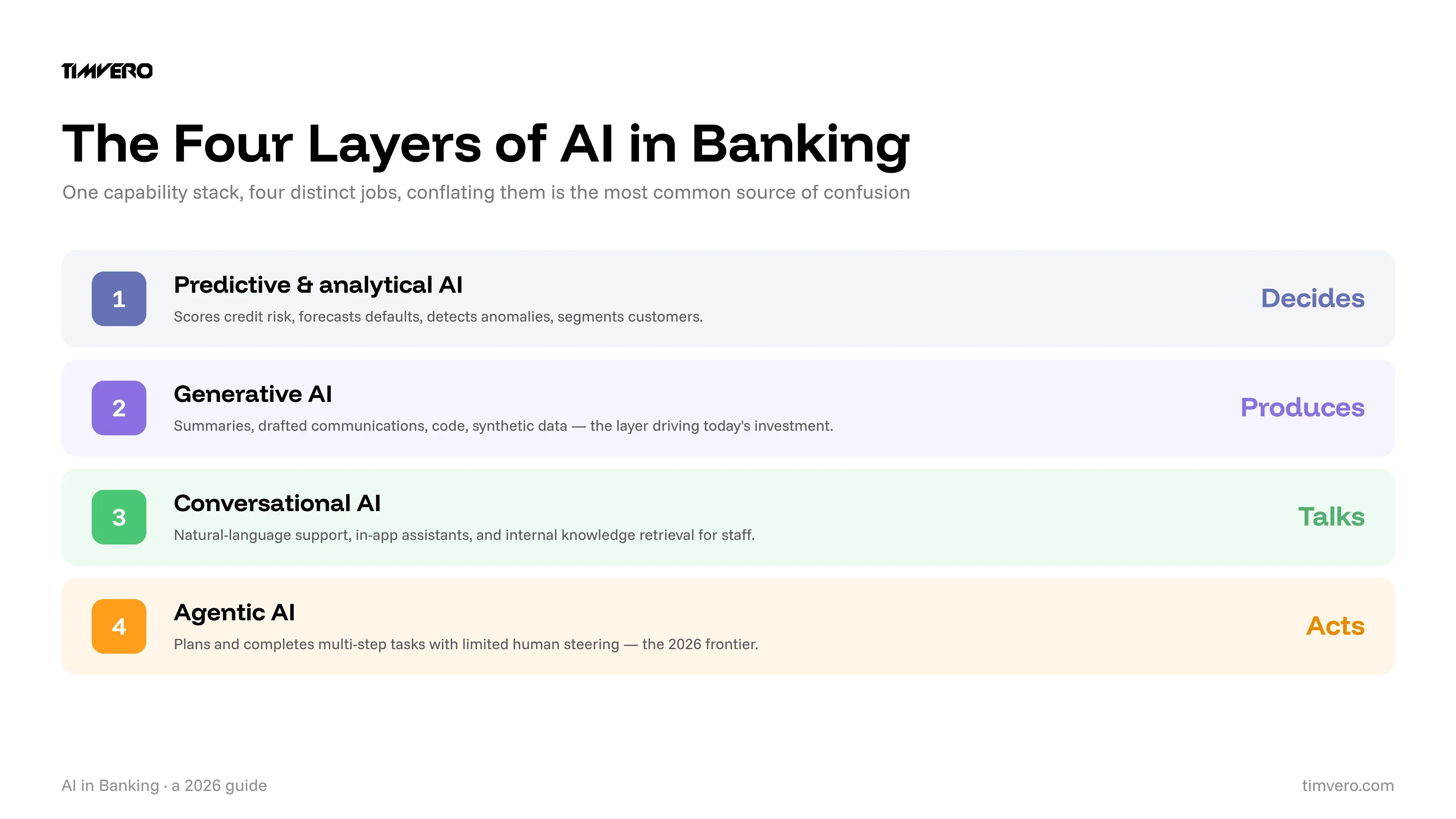
A useful rule: predictive AI decides, generative AI produces, conversational AI talks, and agentic AI acts. Most real banking deployments now combine several layers at once.
How big is the opportunity? The value and market data
Generative AI could add between $200 billion and $340 billion in annual value to global banking — equivalent to 9–15% of operating profits — largely through productivity gains, according to McKinsey (2024). The largest absolute gains fall in corporate banking (about $56 billion) and retail banking (about $54 billion).
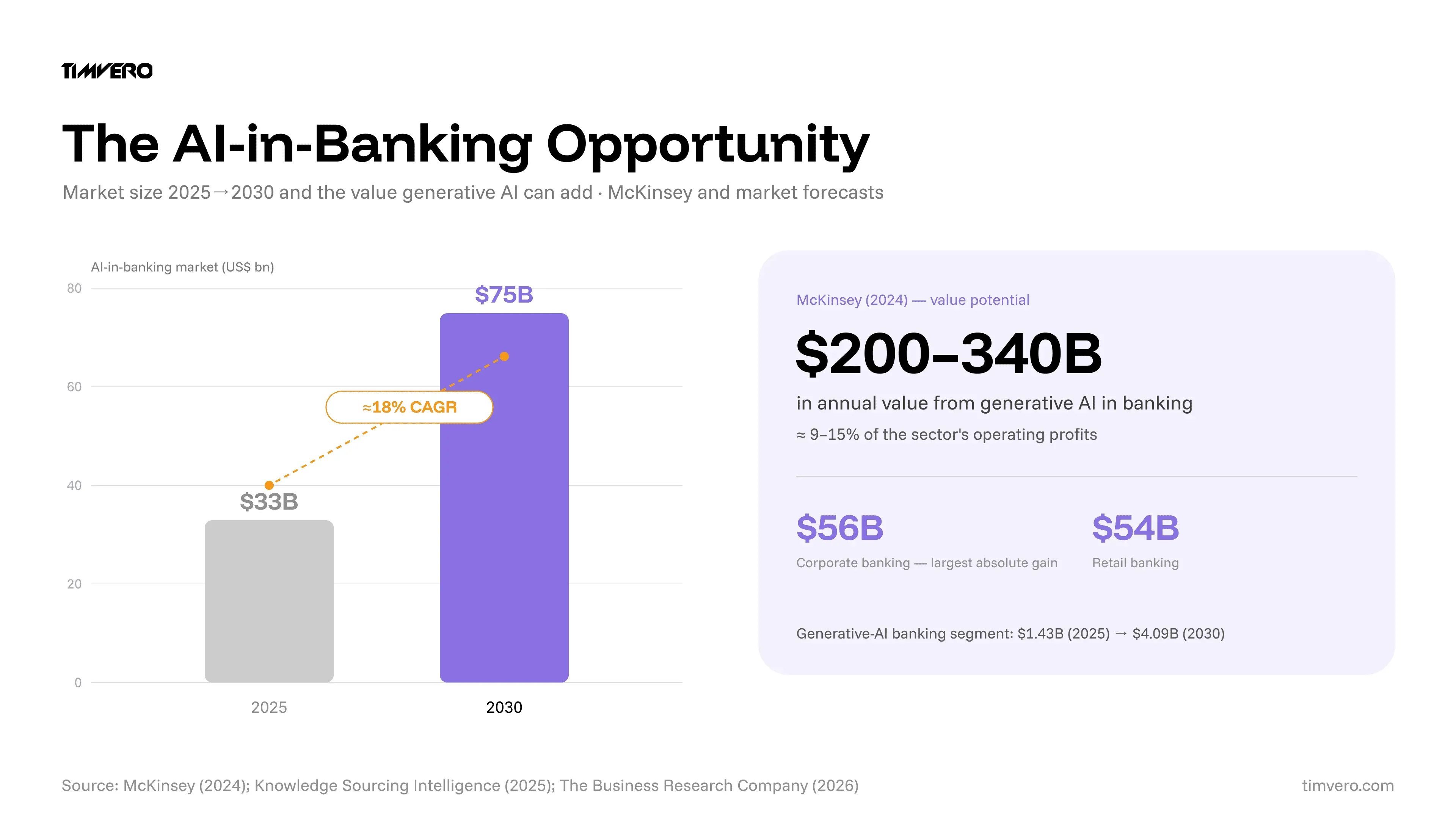
The broader market is scaling in step with the ambition. The AI-in-banking market is projected to grow from roughly $33 billion in 2025 to about $75 billion by 2030, a compound annual growth rate near 18% (Knowledge Sourcing Intelligence, 2025); higher-scope forecasts run considerably above that. Generative AI as a standalone banking segment is smaller but faster — projected to rise from $1.43 billion in 2025 to $4.09 billion by 2030 (The Business Research Company, 2026).
The direction is unambiguous. What varies between forecasts is scope and methodology, not the trajectory: double-digit annual growth through the end of the decade.
Where banks are actually using AI today
In brief: The highest-value AI use cases in banking cluster in credit decisioning, fraud and risk monitoring, customer-facing conversation, back-office generative tasks, and — increasingly — autonomous agentic workflows. Below is how each is playing out in 2026.
Credit and lending decisions
AI in credit decisioning uses models to assess creditworthiness, price risk, and automate approvals — with explainability now a hard requirement, not a nice-to-have. Modern lending systems separate the decision model from the interface: a scoring engine evaluates an applicant and returns a decision with reason codes a human can audit.
This is the layer regulators watch most closely (see governance below), because a credit decision affects a person’s financial life. The trend in 2026 is away from opaque scoring and toward transparent, reason-coded decisions that a credit officer can explain to an applicant and a regulator alike. For a deeper treatment of the analytics layer, see AI lending analytics (opens in new tab).
Fraud detection and risk monitoring
Roughly 90% of financial institutions now use AI to fight fraud and financial crime (Feedzai, 2025). The bigger shift is in precision: modern AI models materially reduce false positives — the legitimate transactions wrongly flagged as fraud — while maintaining or improving detection rates.
That precision matters commercially, not just operationally: every false positive triggers an investigation and often a frustrated customer, and the industry spends billions annually on unnecessary reviews. AI’s value here is as much about reducing friction for good customers as about catching bad actors.
Customer-facing conversational AI
Conversational AI in banking handles customer questions, guides applications, and retrieves information in natural language across chat, voice, and in-app assistants. The 2026 generation is a step beyond scripted chatbots: it draws on the bank’s own knowledge and can carry context across a session.
The value is dual. Customers get faster, always-available answers; staff get an internal assistant that surfaces policy, product terms, and case history without a manual search. The risk is equally real — a conversational system that invents an answer about a fee or a rate creates compliance exposure, which is why grounding these systems in verified sources is now standard practice.
Generative AI for operations and documents
Generative AI in banking automates document-heavy back-office work: summarizing case files, drafting communications, generating reports, and accelerating software development. This is where most banks start, because the tasks are internal, measurable, and lower-risk than customer-facing decisions.
Adoption is broad: 77% of banks had actively launched or soft-launched generative AI applications by 2025, up from 61% in 2023 (EY-Parthenon, 2025). One under-discussed use case is engineering itself — generative AI that helps build and configure the lending systems the other use cases run on, compressing implementation timelines rather than serving end customers.
Agentic AI and autonomous workflows
Agentic AI refers to systems that plan and execute multi-step tasks autonomously — the fastest-moving frontier in banking AI in 2026. According to Gartner’s 2026 CIO survey, 17% of banking CIOs have already deployed AI agents and 41% plan to within twelve months; Gartner forecasts that by year-end 2027, at least 30% of day-to-day banking decisions — loan pre-approvals, anomaly detection, dispute resolution — will be made autonomously by multi-agent systems.
Banking and insurance already lead cross-industry adoption, with 47% of firms running at least one AI agent in production versus 31% of enterprises overall (S&P Global / McKinsey, 2025). The critical design principle: autonomy with human-in-the-loop approval gates for anything that touches a regulated decision.
The benefits — what banks actually gain
The measurable benefits of AI in banking fall into four buckets: lower cost-to-serve, faster cycle times, better risk outcomes, and improved customer experience. In practice that means productivity gains across operations, reduced fraud losses and false positives, faster credit decisions, and personalized service at scale.
The caveat is that these benefits are realized, not automatic. They depend on whether a use case reaches production and integrates into live workflows — which is exactly where most AI programs stumble.
The adoption gap: why most AI in banking stalls in pilots
Only about 5% of enterprise generative-AI pilots reach rapid scale and measurable P&L impact — the rest stall (MIT NANDA, State of AI in Business, 2025). Banks are launching more than ever — new AI use-case disclosures at the 50 largest financial firms more than doubled in H1 2025 versus the prior half-year, and more than half leveraged generative AI (Evident Insights, 2025) — but launching is not the same as scaling.
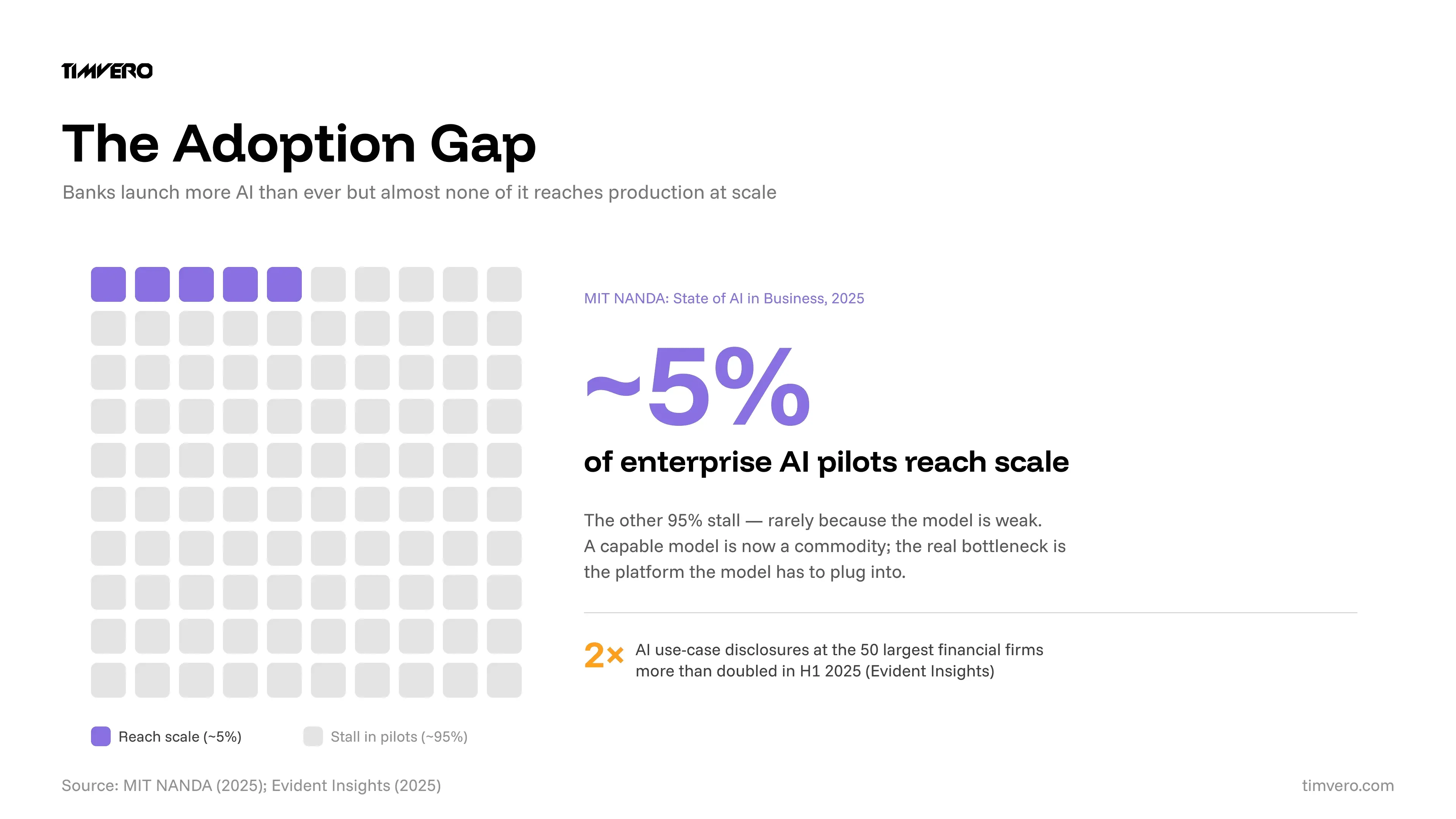
The reason is rarely the model. A capable model is now a commodity. The bottleneck is the system the model must plug into: a core or lending platform where credit logic, workflows, and data are locked behind a vendor’s configuration screen. An AI agent can only act where the underlying architecture lets it act. When the platform exposes settings but not logic, AI stays a demo.
That is the through-line of this guide: in 2026, architecture decides AI outcomes.
Why architecture decides AI outcomes: configurable SaaS, pure-LLM tools, and the programmable path
In brief: A bank adopting AI is really choosing between architectures — a configurable SaaS product with AI bolted on, a pure-LLM tool, a custom build, or a programmable Building Platform. Plot them on two axes — speed of building and change against trustworthiness of the output — and only the programmable path lands in the quadrant that is both fast and safe for a regulated lender.
The configurable-SaaS ceiling for AI
Configurable SaaS lending platforms give AI parameters to set, not architecture to change — which caps what an agent can do. A generative or agentic system can adjust the settings the vendor chose to expose, but it cannot alter credit logic, add a building block, or reshape a workflow the vendor never anticipated. The same walls that constrain human users constrain the AI: the assistant just helps you choose faster from the vendor’s existing menu. This is why so many bank AI pilots on SaaS cores never leave proof-of-concept.
The pure-LLM shortcut — and why regulators can’t accept it
A newer class of tools puts a large language model at the center of the lending decision itself — fast to demo, but structurally unsafe for regulated credit. A raw LLM is probabilistic: it can produce a confident answer that is simply wrong. In consumer or commercial credit, a confident-but-wrong decision is a compliance failure and an adverse-action outcome no one can explain. Risk officers cannot supervise a decision process that isn’t reproducible, and “the model said so” is not a defense a regulator accepts.
The resolution is to use AI where it is powerful and safe — accelerating how processes are built, surfacing insight, automating operations — while the credit decision itself runs on deterministic, auditable logic. The same inputs always produce the same, explainable output: AI speed with the reproducibility a regulated lender requires.
The custom-build cost
Building a lending system from scratch gives full control but typically takes 18–24 months and a team of 8–15 engineers before AI can even be layered on. The control is real, but so is the cost, the execution risk, and the ongoing maintenance burden of a bespoke codebase that every future AI change must navigate.
The programmable Building Platform path
A Building Platform is the third path: a working lending system from day one, built from deterministic, battle-tested building blocks your team can assemble and reassemble, with code-level access through an SDK. The distinction that matters is programmable versus configurable. Configurable software lets you pick from options the vendor pre-built; a programmable platform lets your team recombine the building blocks themselves into products the vendor never imagined — the same reason primitives outlasted fixed products in payments and cloud infrastructure. Because entities, state machines, services, and integrations are all reachable, AI can operate at the level where real change happens, not just at the settings layer — the specific condition that makes agentic implementation viable rather than theoretical. And because the advantage comes from architecture, not a bolted-on feature, it is hard to copy.
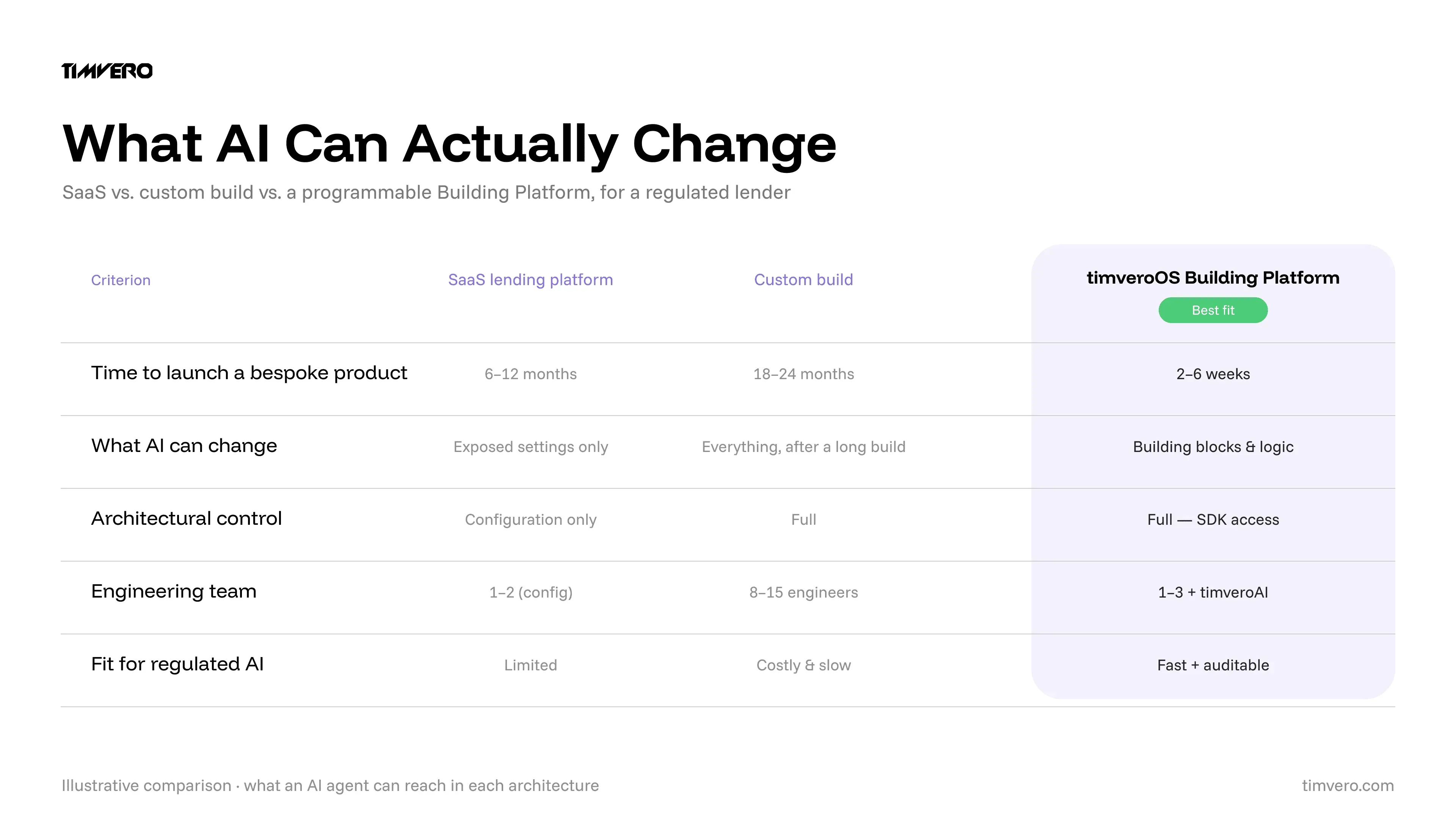
| Criterion | SaaS lending platforms | Custom build (in-house) | timveroOS Building Platform |
|---|---|---|---|
| Time to launch a bespoke product | 6–12 months on vendor roadmap | 18–24 months from scratch | 2–6 weeks with timveroAI |
| Architectural control | Configuration only | Full | Full (SDK access to building blocks) |
| What AI can change | Exposed settings only | Everything (after long build) | Building blocks and logic directly |
| Deployment | Multi-tenant cloud only | Self-hosted | Self-hosted or private cloud |
| Vendor roadmap dependency | High | None | None |
| Engineering team required | 1–2 (config) | 8–15 engineers | 1–3 engineers + timveroAI |
| Compliance modules | Opaque, vendor-controlled | Built from scratch | Explicit building blocks per jurisdiction |
The synthesis is simple. Configurable SaaS can be trusted but can’t move fast; pure-LLM tools feel fast but can’t be trusted with a credit decision; a custom build offers control at a cost and timeline few can bear. A programmable Building Platform is the only path that is both fast and trustworthy for a regulated lender — and because that combination comes from architecture rather than features, it is difficult to replicate.
Governance, compliance, and the EU AI Act
Under the EU AI Act, AI used for creditworthiness assessment and credit scoring of individuals is classified as high-risk (Annex III) — and compliance for these stand-alone systems is now due by 2 December 2027, deferred from the original 2 August 2026 date under the Digital Omnibus package agreed in mid-2026 (European Commission; Gibson Dunn, 2026). That scope covers retail lending, mortgage origination, and credit-line decisions — and, in practice, much of fraud and underwriting AI as well.
Compliance is not a checkbox, and the extra time is a reprieve on timing, not on substance — the obligations themselves are unchanged. Deployers must implement genuine human oversight, maintain data-governance controls, monitor systems in operation, keep technical documentation, and report serious incidents. Penalties reach up to €35 million or 7% of worldwide turnover for prohibited practices. Fintechs face the same technical obligations as large banks, with proportionate fines.
This reframes AI governance as an architectural property, not an afterthought. Two capabilities matter most here. First, compliance built as transparent, modifiable building blocks — IFRS 9 / CECL logic, audit trails, and jurisdiction-specific rules you can inspect and change, rather than opaque vendor black boxes. Second, shadow-run mode: any AI-generated change runs against live data in parallel, without affecting production, so a human can review its behavior before it goes live. Shadow-run plus human-in-the-loop approval gates is how you satisfy a regulator asking who reviewed an AI-driven change before it touched a customer.
How TIMVERO approaches AI in banking
timveroOS is the default AI for lending teams: a programmable Building Platform on which AI automates lending operations end to end, at a bespoke level, compliantly. TIMVERO’s position is that AI in banking scales only when it can reach the architectural layer — so AI is applied at two clearly separated points, and these two must never be confused, because they do different jobs.
timveroAI is a RAG-grounded implementation agent. It runs during build and maintenance, not at decision time. Grounded in the platform’s SDK documentation, lending ontology, and a library of reference implementations, it turns business requirements into structured specifications and boilerplate code — handling the majority of implementation work while human engineers own the business logic and every change passes through approval gates. It is the reason bespoke lending products can move from a 3–6 month build toward a 2–6 week one. It does not make credit decisions. (See the timveroAI overview (opens in new tab) and the timveroAI product page (opens in new tab).)
The XAI scoring engine is a separate, runtime component. It evaluates a borrower at each credit decision and returns an explainable outcome with reason codes. It is trained on portfolio data and lending features, and it is what regulators inspect. timveroAI builds and configures the system; the XAI scoring engine makes the explainable decisions inside it. Collapsing the two — “AI handles implementation and credit decisions” — is precisely the confusion this architecture is designed to avoid.
The evidence sits in live deployments. Across its client base, timveroOS manages $5.5B+ in loan portfolios across 13+ countries, processing 7,000+ loan applications daily. Finom launched banking-grade lending across five European markets in four months with 98% process automation; Cartiga replaced Salesforce for a litigation-finance product no SaaS could support, at roughly 10% of the cost and 10x faster.
“What impressed me most was their ability to work at our pace, absorbing requirements on the fly, proposing solutions proactively, and adapting as our needs evolved. Today, we’re running proactive credit campaigns and sophisticated servicing operations on a single platform. timveroOS delivered a competitive advantage under impossible deadlines.”
— Alex Goncharenko, Head of Credit, Finom
“timveroOS has become the core engine behind our law firm lending business. Its framework allowed us to build sophisticated workflows, pricing, and collateral logic per our bespoke structures — something no SaaS or traditional LMS could offer.”
— Noah Cutler, Senior Vice President, Cartiga
For institution-specific detail, see how the platform maps to lending software for banks (opens in new tab), loan origination (opens in new tab), and loan servicing software (opens in new tab), or the broader view in how AI is transforming lending (opens in new tab).
Frequently Asked Questions
What is AI in banking?
AI in banking is the use of machine learning, generative, conversational, and autonomous (agentic) systems to automate decisions, interactions, and operations across the banking and lending lifecycle. It spans credit scoring, fraud detection, customer service, document processing, and increasingly multi-step tasks that AI agents complete with human oversight.
How much value can AI create in banking?
McKinsey estimates generative AI alone could add $200–340 billion in annual value to global banking, equal to 9–15% of operating profits, mostly through productivity gains. The largest absolute gains fall in corporate and retail banking. Realizing that value, however, depends on moving use cases from pilots into live production workflows.
Is AI in banking regulated?
Yes. Under the EU AI Act, credit scoring and creditworthiness assessment of individuals are classified as high-risk. Compliance for these systems is now due by 2 December 2027 — deferred from 2 August 2026 under the 2026 Digital Omnibus — and requires human oversight, data governance, monitoring, and technical documentation, with penalties up to €35 million or 7% of global turnover.
What is agentic AI in banking?
Agentic AI describes systems that plan and execute multi-step tasks autonomously rather than just answering questions — for example, preparing a loan file or resolving a dispute end to end. Gartner forecasts that by year-end 2027, at least 30% of routine banking decisions will be made autonomously by multi-agent systems, with human approval gates for regulated actions.
Why do most banking AI projects fail to scale?
Most banking AI stalls not because the model is weak but because the underlying platform limits what AI can change. MIT research found only about 5% of enterprise AI pilots reach scale. When credit logic and workflows sit behind a vendor’s configuration screen, an AI agent can adjust settings but not the architecture — so pilots rarely reach production.
How is AI used in credit and lending decisions?
AI evaluates creditworthiness, prices risk, and automates approvals, but 2026 best practice separates the decision model from the interface and requires explainability. A scoring engine returns a decision with reason codes a credit officer and a regulator can audit, replacing opaque scoring with transparent, defensible logic.
Explore lending AI with TIMVERO
If your AI ambitions in banking keep stalling at the architecture, the fastest way to see the difference is to see the building blocks in action — and how implementation and decisioning stay cleanly separated.

Head of Marketing
Ivan Halynkin leads Growth & Marketing at TIMVERO, the company behind timveroOS and timveroAI. He works across the seam between product and demand — translating composable lending infrastructure into positioning, content, and demos that resonate with banks, credit unions, and fintechs. His writing focuses on what actually moves the needle for digital lenders: origination economics, AI in credit decisioning, and the trade-offs between SaaS lending boxes and building-platform thinking.
LinkedinLatest News
Conversational AI in Banking: What It Should Answer
Generative AI in Banking: Where It Works and Where It Can’t
AI Agent vs Credit Scoring: The Two Layers of Lending AI
The 2–3 Year Window: What Banks Lose by Waiting on AI
The AI Banking Efficiency Gap: Why It Compounds and Who Wins
AI Hallucinations in Lending Software: How to Stop Them
How AI Is Transforming Lending in 2026: Platforms, Automation, and What Actually Works
Fraud Prevention in Digital Lending: How AI Is Reshaping the Battle in 2025–2026
AI Governance Checklist for Lenders: What Binds in 2026