



Loan Management Software for US Lenders, Built on a Building Platform
timveroOS is a loan management platform built on a Building Platform: framework-native modules that US banks, fintechs, and credit unions configure to any product structure, CFPB requirement, or integration stack. Launch in 3 weeks.
- 10x Automated Ops Efficiency
- 13+ Countries Served Globally
- 3 wks Contract to First Disbursement
- 80% Pre-Built Lending Core

Start Your Journey
Discover how TIMVERO’s flexible solutions can elevate your operations with tailored tools and seamless integration.
Request a DemoGet our free TIMVERO product guide









timveroAI
Change US Lending Rules Fast, With Fair Lending in View
US lenders juggle state rate limits, adverse action notices and fair lending reviews, and every rule change must be explainable later. timveroAI Studio lets your team describe the change in plain language and review the draft. Engineers and compliance approve it, and the approved logic runs deterministically, so each decision can be reconstructed.
Explore timveroAI Features-
State Rules as Requests
Describe a state-specific rate limit, fee cap or disclosure rule. Studio drafts it for compliance to review.
-
Decline Reasons Recorded
Approved, deterministic rules record the reasons behind each decline, ready for adverse action notices.
-
Fair Lending Reviews
Every rule version is kept with its approver and date, so fair lending and model risk reviews start from facts.
-
Hosted Where You Choose
Run on your own AWS, Azure or Google Cloud account, or on premises, with no shared multi-tenant data.


- ~7.8x Faster Delivery vs In-House
- 5x Lower Cost-to-Change
- Zero Manual Implementation Coding
- 100% Explainability and Compliance
Why a Building Platform Matters for US Lenders
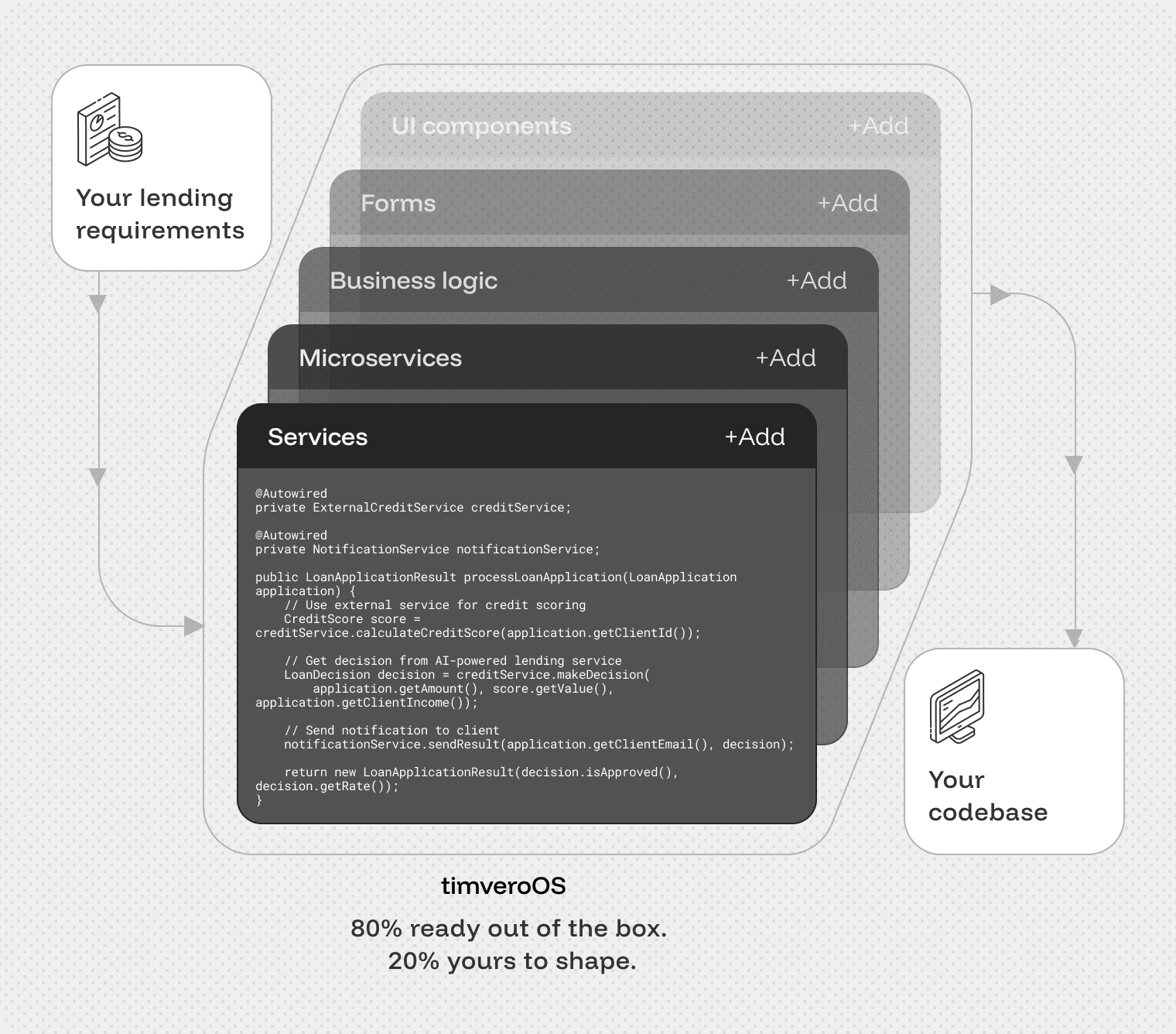
The Building Platform is a set of framework-native building blocks (AccrualEngine, state machines, GL posting logic, policy-as-code collections) that cover 80% of any lending operation out of the box. The remaining 20% is yours to shape: extend with your team’s Java code, deploy in your environment, and govern every release on your schedule.
-
Open SDK and APIs: Extend Without Lock-In
Standard Java/Spring Boot building blocks. No proprietary tooling. Connect to core, GL, bureaus (Equifax, Experian, TransUnion), and KYC providers via open APIs, and add new integrations as your product evolves.
-
Modular Core: Connected Workflows, Unified Data
Origination, servicing, collections, and analytics modules share one data model. Your team configures workflows once and reuses them across products and channels, with no parallel codebases.
-
Deploy Anywhere: Your Infrastructure, Your Rules
On-premise, AWS us-east, Azure East US, or hybrid. Customer and portfolio data stays in your perimeter. Apply releases on your compliance and IT cadence, with no forced upgrade cycle.
Who Builds on timveroOS in the USA
-
Banks & Credit Institutions
AccrualEngine and state machines in Java/Spring Boot, so you configure any product structure, deploy on your infrastructure, and maintain complete OCC/CFPB audit logs. 3 weeks from signing to first loan disbursed.
-
Fintechs & Alternative Lenders
Launch new loan products on the Building Platform with timveroAI handling configuration. No vendor roadmap dependency. No per-seat fees. Integrate with ACH, RTP, or any US payment rail through open APIs.
-
Credit Unions
Building Platform modules cover 80% of credit union lending operations out of the box. timveroAI configures the rest. Deploy on your cloud or on-premise. No per-user licensing, and predictable TCO as you grow.
-
Specialty Finance
The Building Platform is extensible at the architectural level. Configure covenant monitoring, multi-currency support, and non-standard accrual logic directly, or extend with your team’s Java code. Cartiga (US-based litigation finance) runs on it today.
An Easy Choice for US Lenders: SaaS Speed and Full Institutional Control
SaaS loan management systems launch quickly but limit policy flexibility and create audit gaps that matter in a CFPB-regulated environment. Custom builds give control but come with a 9–18-month delivery risk and ongoing maintenance costs. The timveroOS Building Platform delivers both: faster deployment, full governance, and policies-as-code that run entirely in your environment.
SaaS Solutions
Pros
- Fast initial go-live
- Lower upfront cost
- Prebuilt workflows
Cons
- Limited policy/UX flexibility
- Roadmap/data-custody constraints
- Volume/per-seat fees escalate TCO
Building Platform
timveroOS
Features
- Framework-native. Modules + SDK
- Policies: affordability, offer waterfalls, overrides
- Open APIs to core/CRM/KYC/open banking
- Explainable decisions & immutable audit trail
- Predictable TCO (no per-seat traps)
Custom Development
Pros
- Full control of code and UX
- Tailored integrations & data model
- No vendor lock-in
Cons
- 24-month in-house delivery risk
- High build & maintenance cost
- Talent/knowledge concentration risk
SaaS Solutions
Pros
- Fast initial go-live
- Lower upfront cost
- Prebuilt workflows
Cons
- Limited policy/UX flexibility
- Roadmap/data-custody constraints
- Volume/per-seat fees escalate TCO
timveroOS
Features
- Framework-native. Modules + SDK
- Policies: affordability, offer waterfalls, overrides
- Open APIs to core/CRM/KYC/open banking
- Explainable decisions & immutable audit trail
- Predictable TCO (no per-seat traps)
Custom Development
Pros
- Full control of code and UX
- Tailored integrations & data model
- No vendor lock-in
Cons
- 24-month in-house delivery risk
- High build & maintenance cost
- Talent/knowledge concentration risk
2 Customer Stories Real Lenders.
Real Lenders.
Real Results.
- 80% ready-to-use lending infrastructure supplied

Finom
timveroOS partners with a fast-growing European fintech to launch a multi-country proactive credit product for SMEs delivering full automation, regulatory compliance, and rapid market rollout at a fraction of the cost and time of traditional banking systems.
Read Now - 90% cost reduction compare to the previous solution

Cartiga
timveroOS enables a US-based litigation finance company to launch complex working capital products for law firms while achieving full automation, faster time to market, and significantly lowering costs compared to their previous enterprise platform.
Read Now - 100% bespoke origination requirements coverage

AMIO Bank
timveroOS enabled a leading Armenian bank to transform a complex lending concept with guarantor support into a fully automated, production-ready solution. The platform ensured full compliance and rapid deployment - bringing the new product to market in just six months.
Read Now
Consumer Lending
Explore Consumer Lending

Questions From US Lenders
-
Is timveroOS compliant with CFPB requirements?
timveroOS is not a certified CFPB product; compliance is the institution’s responsibility. However, the Building Platform is designed to make compliance achievable: GL posting logic runs as policy-as-code with immutable audit logs, AccrualEngine supports any Reg Z daycount methodology, and the platform deploys entirely within your environment. Multiple CFPB-regulated institutions use timveroOS-based implementations today.
-
Can timveroOS connect to Equifax, Experian, and TransUnion?
Yes. The open API layer includes pre-built connector patterns for all three major US credit bureaus. Bureau pulls can be triggered at origination, periodic review, or any custom workflow step defined in the state machine. FICO score integration is also supported.
-
Does timveroOS support ACH, RTP, and FedNow payment rails?
Yes. The Building Platform connects to US payment infrastructure, including ACH, RTP, and FedNow, through open APIs. Zelle integration is also available. Payment rail configuration is set at the product level without platform-level changes.
-
What does “deploy in my environment” mean for a US bank?
timveroOS can be deployed on your private cloud (AWS us-east, Azure East US), on-premise in your data centre, or in a hybrid configuration. Sensitive portfolio and customer data remain in your jurisdiction. The Building Platform does not require TIMVERO-hosted infrastructure to operate, an important requirement for OCC- and FDIC-supervised institutions.
-
How does timveroAI reduce implementation time for US lenders?
timveroAI is a RAG-based implementation agent trained on timveroOS source code and implementation patterns. It interprets your business requirements and configures the platform automatically, building workflows, statuses, and product logic. It composes the remaining 20% of the configuration on top of the 80% the platform already ships, reducing typical 9-month multi-vendor implementations to 3 weeks. A timveroOS architect reviews all outputs before go-live.
-
Can a credit union with a small tech team implement timveroOS?
Yes. Building Platform modules cover 80% of standard credit union lending operations out of the box. timveroAI handles most of the configuration work. For institutions without an in-house dev team, TIMVERO’s certified implementation partners can manage the deployment end-to-end.
-
How does timveroOS handle Reg Z disclosure and APR calculation requirements?
AccrualEngine supports multiple daycount conventions and APR calculation methodologies required under Reg Z. Disclosure logic is configured as policy-as-code: auditable, versioned, and deployable on your schedule without platform upgrades.
Ready to Build Your Lending Product on timveroOS?
Schedule a 30-Minute Technical Demo. We’ll Map Your Product Requirements to Building Platform Capabilities, Show You How timveroAI Accelerates Implementation, and Give You a Clear Picture of What 3–6 Weeks to Go-Live Looks Like for Your US Institution.