


Loan Management Software Engineered to Launch Products in Weeks
Loan management software with custom flexibility in your own secure environment. Expand your portfolio easily and ship updates in days. timveroAI builds, your team keeps total control.
- 10x Automated Ops Efficiency
- 20+ Lending Products Live
- 13+ Countries Served Globally
- 85% Lower Build Cost vs Multi-Vendor









The Third Path for
Enterprise Lending
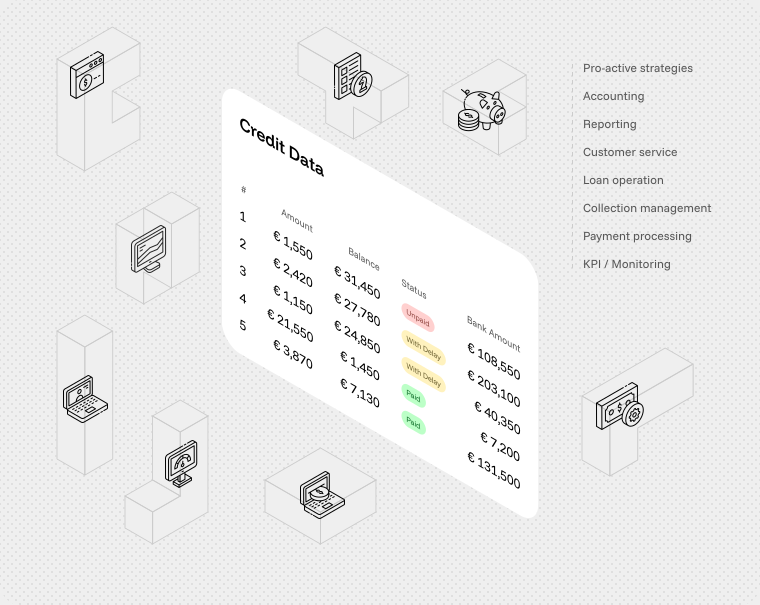
Automate the complete post-origination lifecycle: billing, GL posting, reconciliation, and reporting, as policy-as-code on your own infrastructure. Deploy in 3 weeks across cloud or on-premise with immutable audit trails.
-
Not a Packaged SaaS Product
Customization is never capped by a vendor roadmap. Every repayment workflow, posting rule, and policy composes directly in your own code with zero forced updates.
-
Not Built Custom From Scratch
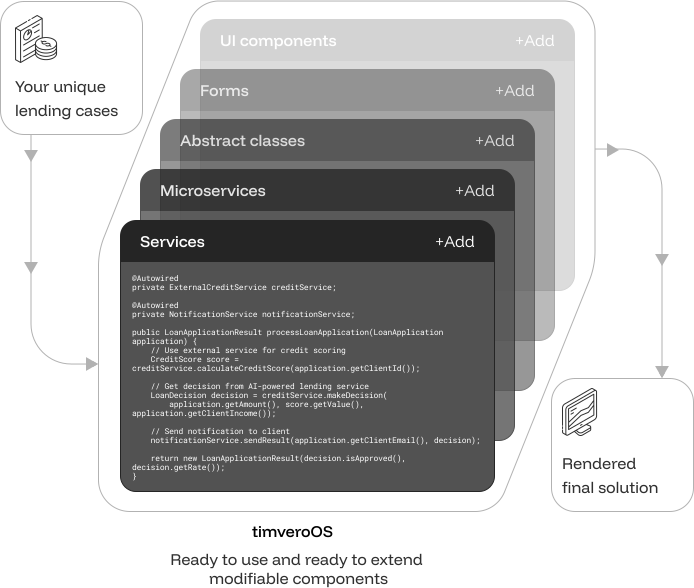
Foundational core blocks are already in place: accrual engines, state machines, GL posting, and integrations. Skip 18 months of groundwork and launch immediately.
-
A Third Path Between Them
Your team composes custom loan products on top of a battle-tested core. Native Java and Spring Boot, run by your developers, inside your environment.
-
Accelerated by timveroAI
Modify loan schedules, interest rules, and workflows in minutes. timveroAI translates plain-English requirements into versioned policy-as-code with zero black-box risk.
Standard Platforms Only Automate the Easy Part
Explore timveroProofTraditional platforms handle routine happy-path applications, but break when logic gets complex. timveroOS automates the 30% tail cases that consume the bulk of your team’s time.
100% Covered End-to-End by timveroOS
SaaS LMS, Custom Build, or timveroOS LMS?
SaaS systems launch quickly but constrain your loan accounting and interest rules. Custom builds offer total control over the sub-ledger, but consume 18+ months of engineering. timveroOS delivers a production-ready loan management engine in your own environment with 100% code control.
SaaS LMS
Pros
- Fast initial go-live for basic loan products
- Lower upfront initial cost
- Prebuilt standard repayment schedules
Cons
- Hardcoded interest accrual & calculation math
- Sub-ledger data hosted outside your security perimeter
- Per-loan or per-seat fees that scale rapidly as portfolio grows
timveroOS LMS
Features
- Double-entry sub-ledger running in your secure environment
- Full code ownership to customize interest, fee, & repayment logic
- Automated General Ledger (GL) posting & real-time reconciliation
- Policies-as-code for IFRS 9 & CECL compliance
- timveroAI generates custom product rules in days, not sprints
- Predictable subscription pricing with zero per-loan tax
Custom Build
Pros
- 100% tailored accounting & data models
- Complete ownership of code and user experience
- No vendor dependencies
Cons
- 18+ months to build an audit-compliant ledger from scratch
- High audit & financial risk in custom calculation math
- Permanent engineering drain for maintenance & updates
SaaS LMS
Pros
- Fast initial go-live for basic loan products
- Lower upfront initial cost
- Prebuilt standard repayment schedules
Cons
- Hardcoded interest accrual & calculation math
- Sub-ledger data hosted outside your security perimeter
- Per-loan or per-seat fees that scale rapidly as portfolio grows
timveroOS LMS
Features
- Double-entry sub-ledger running in your secure environment
- Full code ownership to customize interest, fee, & repayment logic
- Automated General Ledger (GL) posting & real-time reconciliation
- Policies-as-code for IFRS 9 & CECL compliance
- timveroAI generates custom product rules in days, not sprints
- Predictable subscription pricing with zero per-loan tax
Custom Build
Pros
- 100% tailored accounting & data models
- Complete ownership of code and user experience
- No vendor dependencies
Cons
- 18+ months to build an audit-compliant ledger from scratch
- High audit & financial risk in custom calculation math
- Permanent engineering drain for maintenance & updates
Complete Coverage Across the Loan Lifecycle
Assemble pre-built modules into your exact operating model. Start with the components you need today, then extend freely with our SDK and timveroAI as your portfolio scales.
-
Loan Origination
Fast application intake, automated decisioning, doc generation, and approvals. Multi-channel digital and branch support with policy-driven underwriting.
-
Loan Servicing & Accounting
Automated schedules, interest accrual, payments, and statements. Features double-entry sub-ledger posting, reason-coded entries, and controlled reversals.
-
Advanced Portfolio Analytics
Real-time portfolio metrics and explainable AI (XAI) scoring. Deliver sub-second credit decisions with audit-ready reasoning attached to every event.
-
timveroAI Implementation
RAG-grounded AI translates business requirements directly into code. Benefit from an 80% pre-built core and compose custom features to launch in just 3 weeks.
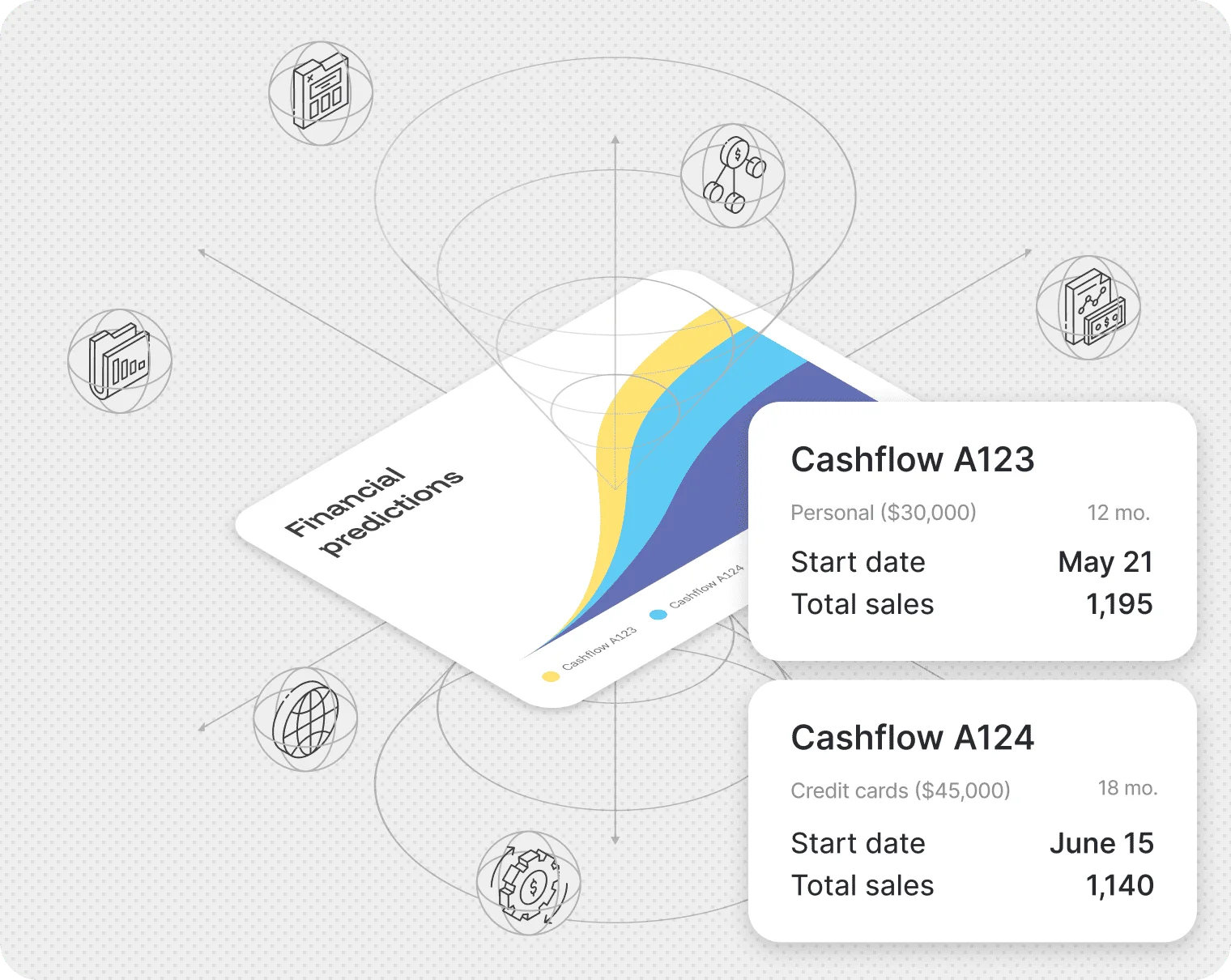
Implement Loan Management in Weeks, Not Months
timveroAI is the acceleration layer for timveroOS: a controlled, RAG-grounded engine built on Claude Code. It interprets plain-language requirements and composes them into production-grade Java configuration, operating within strict safety gates with zero hallucination risk.
Explore timveroAI Features-

Portfolio Logic Generator
Maps account structures, product hierarchies, interest rules, and event triggers directly into versioned policies-as-code.
-

Workflow Orchestrator
Assembles automated repayment schedules, billing cycles, interest adjustments, and hardship workflows instantly.
-

Reconciliation Assembly
Configures posting hierarchies, refund flows, dispute handling, and real-time General Ledger alignment.
-

Reusable Templates
Replicates governed LMS setups across new markets, currencies, and entities with full version control.
- 80% Pre-Built Lending Core
- ~7.8x Faster Delivery vs In-House
- 3 wks Signing to Product Launch
- 0–1 In-House Tech FTEs Needed
AI Brings Speed.
timveroOS Brings Trust.
Launch enterprise-grade loan management software without choosing between go-to-market speed and strict regulatory compliance. timveroOS perfectly aligns developers, product teams, and risk officers.
- Speed
3 weeks from kickoff. timveroOS delivers 80% pre-built core infrastructure, while timveroAI composes the remaining 20% custom logic.
- Trust
Policies-as-code, deterministic execution, immutable audit logs, and full codebase ownership deployed inside your secure environment.
- Together
The ultimate enterprise balance: rapid product iteration for growth teams with zero compromise on institutional compliance.
One LMS Engine for Every
Financial Institution
Tailored operating contexts built on a single audit-ready core. From tier-1 banking books to fast-scaling fintechs, deploy custom loan products with complete codebase control and zero vendor lock-in.
-
Banks
Modernize legacy portfolios with policies-as-code and automated GL posting. Maintain tier-1 compliance, IFRS 9/CECL reporting, and audit readiness without disrupting active books.
Lending Software for Banks -
Fintechs
Launch custom credit products in weeks. Embed digital servicing, real-time payoff quotes, and automated payment rails driven by your roadmap speed, not a vendor’s.
Lending Software for Fintechs -
Credit Unions
Deliver member-first digital and branch servicing with governed hardship workflows. Scale your portfolio with predictable TCO and zero per-seat or per-loan tax.
Lending Software for Credit Unions
Real Lenders.
Real Results.
See how regulated lenders scale portfolios, slash TCO, and launch complex credit products on infrastructure they fully control.
- 80% Pre-built Core Supplied

Finom
Launched multi-country SME credit products across Europe with complete lifecycle automation, regulatory compliance, and zero legacy tech overhead.
Read Case Study - 90% Cost Reduction vs Legacy

Cartiga
Automated complex working capital portfolios for US law firms, replacing a rigid legacy platform with 100% custom servicing logic.
Read Case Study - 6 Mos Launch Time to Market

AMIO Bank
Transformed complex guarantor loan workflows into an automated, audit-ready core engine, taking a new banking product live in just 6 months.
Read Case Study
Stop Filing Tickets.
Start Building Your Loan Engine.
Bring us your most complex interest accrual logic, repayment schedules, or posting rules. We’ll build a working LMS policy live in a 90-minute session, on your infrastructure concept, with your code.
Frequently Asked Questions About Loan Management Software
Talk to Sales-
What is loan management software?
Loan management software automates the post-origination lifecycle of a loan: billing, payments, posting, reconciliation, hardship handling, collections, and reporting. Modern loan management software unifies servicing, accounting, and compliance on one governed engine, replacing spreadsheets, batch jobs, and disconnected vendor modules. The timveroOS loan management platform delivers this as policies-as-code on infrastructure you own, with full audit trails on every event.
-
How is timveroOS different from SaaS loan management systems?
SaaS loan management systems run on the vendor’s infrastructure, cap customization at what the vendor’s roadmap allows, and meter usage by user or by loan. timveroOS runs in your cloud or on-premises, gives you the source for your customizations, and prices on portfolio tier, not per seat. The Building Platform fits non-standard lending products that SaaS cannot accommodate without vendor engineering tickets.
-
What is a Building Platform and how does it differ from custom development?
A Building Platform contains the lending building blocks (accrual engine, participant data model, servicing state machines, GL posting logic, integrations) that custom development would otherwise require 24 months in-house to write from scratch. Your team composes these blocks into your loan product using the SDK instead of writing lending primitives. You get full code ownership without paying the 24-month in-house build timeline.
-
Can timveroOS be deployed on-premises or only in the cloud?
Both. timveroOS runs as a fully online loan management system in your cloud (AWS, Azure, GCP, or private) or as a web-based loan management system on-premises in your data centre. You retain full control over data residency, security configurations, and release schedules. This makes timveroOS suitable for regulated lenders in the UK, EU, and other jurisdictions where on-premises deployment is required, and for any institution prioritising data custody and audit defensibility over vendor convenience.
-
Can timveroOS be customized for our specific loan products?
Yes. timveroOS is a Building Platform: customization is the normal operating mode, not an exception. Your team uses the SDK (Java / Spring Boot) and the configuration layer to compose loan products, workflows, integrations, and policies. With timveroAI, the typical implementation runs in 3 weeks, with 80% of the build already shipped by the platform, the remaining 20% composed by the AI agent, and the rest owned by 0–1 engineers on your side.
-
What is the pricing model for timveroOS loan management software?
Tiered subscription aligned with portfolio size, not per-seat, not per-loan, not per-transaction. Adding users, branches, or new products does not change the price tier, so growing teams and expanding product lines do not face escalating costs. See our pricing page for the current tier breakdown. The total cost of ownership is typically a fraction of equivalent SaaS platforms over a 3–5 year horizon, as documented in the Cartiga case study.
-
What loan products does timveroOS support?
Consumer (auto, BNPL, POS, micro, installment, retail, personal, mortgage), SME and commercial (working capital, asset-based, factoring, leasing, construction, private credit, B2B installment), and specialized products (litigation finance, embedded credit). Multi-participant entity model handles guarantors, co-signers, syndications, and intermediaries natively. See the AMIO Bank case for an example of complex guarantor-backed lending on the platform.
-
What integrations are available with core banking, payment rails, GL, and credit bureaus?
90+ ready connectors ship as standard timveroOS building blocks: core banking, general ledger systems, ACH and card rails, wallet providers, KYC/AML, credit bureaus (US, UK, EU), document signing, identity verification, and reporting platforms. New integrations are added through the SDK in days rather than waitlisted on a vendor marketplace. The integration layer is framework-native, same code patterns as the rest of the platform.
-
How does timveroOS support regulatory compliance and audit?
Every transaction, configuration change, override, and approval is logged with actor, timestamp, reason code, and policy version in an immutable log. The same source drives runtime execution, audit reporting, and regulator submissions: no spreadsheet drift, no hidden business logic. Out-of-the-box modules cover IFRS 9 and CECL provisioning, regulatory reporting templates, and explainable model outputs for analytics. Policies-as-code makes compliance reviewable line by line.