Get in Touch

Loan Servicing Software: Automate Your Full Servicing Lifecycle

timveroAI compiles your servicing logic into a governed system in weeks.

Run billing, payment posting, mid-term events, and collections on policies-as-code, inside your own environment. timveroOS gives you the speed of SaaS with the control of a custom build.

No per-seat fees, no vendor lock-in, no compliance trade-offs, on a Building Platform used by banks, fintechs, and credit unions across 13+ regulated markets.

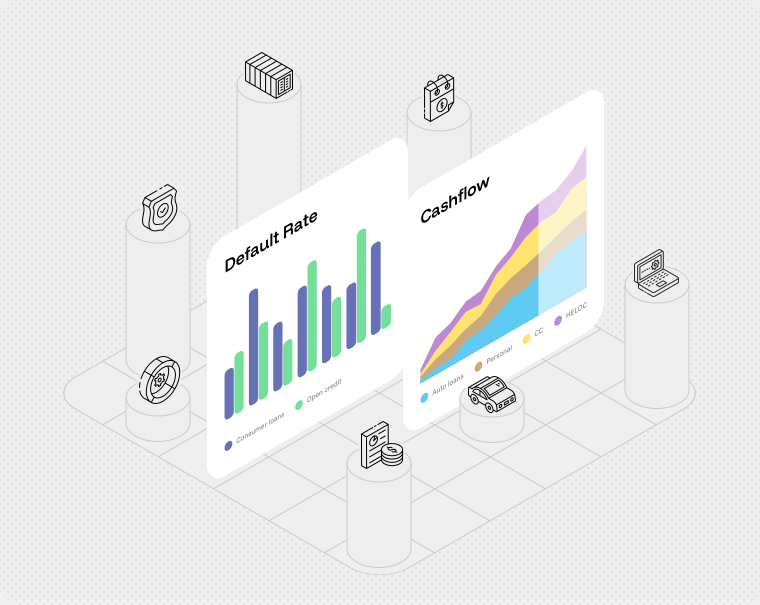
Isometric illustration of the timveroOS loan servicing flow, billing, payment posting, mid-term events, collections, and GL reconciliation on a shared building platform
  • $5.5B+ In Loan Portfolios Serviced
  • 7,000+ Daily Payment Events Processed
  • 13+ Regulated Markets Live
  • 5.0 ★ Verified Customer Rating

Trusted by banks, fintechs, and credit unions across 13+ regulated markets

  • Amio Bank logo
  • Cartiga logo
  • Finom logo
  • GoGoProp logo
  • Aizdevums.lv Bank logo
  • Plumery logo
  • SaaScada logo
  • GF Bankas logo

timveroAI compiles servicing policies into a production-ready system.

Exception paths, collections rules, and audit-ready configurations on timveroOS, with full audit trail in weeks, not months. AI brings the speed, the Building Platform brings the trust.

2 What & Why

Loan Servicing Software: What It Is and Why a Building Platform

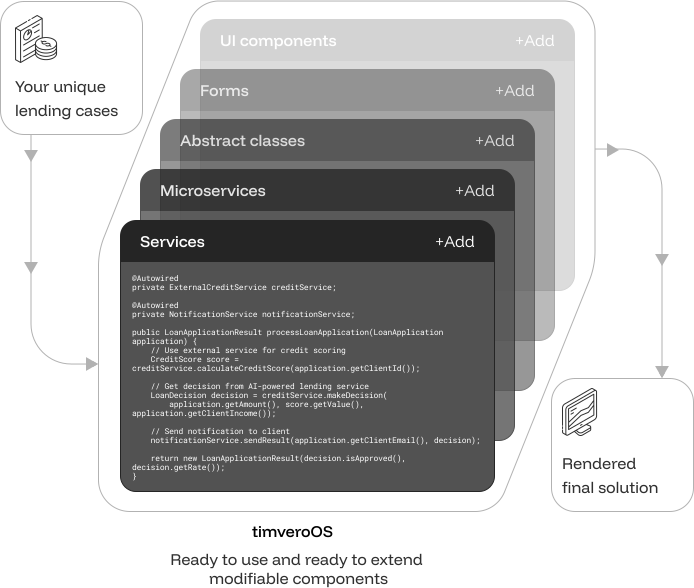
timveroOS modifiable components stack

Loan servicing software handles the entire post-origination lifecycle: account setup, billing and payment posting, schedule and interest accrual, mid-term events like deferrals or hardship, collections and recoveries, and final payoff or charge-off. It is distinct from loan management software, which spans the full lifecycle including origination. Lenders also call it loan service software or loan administration software.

  • A Ready Library of Servicing Building Blocks

    Billing schedules, posting hierarchies, hardship workflows, collections strategies, and GL reconciliation kits ship as composable modules: 18 months of work delivered.

  • An Open SDK for What Differentiates You

    Encode the policies, fee structures, and customer-facing flows that only your team should own. Java and Spring Boot, your developers, your environment.

  • timveroAI Accelerates Implementation

    Compile your servicing rules into governed, auditable configurations on timveroOS in 2 to 6 weeks, not 9 to 18 months for a custom build replacement.

3 The Choice

SaaS, Custom Build, or a Building Platform?

Most servicing teams choose between two compromises, a SaaS loan servicing platform that locks you into a vendor’s data model and pricing curve, or a custom build that ties up 9–18 months and a senior engineering team. The Building Platform is the third option.

Fast but capped

SaaS Loan Servicing

Pros

  • Fast initial go-live
  • Lower upfront cost
  • Prebuilt servicing workflows

Cons

  • Limited policy and UX flexibility
  • Vendor-controlled roadmap and data custody
  • Multi-tenant data complicates compliance review
  • Per-seat or volume fees escalate TCO
Total control

Custom Build

Pros

  • Full control of code and UX
  • Tailored integrations and data model
  • No vendor lock-in

Cons

  • 9–18 month delivery risk
  • Permanent build and maintenance cost
  • Talent and knowledge concentration risk
4 The Resolution

AI brings the speed. The Building Platform brings the trust.

Traditional servicing builds give you trust through control, at the cost of 12–18 months and millions of dollars. Standalone AI tools give you speed, but produce ungoverned output that is not production-ready for regulated lending. timveroAI is the implementation agent inside the Building Platform, it composes real servicing modules, not free-form code, grounded in the timveroOS atom library.

  • Speed

    2–6 weeks from kickoff to production. timveroAI automates 70–80% of configuration work.

  • Trust

    Policies-as-code, immutable audit log, your servicing code in your environment.

  • Together

    Regulator-ready servicing for banks, fintechs, and credit unions, fast AND compliant.

timveroAI

timveroAI for Loan Servicing

From servicing policies to a compliant, audit-ready environment

timveroAI is the implementation agent inside the Building Platform. It composes and configures real servicing modules from the timveroOS atom library, not free-form code, translating payment posting hierarchies, fee schedules, exception paths, and compliance documentation into versioned, executable policies.

Explore timveroAI Features
  • Servicing policies compiled into versioned executable code

    Servicing Policy Compiler

    Translates your payment posting hierarchies, fee schedules, and adjustment rules into versioned, executable policies. Every rule retains the business requirement, input context, and policy version that produced it.

  • Exception workflows assembled under governed approval

    Exception Path Builder

    Assembles workflows for reversals, refunds, due-date changes, deferrals, and forbearance. Each path runs under governed approval with reason codes, actor traceability, and full timestamped audit log.

  • Collections cadence and charge-off paths orchestrated by policy

    Collections and Recovery Orchestrator

    Structures outreach cadence, promise-to-pay tracking, hardship workflows, and charge-off paths per your governance rules. Cure prediction and risk prioritization come from the Advanced Analytics scoring engine, not from timveroAI directly.

  • Versioned approvals and immutable documentation embedded by default

    Audit and Compliance Layer

    Embeds versioned approvals, immutable documentation, and full actor traceability in every configuration. Output is regulator-ready from day one, not retrofitted at audit time.

  • 70–80% Implementation Automation
  • Faster vs Custom Build
  • 2–6 wks Time to Launch
  • 90+ Ready Integrations
6 The Stack

Core Servicing Operations on timveroOS

Three operational capabilities run the day-to-day of a booked loan: onboarding from origination, payment posting across rails, and mid-term events under policy control.

  • Loan Onboarding and Booking

    Clean handoff from origination with schedules, fees, GL mapping, and collateral records initialized under policy control.

  • Payment Operations

    Billing, reminders, and posting across ACH, card, wallet, and FedNow rails with versioned posting hierarchies for late and partial payments.

  • Mid-Term Events

    Due-date changes, extensions, deferrals, payoff quotes, and modifications under managed approval workflows with full audit log.

timveroOS loan servicing operations: onboarding, payment posting, and mid-term event handling on one platform
7 Intelligence & Implementation

Audit-Ready Collections, Analytics, and AI Configuration

Collections, GL reconciliation, and platform configuration share one governed engine. Cure prediction draws from Advanced Loan Analytics; policy composition from timveroAI.

  • Collections and Recoveries

    Pre-delinquency signals, promise-to-pay orchestration, hardship flows, and a unified charge-off and recoveries ledger.

  • Analytics and GL Reconciliation

    Real-time GL posting, automated bank file reconciliation, and dashboards that surface breaks before month-end close.

  • timveroAI for Servicing

    Composes policies, exception paths, collections rules, and compliance docs into production-ready configurations on timveroOS.

timveroOS audit-ready collections, analytics, and AI-driven configuration on one governed engine
8 Implementation
  • timveroAI ingests your current policy documentation, posting rules, fee schedules, and exception handlers, producing a versioned configuration on timveroOS. Side-by-side validation runs against your historical data before cutover.

    Result

    Replace an incumbent servicing system without losing the policy library you built.

    Legacy policies compiled into versioned timveroOS configuration

    Migration From Legacy Systems

  • Your existing stack integrates natively, not through a marketplace adapter. Cores, GL and accounting systems, payment rails (ACH, FedNow, RTP, wallets), credit bureaus, KYC/AML, fraud signals, and CRM connect as first-class building blocks on timveroOS during implementation.

    Result

    New vendors get composed by timveroAI in days via the Open SDK, owned in your code and governed by your policies.

    Connector kits as first-class building blocks on timveroOS

    Connector Kits

  • Stand up a sandbox of your servicing configuration in days. Run synthetic and historical loan portfolios through it. timveroAI iterates the policies against your test results before cutover.

    Result

    Go-live happens when your team signs off, not when a vendor’s roadmap allows.

    Sandbox validation against synthetic and historical portfolios

    Sandbox-First Deployment

9 Automation

Driving Down Servicing Costs Through Automation

High-volume servicing is mostly repetitive work, reconciliation, payment posting exceptions, hardship intake, customer status changes. timveroOS replaces manual operations with policies-as-code and routes customer self-service through configurable channels. Predictable, portfolio-tiered pricing replaces per-seat traps.

  • Adaptive Autopay Orchestration

    Configurable autopay logic that adapts to customer balance, schedule, and risk signals. Failed-payment retry rules, grace-period escalation, and dunning workflows run under governed policies, not in spreadsheets. Reduces failed-payment volume by lowering avoidable bounce-backs.

  • Dynamic Posting Hierarchy

    Versioned waterfalls for principal, interest, fees, and escrow application. Partial and late payments post correctly without manual exception review. Refunds and reversals flow through governed approval chains with reason codes and full audit trail.

  • Continuous Reconciliation

    Real-time GL posting matched against bank files and payment processor settlements throughout the day, not in a batch at month-end. Breaks surface within hours, with loan, posting, and bank reference traced in one view. Finance teams close on time, every cycle.

  • Configurable Self-Service and IVR

    Customer-facing modules for payment, payoff quotes, hardship requests, due-date changes, and document retrieval. Routes branch-equivalent flows through web, mobile, and IVR channels. Lowers call volume into branch and contact center.

10 Audit-Ready

Audit-Ready Servicing From Day One to Charge-Off

Servicing audit findings rarely come from missing data, they come from missing context: which policy version applied, who approved the exception, what reason code was used, when the action happened. timveroOS captures this context for every action, every cycle, every customer interaction, automatically. Regulator-ready audit trails are a property of the platform, not an after-the-fact reporting layer.

  • Immutable Per-Action Audit

    Every posting, adjustment, refund, hardship approval, and policy override logs the policy version, input context, actor, timestamp, and reason code. Records are immutable and exportable in regulator-standard formats.

  • Versioned Policy Library

    Policies live in a version-controlled library with full change history. Every loan retains the policy version under which each decision was made. Re-running a calculation produces the same result years later.

  • Real-Time GL Truth

    Servicing actions hit the GL in real time, reconciled continuously against bank files. There is no parallel ledger to reconcile manually before close, and no spreadsheet of pending adjustments.

  • Cure Prediction and Prioritization

    Advanced loan analytics scoring identifies pre-delinquency signals and prioritizes outreach. Each model output is fully explainable, with feature attribution and policy lineage. Auditors and committees see exactly how each recommendation was generated.

11 Why timveroOS

Why Lenders Choose timveroOS for Loan Servicing

Four reasons banks, fintechs, and credit unions choose timveroOS as their loan servicing platform, not the SaaS provider with a familiar logo, not the custom build with a familiar engineering team.

  • Predictable TCO, Not Per-Seat Traps

    Portfolio-tiered pricing, not per-user or per-transaction fees. Scale your servicing team without scaling your software bill. Add new products, new geographies, or new channels without renegotiation. Most clients see flat or declining cost-per-loan-serviced as their portfolio grows.

  • Your Stack, Integrated as Building Blocks

    Cores, GL and accounting systems, payment rails, credit bureaus, KYC/AML, fraud signals, and CRM connect as native building blocks, not marketplace adapters. Every integration is owned in your code, governed by your policies. New vendors get composed by timveroAI in days through the Open SDK. No marketplace dependency, no per-call surcharges, no integration partner gatekeeping.

  • Entity-Centric, Multi-Participant Architecture

    Native support for guarantors, co-borrowers, joint accounts, multi-debtor commercial structures, and complex collateral. Most servicing platforms model a loan as one borrower with one schedule. timveroOS models real lending relationships, which is what banks and commercial lenders actually book.

  • Regulator-Ready Audit Trail by Default

    Every action records its policy version, inputs, actor, timestamp, and reason code, automatically. Immutable, exportable, searchable. CFPB, OCC, FCA, DNB, BaFin audits ship the data you need within hours, not weeks.

12 Built For

One Loan Servicing Platform for Every Institution

timveroOS serves three primary lender types, banks, fintechs, and credit unions. The Building Platform model adapts to the governance constraints, scaling pressures, and operational model of each. Same architecture, different defaults.

  • Banks

    timveroOS deploys in your own environment, with architectural control over every posting rule, hardship policy, and collections workflow. Integrates directly with your core, GL, and bureau systems. Policies-as-code give committees and regulators the audit trail they expect, with no retrofit reporting.

    Lending Software for Banks
  • Fintechs

    timveroOS gives you the architectural freedom of a custom build, with implementation through timveroAI in weeks. Ship new servicing flows, new payment rails, and new customer-facing modules without waiting on a vendor roadmap. Scale digital-first servicing on open APIs, with real-time GL and explainable analytics from day one.

    Lending Software for Fintechs
  • Credit Unions

    timveroOS gives you a Building Platform with admin-panel coverage for day-to-day operations and timveroAI for the configuration work. Pricing is portfolio-tiered, not per-user. Hardship, deferrals, and member-friendly modifications run natively through governed workflows. You stay in full control of data, releases, and member experience.

    Lending Software for Credit Unions
14 Customer Stories

Real Lenders. Real Results.

Three implementations of timveroOS for servicing, across very different regulatory and operational contexts. Each team moved from concept to production faster than their internal stakeholders thought possible.

98% Automation Across Servicing Operations
7 mo Multi-Country Rollout to Production

Finom: Multi-Country SME Servicing, 98% Automated

timveroOS gave us a single servicing platform we could extend per country without a separate engineering project for each market.

Alex Goncharenko

Head of Credit, Finom

Read the Full Finom Case Study

More Stories

  • 6 mo From Legacy Replacement to Production

    AMIO Bank

    AMIO replaced two previous servicing platforms after both failed to support its guarantor-backed lending product. The Building Platform’s entity-centric data model handles guarantors, co-borrowers, and multi-debtor structures natively. AMIO shipped its new product on timveroOS in six months, with 95% automation across the servicing lifecycle.

    Read AMIO’s Story
  • 90% Reduction in Software Costs

    Cartiga

    Cartiga deployed $1.6B+ in litigation finance against an enterprise platform that did not fit their custom servicing model. timveroOS rebuilt their loan management, servicing, and reporting stack with custom advance rate logic, entity-centric records, and law-firm-aware servicing workflows. Result: 90% reduction in software costs, full automation, and an 8-week MVP that went directly into production.

    Read Cartiga’s Story
15 FAQ

Frequently Asked Questions About Loan Servicing Software

Talk to Sales
  • What is loan servicing software?

    Loan servicing software handles the post-origination lifecycle of a loan, billing, payment posting, schedule management, interest accrual, mid-term events such as deferrals or hardship, collections, and final payoff or charge-off. It is distinct from loan management software, which spans the entire lifecycle including origination. Lenders also call it loan service software or loan administration software.

  • How is timveroOS different from a SaaS loan servicing platform?

    SaaS loan servicing platforms run on the vendor’s infrastructure, with multi-tenant data architecture and a fixed roadmap. timveroOS is a Building Platform you deploy in your own environment. You own the code, control the data, and extend the platform where your business model needs to differentiate. Pricing is portfolio-tiered, not per-seat.

  • Is timveroOS a web-based or on-premises loan servicing platform?

    Both. timveroOS deploys in your cloud (AWS, Azure, GCP) or in your on-premises infrastructure. Same platform, same modules, same SDK, same audit guarantees. You choose deployment based on your data residency, security, and compliance constraints, not vendor preference.

  • How quickly can we migrate from a legacy loan servicing system?

    On average, 2 to 6 weeks from contract signing to the first loan disbursed on timveroOS. timveroAI handles discovery, policy compilation, and sandbox validation against your historical data, followed by phased cutover from the legacy system. Compared to a custom build replacement at 9 to 18 months, the Building Platform with timveroAI is roughly 10× faster. AMIO Bank replaced two previous platforms and launched a guarantor-lending product on this Building Platform timeline.

  • Does timveroOS support loan servicing for private lenders?

    Yes. timveroOS is used by private credit and private lender operations for custom schedules, tailored fee structures, individual loan negotiation, and entity-centric records for borrower groups. Configurable advance rate logic, dilution tracking, and law-firm-aware workflows run natively. See our private credit page for the dedicated vertical.

  • Can timveroOS handle commercial loan servicing as well as consumer?

    Yes. Commercial and consumer servicing run on the same Building Platform, with vertical-specific configurations for entity-centric ledgers, multi-debtor structures, advance rate logic, posting hierarchies, and self-service channels. For commercial focus see commercial lending; for consumer see consumer lending.

  • How does timveroOS scale to enterprise loan servicing volumes and multi-portfolio management?

    timveroOS is in production at lenders managing $5.5B+ in loan portfolios across 13+ countries, processing 7,000+ daily payment events. Multi-portfolio servicing runs as separate policy configurations on the same platform, with shared audit trail and GL reconciliation. Horizontal scaling is handled by your cloud infrastructure or on-prem cluster.

  • What should we look for when comparing loan servicing software vendors?

    Five criteria matter most: (1) data and code ownership, do you control the platform or does the vendor; (2) deployment options, vendor cloud only or your environment; (3) policy flexibility, configurable in admin or hard-coded; (4) integration model, open APIs or vendor-controlled middleware; (5) pricing structure, per-seat or portfolio-tiered. timveroOS leads on all five.

  • How does AI handle loan servicing on timveroOS?

    timveroAI does not make servicing decisions or score loans. It composes and configures your servicing policies, exception paths, and compliance documentation into production-ready configurations on timveroOS. AI implements the platform; the platform runs your business. Scoring and cure prediction come from the Advanced Analytics engine, with full explainability.

  • What integrations does timveroOS support for loan servicing?

    timveroOS integrates with the categories a servicing operation needs: cores, GL and accounting systems, payment rails (ACH, FedNow, RTP, wallets, cards), credit bureaus, KYC/AML, fraud signals, communications, and CRM. Every integration is built as a first-class building block on the Building Platform during implementation, owned in your code and governed by your policies. New vendors get composed by timveroAI in days through the Open SDK, not by waiting on a vendor marketplace.

  • How much does loan servicing software cost on timveroOS?

    Pricing is portfolio-tiered, based on your loan portfolio size and product mix. No per-seat fees, no per-transaction fees, no per-API-call charges. Most clients see flat or declining cost-per-loan-serviced as their portfolio grows. See our pricing page for the current model.

  • Can timveroOS replace our existing loan servicing system?

    Yes. timveroOS is designed to replace incumbent loan servicing systems, including SaaS platforms, custom builds, and combined LMS and LOS systems. Migration runs through timveroAI policy compilation and side-by-side validation against your historical data. On average, 2 to 6 weeks from contract signing to the first loan disbursed on the new stack.

  • Is timveroOS compliant for regulated loan servicing markets?

    timveroOS runs in production under CFPB, OCC, FCA, DNB, AFM, BaFin, and OSFI oversight, across 13+ countries. Compliance is a property of the platform, every action logs policy version, inputs, actor, and reason code automatically. Audit packages export in regulator-standard formats.

  • Does timveroOS support automated collections and recovery within servicing?

    Yes. Collections and recoveries run as configured strategies inside timveroOS, with pre-delinquency signals from Advanced Loan Analytics, promise-to-pay orchestration, hardship and restructure flows, and a unified charge-off and recoveries ledger.

  • How does timveroOS handle escrow management within loan servicing?

    Escrow is a first-class module on timveroOS. Configurable escrow analysis, shortage and surplus handling, tax and insurance disbursement workflows, escrow account reconciliation, and customer-facing escrow statements all run as governed configurations. Real-time GL posting and audit trail apply to escrow the same as to principal and interest.

  • Can timveroOS automate forbearance, hardship, and modification workflows?

    Yes. Forbearance, hardship, and modification workflows run as governed policy chains, customer intake (through self-service, IVR, or agent), eligibility check, approval routing, terms recalculation, document generation, and post-modification scheduling. Each step logs policy version, actor, and reason code. Lenders typically automate 70–80% of hardship cases that previously required manual review.

Ready to Own Your Servicing Stack?

timveroOS is the loan servicing platform behind $5.5B+ in loan portfolios, 7,000+ daily payment events, and 13+ regulated markets. See how the Building Platform fits your portfolio, your migration constraints, and your timeline, in a working demo, not a slide deck.