Get in Touch

Asset-Based Lending Software: Eligibility, NOLV & Field Exams

Build your ABL stack on the timveroOS Building Platform instead of building from scratch. Assemble borrower onboarding, collateral ingestion, borrowing base, funding, and field exams as configurable building blocks.

timveroOS models AR, inventory, reserves, and ineligibles natively, with reconciliation and covenant monitoring built in. You get full control of deployment, predictable TCO, and transparent audit trails.

Asset-Based Lending Software

Request a Custom Demo

Tell us the ABL facility you want to see: AR-backed, inventory-backed, or blended, with your own eligibility, NOLV, and reserve logic. We tailor the demo bench to your exact case.

Request a Demo

Your Facility. Our Bench.

  • $5.5B+ In Loan Portfolios Managed
  • 5.0 ★ Verified Customer Rating
  • 13+ Regulated Markets Live
  • 3-6 wks From Signing to First ABL Disbursed
  • Finom logo
  • Cartiga logo
  • AMIO Bank logo
  • GoGoProp logo
  • Aizdevums.lv Bank logo
  • Plumery logo
1 Lifecycle

End-to-End ABL Lifecycle, Built for Control and Compliance

Asset-based lending only works if eligibility, borrowing base math, reconciliations, and exams run without gaps. timveroOS connects borrowers, collateral, and policies natively, so every facility is transparent, auditable, and compliant by design.

Get a Quote
  • Onboard Borrowers Without Rework

    KYB/KYC checks, UCC filings, and dominion or lockbox terms are captured upfront with audit-ready documentation. Facility structures (AR, inventory, or blended) are defined with limits, covenants, advance rates, reserves, and ineligibles set as policy-driven code. Approval chains, reporting cadences, and role permissions are embedded into workflows. Every action, override, and document is versioned and logged, reducing rework, eliminating spreadsheet dependency, and supporting compliance from day one.

  • Ingest Collateral and Apply Eligibility Rules

    Accounts receivable agings, invoices, credit memos, and payments are ingested automatically, with dilution, contra, and dispute detection built in. Inventory feeds import balances, SKUs, locations, and WIP, with NOLV haircuts applied consistently. Eligibility and concentration rules (debtor, SKU, or geography) execute as code with governed overrides when required. All inputs and versions are persisted for committee review, regulator traceability, and internal audit trails.

  • Compute Borrowing Base and Fund With Confidence

    The borrowing base engine computes availability using reserves, participations, and concentration limits, producing transparent BBCs on demand. Explanation packs break down how headroom changed and why, highlighting ineligible shifts and reserve movements. Once approvals flow through governance, funding triggers and updates borrower portals. GL postings, fee and interest accruals, and daily sweeps reconcile automatically with bank and lockbox data.

  • Monitor Covenants and Run Exams Predictably

    Covenant tracking covers minimum availability, dilution caps, and inventory turns, generating real-time alerts before thresholds break. Exceptions, disputes, and past-dues are routed into governed workflows with full audit trails. Field exams are scheduled digitally, with sampling, variance checks, and roll-forward reconciliations aligned to book and physical counts. Standardized exam workpapers and variance reports shorten cycle times.

2 The Problem

Why Generic LMS Platforms Break on Asset-Based Lending

Asset-based lending does not fit standard installment schemas. Facilities run on receivables and inventory that move daily, on borrowers with guarantors and collateral holders, and on covenants that need continuous monitoring, not a one-time check at origination. Specialist ABL lenders and bank ABL divisions hit the same architectural ceiling.

  • Generic SaaS Was Built for Vanilla Products, Not ABL Structures

    Receivables agings, NOLV haircuts, reserves, and ineligibles do not map onto a one-borrower-per-loan data model. The result is spreadsheets bolted onto a loan record, not native borrowing base logic.

  • Eligibility and Exam Logic Live Outside the System

    Concentration limits, borrowing base certificates, dilution caps, and field exam triggers should run as monitored code, not as manual workflows attached to a generic LMS.

  • Compliance Configuration Sits Behind Vendor Permissions

    Bank ABL divisions cannot accept “your compliance is in our config.” Regulators want transparent decision logic and audit trails, not a vendor black box.

  • Collateral and Asset-System Integrations Need Code-Level Access

    Lockbox, ERP, WMS, appraisal, and NOLV systems integrate at the architectural level, not through a fixed vendor connector list.

3 Solution Fit

How timveroOS Powers Asset-Based Lending

Eligibility calculations, NOLV monitoring, borrowing base updates, and field exams run as building blocks on the Building Platform. Risk and finance agree on the same transparent logic. You configure facility structures, advance rates, reserves, and covenants your portfolio needs, then deploy in your own environment with full data ownership, accelerated by timveroAI.

  • Transparent Borrowing Base Math, Versioned and Explainable

    Native AR, inventory, and reserve objects replace spreadsheets. Eligibility and ineligibles run as explainable code, producing transparent BBCs with versioned inputs. Finance and risk see the same borrowing base, supporting regulator-ready explanations.

  • Lockbox and Bank Matching, Automated and Traceable

    timveroOS ingests lockbox and bank files automatically, matching remittances to AR line items. Daily sweeps, short-pay detection, and governed exception workflows reduce leakage and write-offs.

  • Preventing Over-Advances With Built-In Alerts

    Appraisals and haircuts apply consistently across SKUs and locations. Concentration limits by debtor, SKU, or geography run in real time, while dashboards track inventory turns and shrinkage.

timveroAI

Configure Your ABL Stack in Weeks, Not Quarters

timveroAI is the AI acceleration layer for the timveroOS Building Platform. It is a controlled, RAG-grounded implementation agent built on Claude Code, trained on the Building Platform’s source code and past deployments. You describe an ABL requirement in plain language: a new facility type, an eligibility rule, a covenant. timveroAI asks clarifying questions like a senior product owner, then composes the building blocks: entities, state machines, the borrowing base logic, GL posting, and integrations. The output is production-grade configuration on trusted infrastructure, not a prototype.

Explore timveroAI
  • RAG-grounded agent trained on the Building Platform

    RAG-Grounded on the Building Platform

    A controlled implementation agent built on Claude Code, trained on the timveroOS source code and past deployments. timveroAI composes building blocks from the same SDK your engineers use, so configurations land in production-grade code, not a sandbox prototype.

  • Plain-language requirement converted to configuration

    From Plain-Language Spec to Configuration

    Describe a facility type, an eligibility rule, or a covenant in plain language. timveroAI asks clarifying questions like a senior product owner, then composes entities, state machines, borrowing base logic, GL postings, and integrations.

  • Implementation timeline accelerated from quarters to weeks

    Live in 3 to 6 Weeks

    Lean engineering teams launch an ABL product in 3 to 6 weeks instead of spending 18 to 24 months building borrowing base, reconciliation, and exam logic from scratch. The Building Platform already ships these building blocks; timveroAI composes them into your spec.

  • Human review and governance over every change

    Human Review at Every Step

    timveroAI does not make credit decisions and does not touch runtime portfolio data. It handles configuration and customization with your engineers reviewing and extending every output, so governance and accountability stay inside your team.

Participants and Collateral → Data & Documents → Flows → ABL Products

The timveroOS platform by TIMVERO models every ABL element: borrowers, debtors, guarantors, AR, inventory, appraisals, reserves, and participations. Documents and raw or featured data are captured natively, then composed into flows for onboarding, BBCs, funding, exams, and reconciliations, assembled into ABL products that run end-to-end in your environment.

timveroOS entity-centric architecture for asset-based lending: participants, collateral, data, flows, and ABL products
5 Advanced Analytics

AI That Protects Availability and Reduces Leakage

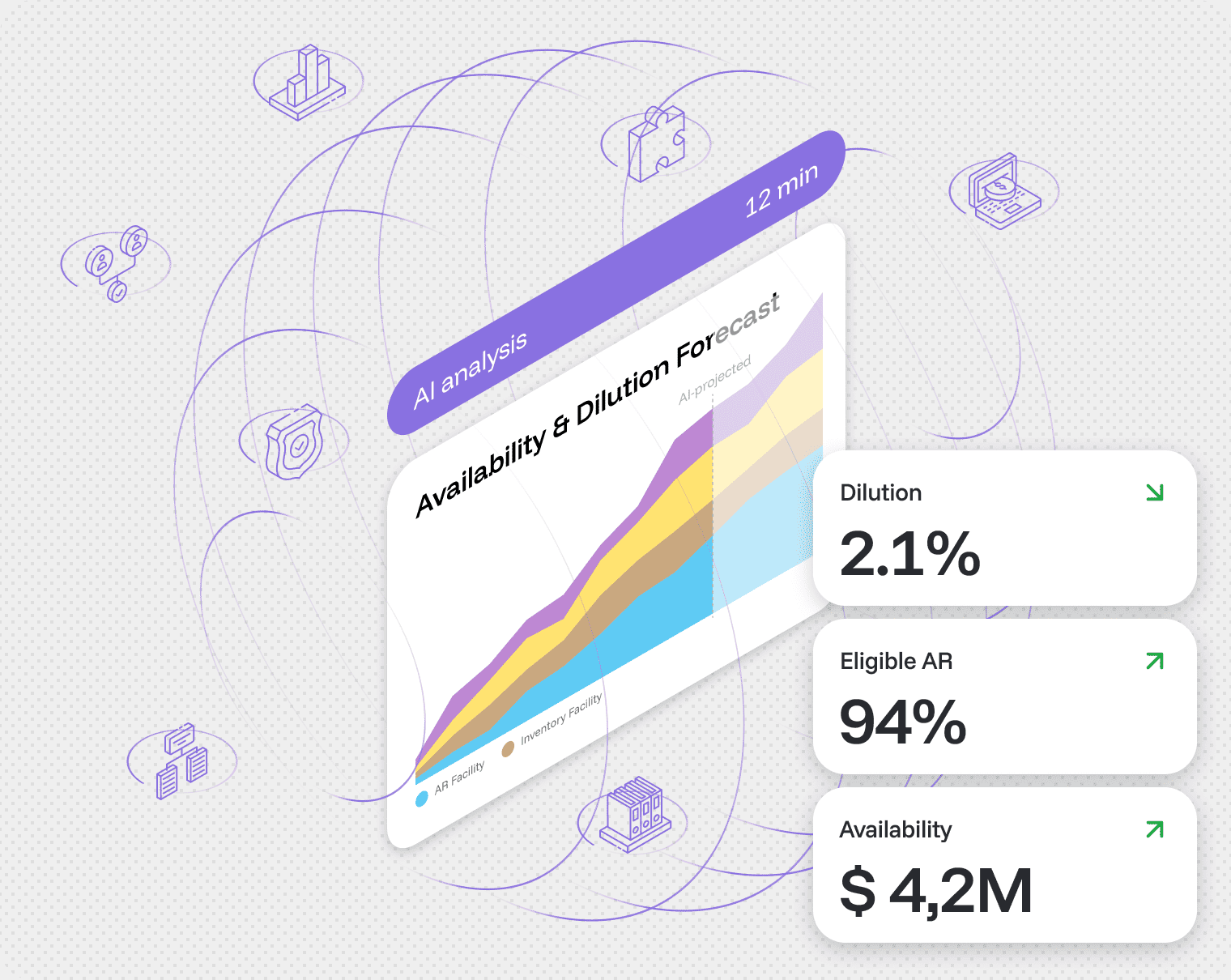
The timveroOS platform applies AI where traditional ABL controls fall short. All models run in your environment, explainable, governed, and audit-ready. This is the Advanced Analytics layer, distinct from timveroAI: it works on your portfolio data to protect availability, while timveroAI accelerates configuration.

  • Dilution and DSO Forecasting

    Models project dilution and days-sales-outstanding per debtor, so reserve and advance-rate decisions are forward-looking rather than reactive. Inputs and versions are persisted for committee review and audit traceability.

  • Inventory NOLV Predictor

    Predicts true net orderly liquidation value across SKUs and locations, keeping inventory advances aligned to recoverable value. Haircuts apply consistently with explanation packs showing how the recommended NOLV was derived.

  • Ineligible and Fraud Anomaly Detection

    Flags anomalous ineligibles, contra accounts, and remittance patterns before they distort the borrowing base. Anomalies route into governed exception workflows with full audit trails, not silent flags.

  • Over-Advance Early Warning

    Triggers alerts as headroom tightens, giving risk and ops teams time to act before a facility breaches. Concentration limits by debtor, SKU, or geography run in real time alongside inventory turn and shrinkage dashboards.


timveroOS Advanced Analytics dashboard with Availability and Dilution Forecast chart and Dilution, Eligible AR, and Availability metric tiles
6 Customer Stories

Real Lenders. Real ABL Results.

A working-capital and asset-backed stack on the Building Platform combines SaaS time-to-live with custom-build architectural control. These lenders configured complex products on timveroOS without rebuilding the underlying lending logic each time.

90% Cost Reduction vs Salesforce
$1.6B+ Deployed on timveroOS

How Cartiga Cut Costs 90% on a Complex Working-Capital Product

“timveroOS gave us 10 to 12% of Salesforce’s TCO for a product they couldn’t even configure for our model. We automated origination and servicing end-to-end and reached market faster.”

Noah Cutler

SVP, Cartiga

Read the Cartiga Story
  • 98% Automation

    Finom

    Multi-country proactive credit launched in 7 months with 98% automation. The Building Platform let Finom configure a credit product across markets without rebuilding the lending logic each time.

    Read the Finom Story
  • 95% Automation Across the Lifecycle

    AMIO Bank

    Armenia, est. 1991. Guarantor lending launched in 6 months after three failed attempts with two other vendors. 8x faster origination than the legacy stack, with 95% automation across the lifecycle.

    Read the AMIO Story

An Easy Choice Between SaaS Speed and Custom Control

SaaS loan management systems launch quickly but limit flexibility and audit depth. Custom builds offer control but come with long delivery cycles and high maintenance costs. The timveroOS Building Platform delivers all-in-one: faster deployment, reasonable costs, and full governance, with policies-as-code for eligibility, reserves, and collections logic that runs entirely in your environment.

SaaS solutions

Pros

  • Fast initial go-live
  • Lower upfront cost
  • Prebuilt workflows

Cons

  • Limited policy/UX flexibility
  • Vendor roadmap and data custody constraints
  • Per-seat fees escalate TCO

Custom Development

Pros

  • Full control of code and UX
  • Tailored integrations and data model
  • No vendor lock-in

Cons

  • 9–18 month delivery risk
  • High build and maintenance cost
  • Talent/knowledge concentration risk
8 Built For

Asset-Based Lending Teams We Serve

Specialist ABL Lenders & NBFIs

NBFIs and specialty finance

Run blended AR and inventory facilities with daily sweeps, participations, and transparent availability reporting. Automate BBCs, lockbox reconciliations, and reserve accounting while keeping full data sovereignty. Field exam workflows, variance tracking, and over-advance alerts strengthen portfolio control, delivering scale without adding headcount. Configure new facility types on the Building Platform in weeks.

Bank ABL Divisions

Regional and commercial banks

Stand up AR- and inventory-backed facilities with eligibility, ineligibles, reserves, and concentration rules as policy-driven code. timveroOS connects to ERP, WMS, banking, and lockbox systems, producing audit-ready BBCs and reconciliations. Risk and finance see the same borrowing base, accelerating funding decisions and reducing exam exceptions, with transparent decision logic that satisfies regulators.

10 FAQ

Common Questions About Asset-Based Lending Software

Request a Demo
  • What is asset-based lending software?

    Asset-based lending software manages facilities secured by accounts receivable and inventory. It handles collateral ingestion, eligibility and ineligibles, borrowing base calculation, funding, covenant monitoring, and field exams. timveroOS delivers these as building blocks on a Building Platform, so the borrowing base is transparent, versioned, and auditable in your own environment.

  • How is timveroOS different from a SaaS ABL platform?

    SaaS ABL tools lock eligibility and reserve logic inside a vendor configuration you cannot see or change at the architectural level. timveroOS is a lending solution built on a Building Platform: AR, inventory, reserves, and covenants are native building blocks you configure and extend through a standard Java/Spring Boot SDK, deployed in your environment with full data ownership.

  • Which tools help manage asset-based lending compliance?

    Compliance in ABL depends on transparent eligibility logic, versioned borrowing base inputs, and complete audit trails. On the Building Platform, every eligibility rule, reserve, override, and exam workpaper is logged and explainable, so committees, auditors, and regulators can trace any availability calculation. Concentration limits and covenant tests run as monitored code, not spreadsheets.

  • What is the best platform for ABL monitoring?

    The strongest ABL monitoring runs covenant tests, dilution caps, inventory turns, and over-advance alerts as continuous, native logic rather than periodic manual checks. timveroOS does this on the Building Platform, with real-time alerts before thresholds break and Advanced Analytics that forecasts dilution and NOLV, all governed and audit-ready in your environment.

  • How long does it take to launch an ABL product on timveroOS?

    Typical implementation is 3 to 6 weeks. The Building Platform already includes the borrowing base engine, reconciliation, and exam building blocks that would take 18 to 24 months to write from scratch. timveroAI composes them into your specific facility structures and eligibility rules, with your engineers reviewing and extending the configuration.

  • Is timveroOS cloud or on-premises?

    Both. Because timveroOS is built on a Building Platform you deploy and own, you can run it in your private cloud, a public cloud, or on-premises. Your configurations, data, and customizations remain your IP and travel with you. This matters for confidentiality-sensitive ABL and bank deployments.

  • What collateral and loan structures does it support?

    timveroOS supports AR-backed, inventory-backed, and blended facilities, with guarantors, co-borrowers, multiple debtors, collateral holders, and participations modeled natively. Advance rates, reserves, ineligibles, and concentration limits are configured as building blocks on the Building Platform, so non-standard facility structures do not require custom workarounds.

  • How does ABL software pricing work?

    timveroOS uses a tiered subscription aligned with your portfolio size, not per-user or per-loan fees. You pay for continuous access to the Building Platform, timveroAI implementation capacity, and platform updates. The cost stays predictable as your portfolio grows, and your configurations remain your IP.

Launch Your ABL Product on timveroOS

Ready to see how eligibility, BBCs, NOLV, and field exams run natively in your environment?

Request a Demo

$5.5B+ managed across 13+ countries. 3 to 6 weeks to go live.