










Get in Touch

Private Credit Software With Covenants, Agency, and Monitoring Built In

One platform for every deal, from sponsor pipeline to LP reporting.

timveroOS runs the full private credit and private debt lifecycle on a Building Platform: faster IC cycles, auditable covenants, clean agency settlements, and fund-level allocations. Sponsors, borrowers, co-investors, and SPVs are modeled natively, with waterfalls and monitoring dashboards built in. You deploy in your own environment: your rules, your data, your portfolio.

  • $5.5B+ In Loans Managed
  • 13+ Countries Live
  • 5.0 ★ Verified Customer Rating
  • 3-6 wks From Signing to First Disbursement

Trusted by direct lenders, private credit funds, and bank private-credit desks running portfolios across 13+ regulated markets

  • AMIO Bank logo
  • Cartiga logo
  • Finom logo
  • GoGoProp logo
  • Aizdevums.lv Bank logo
  • Plumery logo
1 The Problem

Where Generic Platforms Break for Private Credit and Private Debt

Private credit doesn’t fit standard installment schemas. Deals arrive with sponsors, guarantors, co-investors, agents, and SPVs. Covenants need continuous monitoring, not a one-time check at close. The same teams running private debt funds face one architectural ceiling.

  • Multi-Participant Structures Don’t Fit the Data Model

    Generic SaaS platforms assume one borrower per loan. Private credit needs native entities for sponsors, co-investors, SPVs, facilities, and tranches, each with its own documents, scoring, and lifecycle. The Building Platform models them as first-class entities.

  • Covenant Tracking Is Bolted On, Not Native

    Financial covenants, baskets, and borrowing-base triggers need to live inside the system as monitored logic, not as spreadsheets attached to a generic loan record. On timveroOS they run as policies-as-code with automated testing.

  • Valuations and LP Reporting Live Outside the System

    Valuation marks, NAV, and investor disclosures get rebuilt by hand in spreadsheets, disconnected from servicing data and audit trails. The Building Platform keeps them on one data model with full input provenance.

  • Compliance Configuration Sits Behind Vendor Permissions

    Private credit IC workflows, agency handoffs, and covenant monitoring require transparent, auditable logic, not a vendor black box you can’t inspect. timveroOS keeps the logic in code your team owns and can extend.

2 Lifecycle

Private Credit, From Sponsor Pipeline to Portfolio Monitoring

From sponsor pipeline to portfolio monitoring, timveroOS connects every stage on one Building Platform. Investment policies, covenants, and committee workflows run as configurable code, so lenders get faster approvals, explainable decisions, and clean audit trails.

Request a Demo
  • Pipeline Discipline With Automated Mandate Filters

    Capture sponsor pipelines with NDA gating and teaser data. Standardize term sheets for unitranche, senior, mezzanine, OID, or PIK with collateral packages. Mandate filters, exposure, and concentration limits run as code and screen deals upfront. IC-ready packs are generated automatically, with versioned comments and audit logs.

  • IC Confidence With Explainable Underwriting

    Model normalized EBITDA, add-backs, leverage, and coverage tests under multiple scenarios. Encode covenants, baskets, and triggers as governed policies. Financials, bureaus, and collateral appraisals integrate directly. This is private credit underwriting software that produces IC decks and minutes with full input provenance.

  • Agency Operations That Run Without Friction

    Generate closing documents from a clause library covering credit, intercreditor, and fee terms. Capture conditions precedent, funding approvals, rate settings, notices, participations, and co-invest allocations. Multi-currency schedules post directly to the GL, while lenders and borrowers use portals for settlements, allocations, and documents.

  • Portfolio Monitoring and Servicing That Protects Downside

    Automate interest accruals (cash and PIK), fees, notices, and settlements: private credit loan servicing software built into the platform. Covenant certificates and borrower reporting feed automated testing, with early-warning alerts on breaches. Dashboards track exposure, concentrations, FX, and valuation marks for IC and LP/BDC reporting.

3 Architecture

Built on a Building Platform for Complex Private Credit Deals

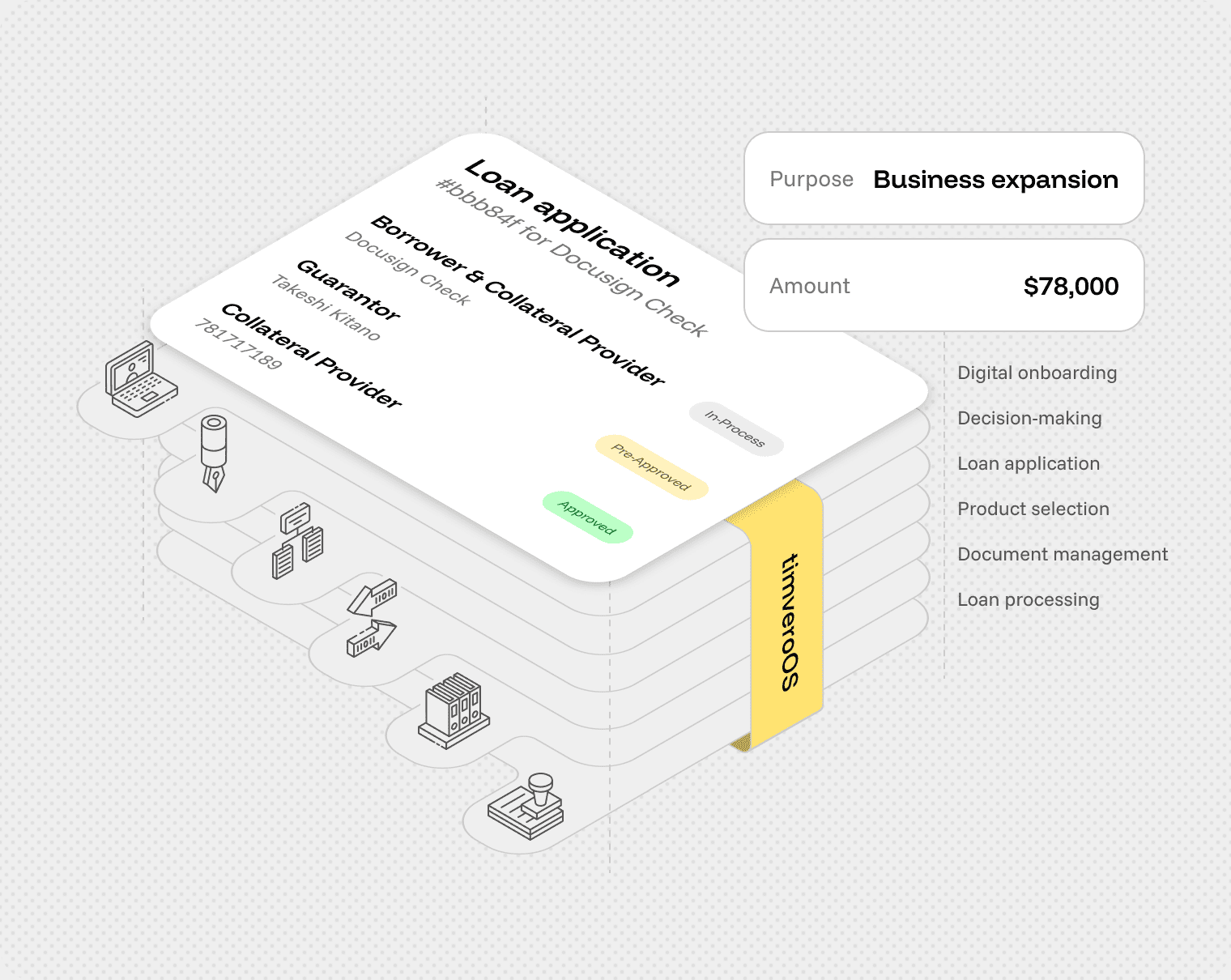
timveroOS models sponsors, borrowers, and co-lenders alongside funds, SPVs, facilities, and tranches. Raw and featured financials, covenants, and document sets are captured natively. Configurable flows (pipeline, underwrite, close, amend, and monitor) assemble unitranche, mezzanine, and club deals as building blocks on the Building Platform. You launch faster while keeping full extensibility in code your developers already know.

timveroOS Building Platform architecture for private credit
4 Fund Operations

Valuation, Fund Administration, and LP Reporting in One Platform

In most shops, servicing, valuation, and investor reporting live in three disconnected tools. On timveroOS they share one data model on the Building Platform, so portfolio management, alternative-investment views, and cash-flow analysis all draw from the same source of truth.

  • Private Credit Valuation

    Valuation marks, scenario analysis, and stress tests roll up from deal-level data into portfolio and fund views. Model cash-versus-PIK coverage under multiple rate environments. This is private credit valuation software for illiquid assets, enterprise-grade, with every input traceable to its source.

  • Fund Administration and Allocations

    Funds, SPVs, facilities, and tranches are first-class entities. Manage participations and co-investment allocations across vehicles with automated waterfalls, multi-currency schedules, and clean GL posting. Private credit fund administration software and servicing finally share one ledger, not two.

  • LP and Investor Reporting

    Generate LP, BDC, and investor disclosures from the same data that drives servicing and valuation. NAV, performance, and exposure reports carry full input provenance. An investor portal gives LPs self-serve access to statements and allocations, with no end-of-quarter spreadsheet scramble.

timveroAI

Configure Your Private Credit System in Weeks With timveroAI

AI brings the speed. The Building Platform brings the trust.

timveroAI is the AI acceleration layer for the Building Platform: a controlled, RAG-grounded implementation agent built on Claude Code. You describe a requirement in plain language, a loan structure, a covenant rule, an agency workflow, and timveroAI composes the corresponding building blocks. Typical implementations run 3 to 6 weeks, roughly 10x faster than a traditional build, with an initial up-and-run on a working skeleton in under a week.

Learn About timveroAI
  • timveroAI requirements gathering icon

    Requirements in Plain Language

    Describe a unitranche structure, a covenant package, or an agency workflow in plain language. timveroAI asks clarifying questions about tranches, baskets, and waterfalls instead of guessing.

  • timveroAI architecture checkpoint icon

    Architecture Checkpoint

    A plan with atoms (participant data, covenant policies, state machines, allocation logic) is surfaced for your team to approve before any generation begins. Human-in-the-loop gates remain throughout.

  • timveroAI composition icon

    Composition From Building Blocks

    Code generation uses actual Building Platform components and prior private credit deployment patterns. No invented APIs, no hallucinated imports. Production-grade code on infrastructure your engineering team owns and extends.

  • timveroAI shadow-run and validation icon

    Shadow-Run and Human-in-the-Loop

    Shadow-run mode validates configurations before production. Approval gates remain at every checkpoint. When timveroAI does not know something, it asks. It does not invent.

6 Advanced Analytics

Early Warning That Protects the Portfolio

Separate from timveroAI, the platform’s explainable scoring and analytics engine scores sponsor and borrower risk, predicts covenant-breach probability, and flags anomalous adjustments or reporting gaps early. Models run in your environment on your portfolio data, and stay explainable, auditable, and aligned with your governance.

  • Early Warnings on Likely Covenant Breaches

    Borrower certificates and reporting feed automated testing, with alerts firing on likely breaches before they crystallize into losses.

  • Risk Scoring That Prioritizes Sponsors and Borrowers

    Explainable scores rank sponsor and borrower exposure so risk teams act on the deals that matter first, with reason codes on every output.

  • Coverage Forecasts That Stress-Test Cash vs. PIK Toggles

    Model coverage under multiple rate environments and cash-versus-PIK scenarios, surfacing portfolio concentration risk before it materializes.

  • Amendment Predictions That Improve Recovery Outcomes

    Predict which positions head toward amendment or waiver, so workout teams engage early and improve recovery outcomes.

timveroOS Advanced Analytics dashboard for private credit, showing a coverage forecast by Unitranche, Senior, Mezz, and PiK tranches with breach probability 4%, coverage 1.8x, and expected recovery $1.2M KPI cards
7 Built For

Built for Direct Lenders, BDCs, and Bank Private-Credit Desks

  • Direct Lenders & Private Credit Funds

    Stand up unitranche, senior, or mezzanine facilities with covenants coded as policy, IC packs auto-assembled, and agency ops running cleanly. Connect to CRM, data vendors, and GL systems for faster closes and portfolio-grade monitoring.

  • BDCs & Asset-Manager Debt Arms

    Manage multi-fund and SPV allocations, co-investments, and participations with automated waterfalls and FX support. Audit-ready data and dashboards give boards, regulators, and investors clarity while you keep full control of your environment.

  • Specialty Finance & Bank Private-Credit Desks

    Run sponsor-backed and club deals with intercreditor workflows, amendments, and waivers governed as code. Monitor exposures and covenants in real time while keeping the freedom to evolve products quickly.

8 Customer Story

How Cartiga Cut Costs 90% With timveroOS

Cartiga, a US litigation-finance firm, needed to launch complex working-capital products for law firms, with bespoke repayment schedules no SaaS LMS template fits. On timveroOS it reached full automation and faster time to market while cutting costs roughly 90% versus its previous enterprise platform.

90% Cost Reduction vs the Previous Platform
10x Faster Delivery Than the Replaced Platform

From a Salesforce Workaround to a Building Platform in Months

“timveroOS has become the core engine behind our law firm lending business. Its framework allowed us to build sophisticated workflows, pricing, and collateral logic per our bespoke structures, something no SaaS or traditional LMS could offer.”

Noah Cutler

Senior Vice President, Cartiga

Read the Cartiga Case Study
9 The Choice

SaaS vs Building Platform vs Custom Development

SaaS loan management systems launch quickly but limit policy and UX flexibility and audit depth. Custom builds offer control but come with long delivery cycles and high maintenance costs. timveroOS is a third path: modular building blocks and an SDK in your own environment, policies-as-code for posting, fees, hardship, and collections, with predictable TCO.

SaaS solutions

Pros

  • Fast initial go-live
  • Lower upfront cost
  • Prebuilt workflows

Cons

  • Limited policy/UX flexibility
  • Vendor roadmap and data custody constraints
  • Volume/per-seat fees escalate TCO

Custom Development

Pros

  • Full control of code and UX
  • Tailored integrations & data model
  • No vendor lock-in

Cons

  • 9 to 18 month delivery risk
  • High build & maintenance cost
  • Talent/knowledge concentration risk
10 Integrations

Your Private Credit Stack, Integrated as Building Blocks

Your stack, integrated as building blocks, not bolted on. Every integration becomes a first-class building block on the Building Platform, implemented during deployment and owned in your code. New vendors get composed by timveroAI in days via the Open SDK, with no marketplace dependency and no per-call surcharges.

  • Core and Accounting Systems

    Native GL posting from the Building Platform into your core and accounting systems. Multi-currency schedules and waterfalls reconcile against the same data model, with no middleware layer and no separate reconciliation queue.

  • Credit Bureaus and Data Vendors

    Soft and hard pulls, financial spreading feeds, and alternative data. Whether your bureau is Equifax, Experian, or TransUnion, it composes into your underwriting policies as a building block, not bolted on.

  • Collateral and Valuation Systems

    Appraisal, borrowing-base, and mark sources feed deal-level data directly. Valuation inputs stay traceable to their source and roll up into portfolio, NAV, and LP reporting views.

  • KYC, AML, and Sanctions

    Identity verification, entity screening, and sanctions checks for sponsors, borrowers, and co-investors. New providers compose in days through the Open SDK and feed the analytics engine.

  • Payment Rails

    Funding, drawdowns, and settlements across rails and currencies. Composed for direct, participated, and co-invest funding paths, with bank file reconciliation against the same ledger.

  • CRM and Deal Pipeline

    Sponsor pipeline, mandate, and relationship data sync as building blocks, not as a separate stack. Teaser data and NDA gating connect to the origination flow on the platform.

Isometric diagram of the timveroOS Building Platform private credit integration architecture, connecting core and accounting, bureaus and data vendors, collateral and valuation, KYC and AML, payment rails, and CRM nodes
12 FAQ

Private Credit Software: Common Questions

Common questions from IC, risk, fund-operations, and engineering leaders evaluating private credit and private debt software on a Building Platform.

Talk to Our Team
  • What is private credit software?

    Private credit software is the system direct lenders and private debt funds use to originate, underwrite, service, and monitor non-bank loans. timveroOS delivers it on a Building Platform: covenants, agency workflows, valuations, and LP reporting run as configurable building blocks in your own environment, so the system fits your deal structures instead of forcing them into a fixed SaaS schema.

  • What’s the difference between private credit and private debt software?

    The terms overlap. Private debt usually emphasizes the fund and portfolio view: fund administration, NAV, and LP reporting. Private credit emphasizes the deal and loan view: underwriting, covenants, and agency operations. timveroOS covers both on one Building Platform, so deal-level servicing and fund-level reporting share the same data and audit trail.

  • How does timveroOS handle covenant compliance monitoring?

    Covenants, baskets, and triggers are authored as policies-as-code on the Building Platform. Borrower certificates and reporting feed automated testing, and early-warning alerts fire on likely breaches. Amendments and waivers run through scenario modeling and governed approvals, with every change versioned and auditable.

  • Does timveroOS support private credit valuation and NAV / LP reporting?

    Yes. Valuation marks, scenario analysis, and NAV roll up from deal-level data into portfolio and fund views on the Building Platform. LP, BDC, and investor disclosures are generated from the same source with full input provenance, with no separate spreadsheet reconciliation between servicing, valuation, and reporting.

  • How is timveroOS different from a SaaS fund-administration platform?

    A SaaS platform fits your portfolio into its schema. timveroOS is a Building Platform: you deploy in your own environment, model multi-participant structures natively, and extend logic in code your developers already know. You own the data and the customizations, with predictable portfolio-tiered pricing instead of per-seat fees.

  • How long does it take to launch on timveroOS?

    Typical implementations run 3 to 6 weeks. timveroAI, a controlled, RAG-grounded implementation agent, composes the Building Platform’s building blocks into your private credit product from plain-language requirements. Initial up-and-run on a working skeleton is under a week, so teams test real workflows early.

  • Can timveroOS manage multi-fund, SPV, and co-investment allocations?

    Yes. Funds, SPVs, facilities, and tranches are first-class entities on the Building Platform. Participations and co-investment allocations are managed across vehicles with automated waterfalls, multi-currency schedules, and clean GL posting, so settlements and reconciliations stay traceable.

  • Is timveroOS cloud or on-premises, and who owns the data?

    Both. Deploy the Building Platform in the cloud, on-premises, or hybrid, including private environments for confidentiality-sensitive credit. You own the code, the configurations, and the data, with no multi-tenant commingling and no vendor data custody between you and your portfolio.

Launch Your Private Credit Product on the timveroOS Building Platform

$5.5B+ managed. 3 to 6 weeks to go live. Assemble your own system: covenants, waterfalls, valuations, and LP reporting built in, audit-ready, and fully under your control.

Request a Demo