



Loan Management Software for the Dutch Market
Building lending infrastructure for the Dutch market means connecting BKR, handling DNB reporting, and wiring iDEAL disbursements, before your first product goes live. timveroOS is a Building Platform that delivers this foundation ready to extend: composable modules, policy-as-code for compliance logic, open APIs to local rails. From contract to first loan issued in 3 weeks.
- 3 wks Contract to First Disbursement
- 80% Pre-Built Lending Core
- 13+ Countries Served Globally
- 100% Deployment in Your Environment

Ready to Launch Your Dutch Lending Product?
BKR integration, DNB-compliant workflows, and iDEAL rails, pre-assembled and ready to extend. First loan issued in 3 weeks.
Request a DemoGet our free TIMVERO product guide









timveroAI
Change Dutch Lending Products Under CCD2 and DORA
Dutch lenders face CCD2 from November 2026, DORA on ICT risk and supervisors who expect every automated decision to be explainable. timveroAI Studio lets your team describe a product change in plain language and review the draft. Engineers and risk approve it, and the approved logic runs deterministically in an environment you control.
Explore timveroAI Features-
CCD2 Changes, Described
Describe new creditworthiness or information steps in plain language. Studio drafts them for compliance to review.
-
An Exit You Control
Code and configuration live in your own repository, which supports the exit planning DORA expects.
-
Explainable to DNB and AFM
Approved logic is reproducible, so every automated decision can be reconstructed for a supervisor.
-
Your Choice of AI Model
Connect the AI provider your risk policy allows. The model builds drafts and never runs your production.


- ~7.8x Faster Delivery vs In-House
- 5x Lower Cost-to-Change
- Zero Manual Implementation Coding
- 100% Explainability and Compliance
What Is the Building Platform?
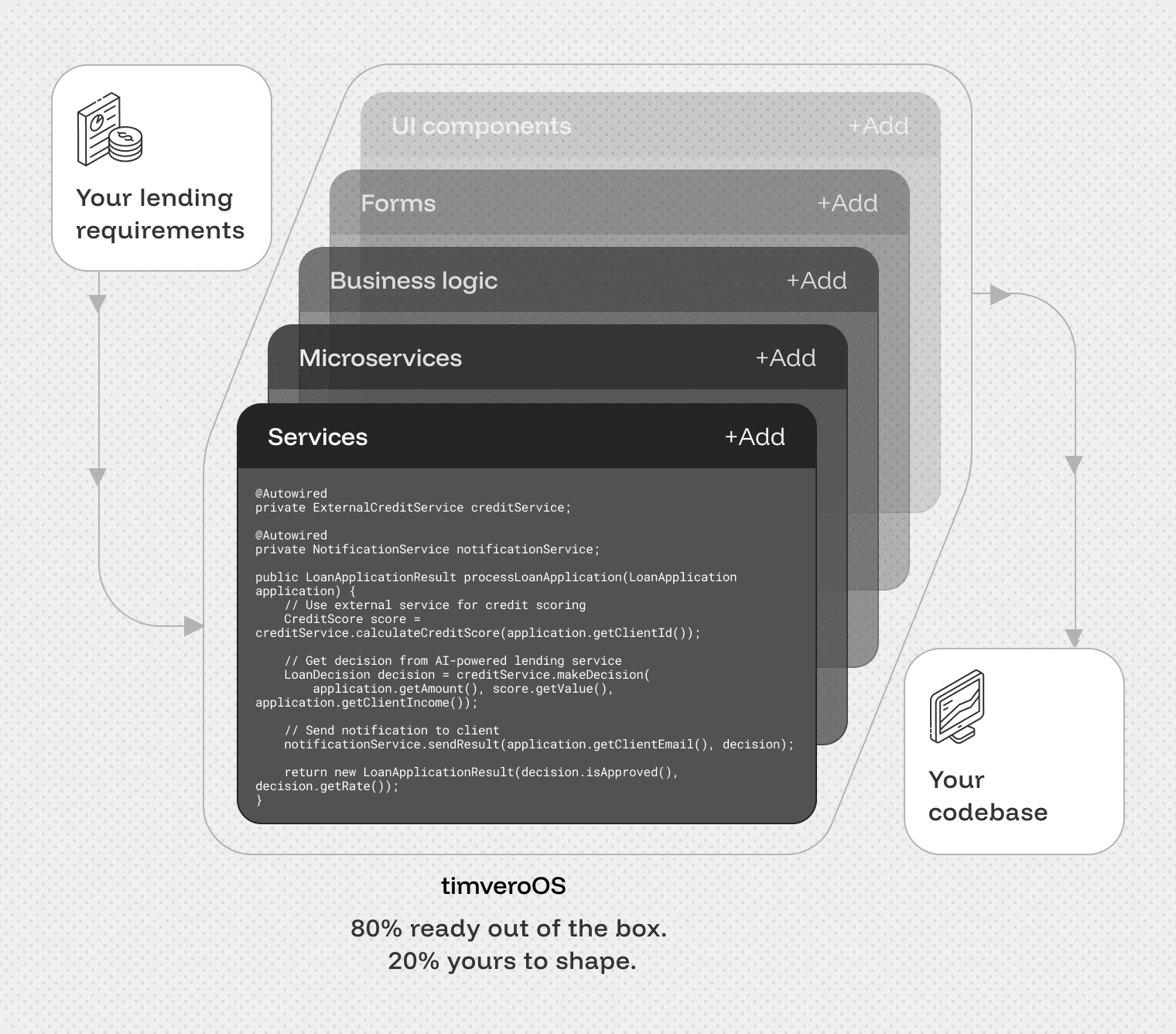
The Building Platform is a set of framework-native building blocks (AccrualEngine, state machines, GL posting logic, policy-as-code collections) that cover 80% of any Dutch lending operation out of the box. The remaining 20% is yours to shape: extend with your team’s Java code, deploy in your environment, and govern every release on your schedule.
-
Composable Modules
Origination, servicing, collections, and analytics modules share one data model. Your team configures workflows once and reuses them across products and channels, with no parallel codebases.
-
Policy-as-Code
BKR connectors, DNB reporting, AFM hardship rules, and IFRS 9 provisioning live as versioned, auditable code. Update rules without a vendor ticket; every change carries a complete audit trail.
-
Your Environment
Deploy on AWS, Azure, GCP, or on-premise, and customer and portfolio data stays in your perimeter. Apply releases on your compliance and IT cadence, no forced upgrade cycle.
Who Builds on timveroOS in the Netherlands?
-
Commercial Banks and Tier-2 Lenders
timveroOS connects to your existing core via open APIs, absorbing origination, loan servicing, and collections as a dedicated lending layer. IFRS 9 provisioning runs as an auditable policy layer. AccrualEngine handles GL posting logic, giving your finance team reconcilable output on a predictable schedule.
-
Dutch Fintechs and Payment Institutions
Build your scoring rules and loan state machines in Java via the SDK. Connect BKR as a configurable bureau connector, the same Building Platform framework used by lenders in 13+ countries. timveroAI reduces your initial configuration to 3 weeks, so product logic iterations stay on your team’s timeline.
-
Specialty Finance and Alternative Lenders
timveroOS covers factoring, leasing, asset-based, and construction loan workflows as native module families on the Building Platform. You extend via SDK, adding your collateral logic, draw mechanics, or margin call triggers through the Java extension layer. Predictable TCO with no per-seat escalation.
An Easy Choice for Dutch Lenders: SaaS Speed vs. Full Control
Dutch institutions running multi-product lending portfolios can’t afford the SaaS ceiling or the custom-build timeline. timveroOS lands between both: composable architecture, predictable cost, and your data in your environment.
SaaS Solutions
Pros
- Fast initial go-live
- Lower upfront cost
- Prebuilt workflows
Cons
- Limited policy/UX flexibility
- Roadmap/data-custody constraints
- Volume/per-seat fees escalate TCO
Building Platform
timveroOS
Features
- Framework-native. Modules + SDK
- Policy-as-code: affordability, waterfalls, overrides
- Open APIs to core/CRM/KYC/open banking
- Explainable decisions & immutable audit trail
- Predictable TCO (no per-seat traps)
Custom Development
Pros
- Full control of code and UX
- Tailored integrations & data model
- No vendor lock-in
Cons
- 24-month in-house delivery risk
- High build & maintenance cost
- Talent/knowledge concentration risk
SaaS Solutions
Pros
- Fast initial go-live
- Lower upfront cost
- Prebuilt workflows
Cons
- Limited policy/UX flexibility
- Roadmap/data-custody constraints
- Volume/per-seat fees escalate TCO
timveroOS
Features
- Framework-native. Modules + SDK
- Policy-as-code: affordability, waterfalls, overrides
- Open APIs to core/CRM/KYC/open banking
- Explainable decisions & immutable audit trail
- Predictable TCO (no per-seat traps)
Custom Development
Pros
- Full control of code and UX
- Tailored integrations & data model
- No vendor lock-in
Cons
- 24-month in-house delivery risk
- High build & maintenance cost
- Talent/knowledge concentration risk
2 Customer Stories Real Lenders.
Real Lenders.
Real Results.
- 80% ready-to-use lending infrastructure supplied

Finom
timveroOS partners with a fast-growing European fintech to launch a multi-country proactive credit product for SMEs delivering full automation, regulatory compliance, and rapid market rollout at a fraction of the cost and time of traditional banking systems.
Read Now - 90% cost reduction compare to the previous solution

Cartiga
timveroOS enables a US-based litigation finance company to launch complex working capital products for law firms while achieving full automation, faster time to market, and significantly lowering costs compared to their previous enterprise platform.
Read Now - 100% bespoke origination requirements coverage
AMIO Bank
timveroOS enabled a leading Armenian bank to transform a complex lending concept with guarantor support into a fully automated, production-ready solution. The platform ensured full compliance and rapid deployment - bringing the new product to market in just six months.
Read Now
Consumer Lending
Explore Consumer LendingQuestions From Dutch Lenders
-
Does timveroOS support BKR bureau integration for Netherlands lenders?
Yes. BKR (Bureau Krediet Registratie) integration is available as a configurable connector in the Building Platform. The connector supports both inquiry flows (for origination decisioning) and reporting flows (for regulatory credit file updates). Field mapping and inquiry rules are configured via the policy layer, independently of the framework core.
-
Is timveroOS compliant with DNB and AFM requirements?
timveroOS is designed to make compliance auditable and verifiable by your own team. The Building Platform provides: an immutable audit log on all loan state changes for DNB data governance, policy-as-code for collections and hardship rules meeting AFM responsible lending requirements, and IFRS 9 staging and ECL calculation output formatted for regulatory reporting. Your compliance team retains full visibility into every configurable rule.
-
What is the typical deployment timeline for a Dutch lender?
Median time from signed contract to first loan issued on the Building Platform is 3 weeks. timveroAI, the RAG-based implementation agent, composes the remaining 20% of the configuration, including module assembly, state machine definition, and BKR connector wiring. Complex products with bespoke scoring logic take longer.
-
Does the platform support iDEAL and SEPA payment rails?
Yes. iDEAL is supported for disbursement and repayment flows via the Building Platform payment connector module. SEPA credit transfers and direct debits are available as standard integrations. Additional payment rail connectors are added via the Java SDK extension layer.
-
Where does timveroOS run: cloud, on-premise, or hybrid?
The Building Platform deploys in your own environment: cloud of your choice, on-premise, or hybrid. There is no shared tenancy. This is important for Dutch lenders under DNB data governance requirements: customer and loan data stays in your perimeter at all times. We support AWS, Azure, GCP, and private data centre deployments.
-
Can we integrate timveroOS with our existing core banking system?
Yes. The Building Platform is designed to complement, not replace, core banking infrastructure. Open APIs connect to your core for GL posting, account management, and KYC data. AccrualEngine handles lending-specific GL logic and passes reconcilable entries to your core ledger. Standard connectors exist for major Dutch and European core banking platforms; custom connectors are built via the Java SDK extension layer.

Ready to Build Your Dutch Lending Product on timveroOS?
Dutch Banks, Fintechs, and Specialty Lenders Can Use the timveroOS Building Platform to Launch DNB- and AFM-Aligned Products in 3 Weeks, on a Predictable Budget, in Their Own Environment.