Contact Sales

Payday Loan Software — Compliant Short-Term Lending on timveroOS

Launch Payday, Cash Advance, and PAL Products on a Building Platform

Configure short-term consumer credit with policies-as-code compliance, XAI scoring as a building block, and 2–6 weeks to go live.

  • $5.5bn+ In Loan Portfolios Managed
  • 13+ Countries With Live Deployments
  • 5.0★ Customer Reviews
  • 2–6 wks From Kickoff to First Launch

Trusted by Lenders Across 13+ Countries

  • Amio Bank
  • Cartiga
  • Finom
  • GoGoProp
  • Aizdevums.lv Bank
  • Plumery
  • SaaScada
  • GF Bankas
  • Partner
  • Partner
  • Partner
  • Partner
  • Partner
  • Partner
  • Partner
  • Partner
1 Challenges

Short-Term Lending Breaks Generic LMS Architecture

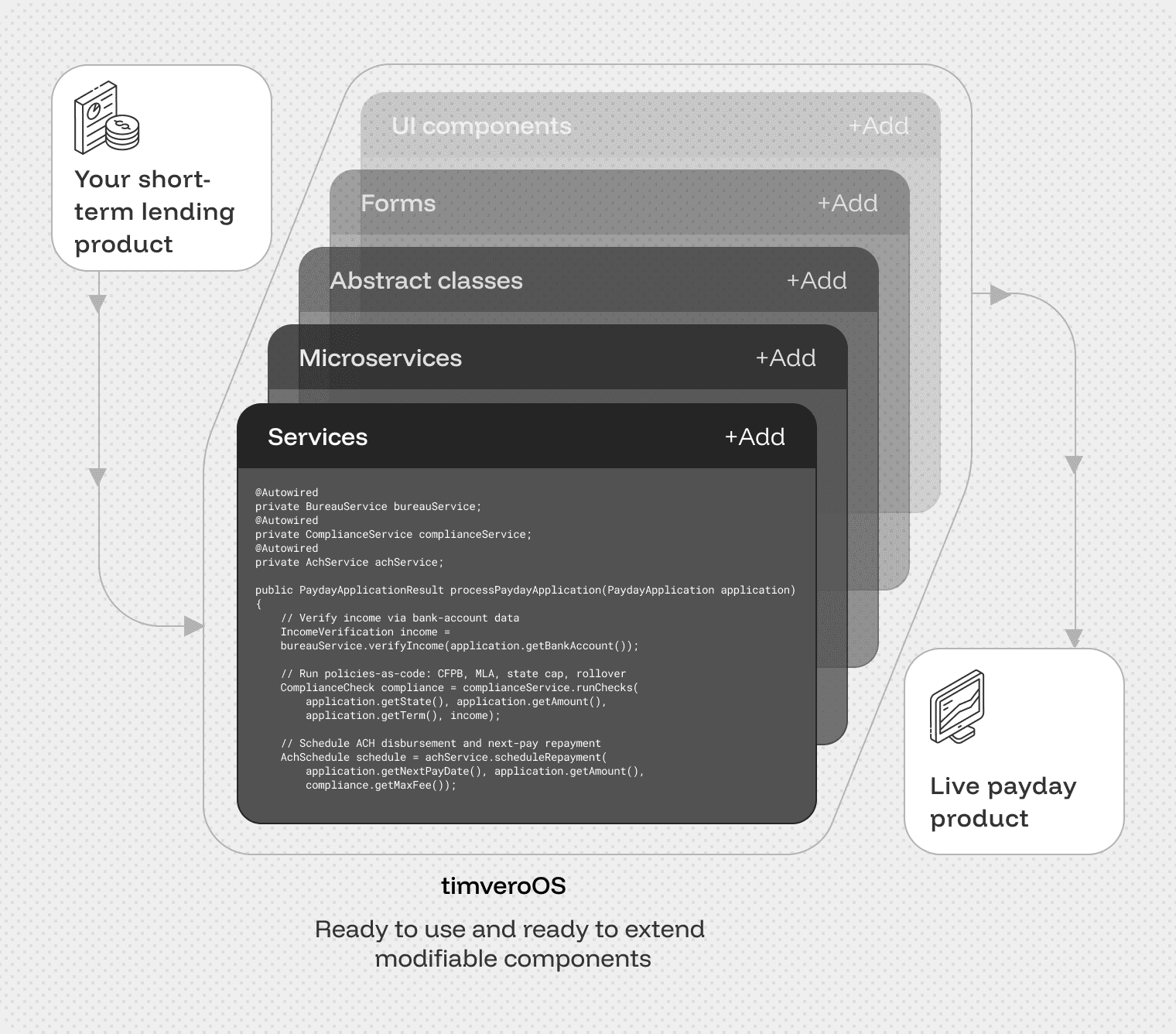
Short-term lending cycle on the Building Platform

Payday, cash advance, and PAL products run on cycles measured in days, not months. Generic loan management software treats them as installment edge cases — forcing workarounds, hidden compliance risk, and slow product launches across state-by-state rule fragmentation.

  • State-by-State Rule Changes Break the Roadmap

    Each rate-cap update, MLA test, or CFPB rule lands in vendor backlog. Your launches stall behind 50 other tickets.

  • PALs Program Economics Don’t Fit Per-User SaaS Pricing

    NCUA-compliant short-term lending should match member-to-staff ratios — not seat-count licensing models.

  • Audit Trails Depend on Vendor Configuration

    CFPB and state examiners want explainable decisioning. Most LMS platforms hide the logic behind a vendor permission gate.

  • Cycle Automation Requires Workarounds

    ACH disbursement, rollover detection, rate disclosures, and collections sequencing get bolted onto installment-loan schemas, not built natively.


2 Solution

Payday Loan Management Software on a Building Platform

Building blocks for short-term credit — origination, decisioning, ACH disbursement, collections, compliance — all configurable in the admin panel and extensible at the architectural level through the SDK. The same Building Platform powers payday, PAL, cash advance, EWA, and small installment products from a single source of truth.

  • Policies-as-Code Compliance

    CFPB Small Dollar Rule, state usury caps, MLA APR limits, and NCUA PAL requirements live as version-controlled policies — not vendor configuration. Update a rule, run shadow mode against historical decisions, deploy with a full audit trail.

  • XAI Scoring Engine

    Explainable AI scoring as a Building Platform building block — separate from timveroAI, part of the Advanced Analytics capability. Every decision factor is traceable; every adverse action notice references the model output. Examiner-ready by design — no vendor black box.

  • Short-Cycle Workflow Native

    Cycle-day accruals, same-day ACH and RTP disbursement, rollover detection, EFTA/Reg E authorization tracking, and collections sequencing are first-class building blocks — not installment workarounds bolted onto a generic schema.

  • Multi-Product, Multi-Jurisdiction

    Run payday, PAL, cash advance, EWA, and small installment from the same Building Platform. State-by-state, country-by-country, with a single source of truth across product lines and credit bureaus.

timveroAI

Implementation in Weeks, Not Quarters

Controlled, RAG-grounded implementation agent built on Claude Code — composing 70–80% of your configuration.

Short-term lenders need to move fast: launch in a new state, swap a credit bureau, ship a CFPB rule update across the policies-as-code layer. timveroAI handles the implementation work — composing entity definitions, policies, workflows, and integrations on the Building Platform — with shadow-run validation before any change goes live.

Explore timveroAI
  • Asks Clarifying Questions

    timveroAI asks clarifying questions like a senior product owner — not pattern-matches. When the agent doesn’t know something about your business model, it asks rather than guesses.

  • Configuration Synthesis

    Composes Building Platform configurations from natural-language requirements — entities, state machines, policies, workflows, and integrations. RAG-grounded on actual BP source code.

  • Shadow-Run Validation

    Every AI-composed change runs in shadow mode against historical data before going to production. Compliance approves diffs — not vendor black boxes.

  • Human-in-the-Loop Control

    User approval gate at the architecture checkpoint, before code generation begins. Engineers review, edit, and extend — code-level access is preserved.

  • 70–80% Implementation Work Composed by AI
  • 2–6 wks From Kickoff to First Deployment
  • 10× Faster Than Traditional Builds
  • <1 wk Initial Up-and-Run on Skeleton
4 Customer Stories

Lenders Running Short-Cycle Products on timveroOS

From consumer credit automation to bank-grade origination speed and non-standard advance products, timveroOS clients ship lending products in weeks and operate them at scale across 13+ countries.

Faster Origination
95% Automation Achieved

Three Vendors Stalled. The Building Platform Shipped.

After three failed attempts with two vendors, AMIO launched guarantor lending on timveroOS in 6 months — 8× faster, 95% automation. Every credit decision is explainable, every policy a reviewable building block.

AMIO Bank Leadership

Mid-Market Commercial Bank

Read Full Story

Other Lenders on timveroOS

  • 98% Of Credit Decisions Automated

    Finom

    EU EMI serving 200K+ SMEs across 4 countries automated 98% of credit decisions on timveroOS in 7 months.

    Read Full Story
  • 90% Lower Total Cost of Ownership

    Cartiga

    US litigation-finance lender deployed $1.6B+ in advances. 8-week MVP, 90% lower TCO vs the prior platform.

    Read Full Story
5 Architecture Choice

SaaS vs Building Platform vs Custom Development

Short-term lenders typically choose between three architectures. Each carries different tradeoffs across speed, control, regulatory configurability, and total cost of ownership.

SaaS LMS

Pros

  • Fast install, low IT overhead
  • Vendor-managed updates
  • Predictable monthly subscription

Cons

  • Roadmap is the vendor’s, not yours
  • No code-level access to logic
  • Multi-tenant data and shared infra
  • Per-user pricing breaks PAL economics
  • Compliance hidden behind vendor config

Custom Development

Pros

  • Full architectural control
  • Owned codebase from day one
  • Tailored to your business model

Cons

  • 12–18 months to first launch
  • $2–5M typical build cost
  • Carry full maintenance forever
  • Hire and retain the entire stack
Lending solution on a Building Platform
6 The Resolution

AI brings the speed. The Building Platform brings the trust.

Together, they deliver bespoke lending systems for regulated institutions — without forcing you to choose between fast and compliant.

  • Speed

    2–6 weeks live with timveroAI

  • Trust

    Policies-as-code with full audit trail

  • Together

    One Building Platform — no architecture trade-off

7 Compliance & Integrations

Compliance Trust Markers and Short-Term Lending Integrations

Building Platform deployments operate under CFPB, OCC, NCUA, FCA, and provincial Canadian regulators. The integration layer covers credit bureaus, ACH/RTP rails, KYC, EWA partners, and core banking — 90+ ready connectors with custom integrations through the open SDK.

  • CFPB & State-by-State Rule Configurability

    Small Dollar Lending Rule provisions, state usury caps, rate-and-term disclosures, and EFTA/Reg E ACH authorization live as policies-as-code in payday loan management software running on timveroOS. Compliance teams approve diffs; engineering ships changes.

  • MLA, NCUA PAL, and Military Borrower Protections

    Military Lending Act 36% MAPR ceiling and NCUA Rule 701.21(c)(7)(iii) PAL requirements implementable as Building Platform policies. Suitable for credit unions running PAL I and PAL II programs alongside other short-term products.

  • Credit Bureaus and Alternative Data

    Equifax, Experian, TransUnion, plus alternative-data providers (bank-account data, utility, telecom) for thin-file decisioning. Bureau swaps configurable in the admin panel — not custom-coded.

  • ACH/RTP Rails and EWA Partners

    Same-day ACH, RTP, FedNow disbursement. Earned-wage access and bank-account-data integrations through the partner SDK. Open SDK for any custom integration not in the 90+ ready set.

8 FAQ

Common Questions About Payday Loan Software

Short answers to the questions short-term consumer lenders ask before evaluating a Building Platform like timveroOS.

Talk to Sales
  • What is payday loan software?

    Payday loan software is the technology stack a lender uses to originate, decision, disburse, service, and collect short-term, small-dollar consumer loans. timveroOS approaches it differently: instead of a closed SaaS product, it is a lending solution built on a Building Platform — 80% pre-built short-term lending capabilities, plus an open SDK to configure or extend the remaining 20%. Lenders own the code and the data, deploy on-prem or in their own cloud, and update CFPB and state-level rules as policies-as-code.

  • How is timveroOS different from a SaaS payday lending platform?

    Traditional SaaS payday platforms install fast, but the product roadmap belongs to the vendor and code-level access is limited or absent. timveroOS is built on a Building Platform: clients deploy in their own environment, configure short-term lending products in the admin panel, and extend through SDK at the architectural level. timveroAI composes 70–80% of implementation work, so a small fintech or credit union team can ship a payday or PAL product in 2–6 weeks without the 12–18-month timeline of pure custom development.

  • How long does it take to launch a payday or short-term lending product on timveroOS?

    Most short-term consumer credit launches on the Building Platform take 2–6 weeks from kickoff to first live deployment — about 10× faster than traditional builds. timveroAI composes the bulk of the configuration — entity models, policies, workflows, and integrations — and your engineering team reviews and extends those configurations through SDK. AMIO Bank launched guarantor lending in 6 months after three failed vendor attempts; Finom automated 98% of credit decisions in 7 months across four EU markets. Software for payday loan business launches typically fall inside this same window.

  • Does timveroOS support CFPB Small Dollar compliance and state-by-state rule variation?

    Yes. CFPB Small Dollar Lending Rule provisions, state usury caps, rate-and-term disclosures, EFTA/Reg E ACH authorization, and the Military Lending Act 36% MAPR ceiling all live as policies-as-code on the Building Platform. When a state caps the rate or a federal rule changes, compliance teams update the policy, run shadow mode against historical decisions, and ship the change with a full audit trail. This is the model payday loan management software needs to operate across fragmented US regulation — and it works the same way for FCA-regulated UK short-term credit and provincial Canadian payday rules.

  • Can credit unions use timveroOS for NCUA PAL programs?

    Yes. NCUA Rule 701.21(c)(7)(iii) requirements for PAL I and PAL II — application fee caps, term limits, rollover prohibitions, and documentation — implement as Building Platform policies. Credit unions running PAL alongside other short-term consumer products use the same payday lending software stack to manage all loan types from one admin panel. Pricing is portfolio-tiered, not per-user, so PAL economics work for credit unions with lean staff and high member-to-employee ratios.

  • Does timveroOS support cash advance and earned-wage access products?

    Yes. Cash advance payday loan software workflows, earned-wage access (EWA), and online payday loan software products all run on the same Building Platform. The integration layer includes payroll-data providers, bank-account-data partners, and same-day ACH/RTP/FedNow disbursement rails. Lenders launching EWA or non-recourse cash advance products configure the cycle, fee model, and disbursement logic in the admin panel; novel structures (e.g. tip-based or subscription-fee models) extend through the open SDK.

  • What integrations does timveroOS provide for ACH, RTP, and short-term lending workflows?

    The Building Platform ships with 90+ ready integrations: Equifax, Experian, and TransUnion for credit data; Plaid, Finicity, and MX for bank-account data; same-day ACH, RTP, and FedNow rails for disbursement and collection; KYC and identity-verification providers; payroll-data partners for EWA; and core-banking connectors for credit unions and banks. Custom integrations beyond this set go through the open SDK — typical effort is days, not vendor change requests.

  • Can we deploy payday loan software on-prem or in a private cloud?

    Yes. Clients of timveroOS deploy the Building Platform on-prem, in private cloud (AWS, Azure, GCP, or sovereign clouds), or in hybrid topologies. Code and data ownership stay with the lender — there is no vendor lock-in and no shared multi-tenant infrastructure. This is the model that works for compliance-sensitive deployments: NCUA-regulated credit unions, Tier 3–4 community banks running adjacent products, and lenders operating under data-sovereignty rules in the UK, EU, or Canada.

Launch Your Short-Term Consumer Lending Product on timveroOS

Configure payday, cash advance, PAL, or earned-wage access on a Building Platform with policies-as-code compliance, XAI scoring as a building block, and timveroAI implementation in 2–6 weeks. $5.5B+ managed, deployed across 13+ countries.