


AI Hallucinations in Lending Software: How to Stop Them
Ask a general-purpose AI copilot to configure a loan product and it will happily invent a field that doesn’t exist, cite an accrual method your platform never implemented, or reference a compliance rule from the wrong jurisdiction — all in fluent, confident prose. In a marketing draft, that’s an embarrassing typo. In a lending system, an AI hallucination is a financial control failure waiting to reach production. The question for any lender adopting AI is not “how smart is the model,” but “what stops it from being confidently wrong.” This is where the Building Platform beneath timveroOS changes the equation: instead of trusting a model’s memory, timveroAI is grounded in the actual source code, lending ontology, and working reference implementations it is allowed to touch.
That distinction — grounding, not cleverness — is the whole argument of this article.
The real cost of an AI hallucination in lending
Hallucination rates in high-stakes domains are not a rounding error. They are the headline finding.
A hallucinated field is a control failure, not a typo
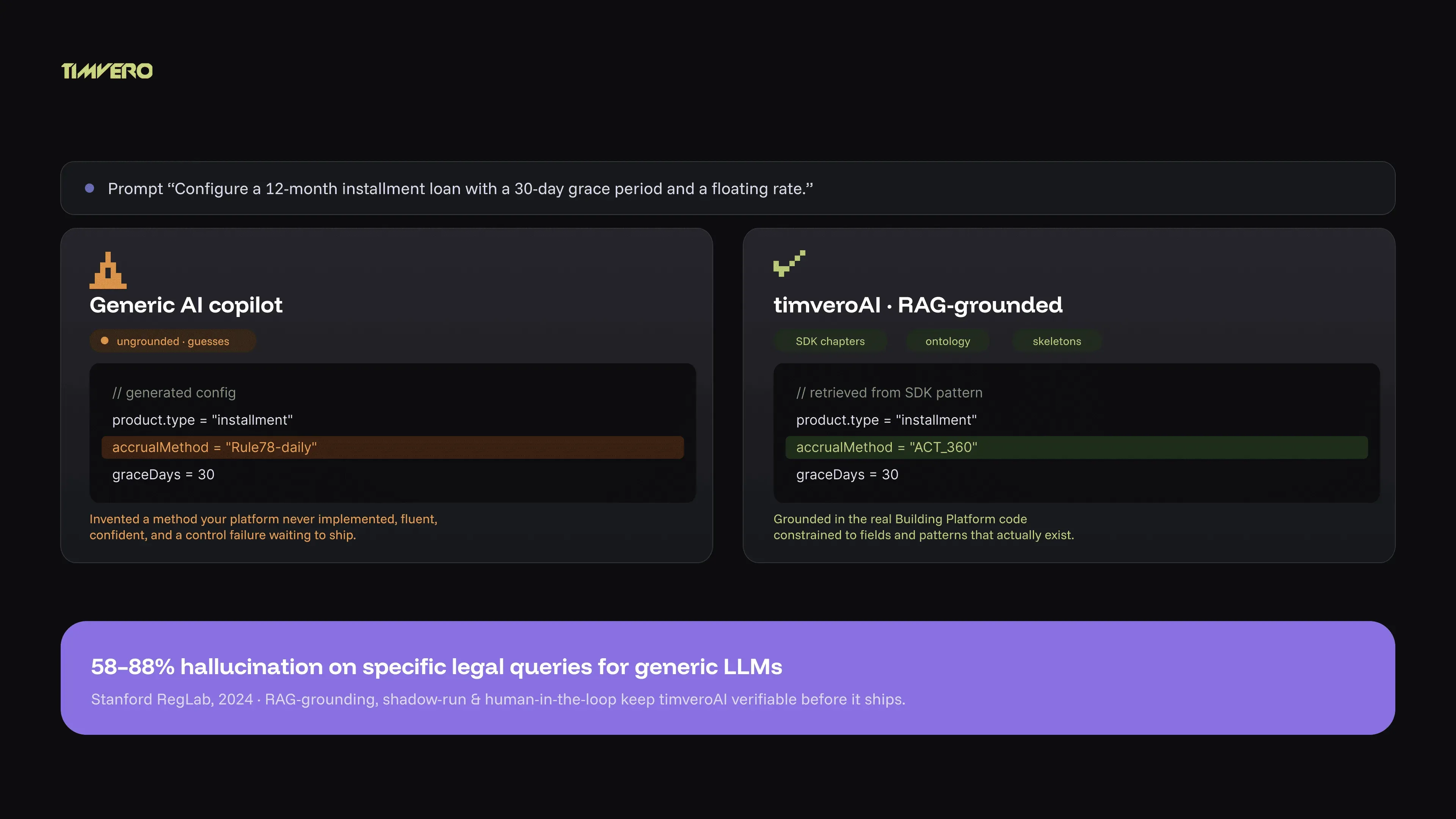
In a Stanford RegLab study of legal queries, general-purpose large language models produced hallucinations between 58% and 88% of the time when answering specific, verifiable questions about court cases (Dahl et al., Large Legal Fictions, 2024). Lending sits in the same category of risk: the output is only useful if it is verifiably correct against a body of rules, code, and regulation. A model that invents a day-count convention, a repayment trigger, or an IFRS 9 staging rule is not “mostly helpful” — it has introduced a defect into a system that moves money and reports to regulators.
The danger is that hallucinations are fluent. A fabricated field name reads exactly like a real one. Without a mechanism that checks generated output against what actually exists in your platform, the error propagates until a human — or an auditor — catches it downstream, where it is far more expensive to fix.
“Mostly right” does not pass audit
Enterprises are already feeling this. In McKinsey’s State of AI in 2025 survey, inaccuracy was the most commonly reported negative consequence of generative AI — affecting close to a third of organizations — yet only about a third of companies say they are actively working to mitigate it (McKinsey, 2025). That gap between exposure and control is the whole problem. For a Tier 3–4 bank evaluating lending software for banks (opens in new tab), or a regulated fintech comparing lending software for fintechs (opens in new tab), an AI change that is 90% correct is not 90% shippable — the 10% is precisely what compliance review exists to catch, and an opaque AI process makes that review harder, not easier.
The lesson is not “avoid AI.” It is that AI belongs inside lending systems only when its output is constrained, inspectable, and reversible before it goes live.
Why generic AI copilots hallucinate on lending systems
The reason a generic copilot hallucinates on your lending platform is structural, not a matter of model quality. It has no reliable knowledge of two things that matter most: your codebase and your domain.
No grounding in your codebase or your domain
A general-purpose copilot is trained on the public internet. It has never seen your platform’s entities, your state machines, your GL posting logic, or the specific way your accrual engine handles overdue interest. When asked to produce something specific, it fills the gap with a statistically plausible guess. That guess is the hallucination.
Retrieval-augmented generation (RAG) is the industry’s default answer — grounding a model’s output in retrieved, verified information rather than its memory. But grounding quality is everything. When Stanford researchers evaluated leading RAG-based legal research tools that marketed themselves as “hallucination-free,” they still hallucinated between 17% and 33% of the time (Magesh et al., Hallucination-Free?, 2025). The takeaway is not that RAG fails — it is that RAG over generic documents is not enough. The retrieval corpus has to be the actual system the AI is operating on.
The custom-build alternative just relocates the risk
The instinct is to keep AI away from the architecture and build everything by hand. But a custom in-house build is an 18–24 month undertaking requiring a team of 8–15 engineers, and the correctness risk doesn’t disappear — it simply moves into human hands writing boilerplate under deadline pressure. Neither the rigid-SaaS path (configuration only, no architectural control) nor the from-scratch build path solves the underlying problem: keeping change fast and verifiably correct at the same time.
The Building Platform is the third path between rigid SaaS and an 18-month custom build — and it is the layer that makes AI grounding possible, because there is a real, structured system for the AI to be grounded in.
| How AI-generated change is handled | SaaS lending platforms | Custom build (in-house) | timveroOS Building Platform + timveroAI |
|---|---|---|---|
| How new logic is created | Vendor configuration only; no architectural change | Engineers hand-write from scratch | timveroAI composes existing building blocks via SDK |
| AI grounding source | None (or a generic bolt-on copilot) | None — human memory of the codebase | RAG over 33 SDK chapters, feature ontology, skeleton library |
| Risk of invented / hallucinated logic | N/A — you can’t change it | High under deadline pressure | Constrained to what exists in the platform |
| Pre-production safety check | Vendor-controlled, opaque | Manual QA only | Shadow-run mode before anything goes live |
| Human approval + audit trail | Limited visibility | Depends on team discipline | Human-in-the-loop gates + divergence detection |
| Who owns correctness | The vendor’s roadmap | Your team, entirely | Your team, with the AI constrained and inspectable |
How timveroAI stays grounded on the Building Platform
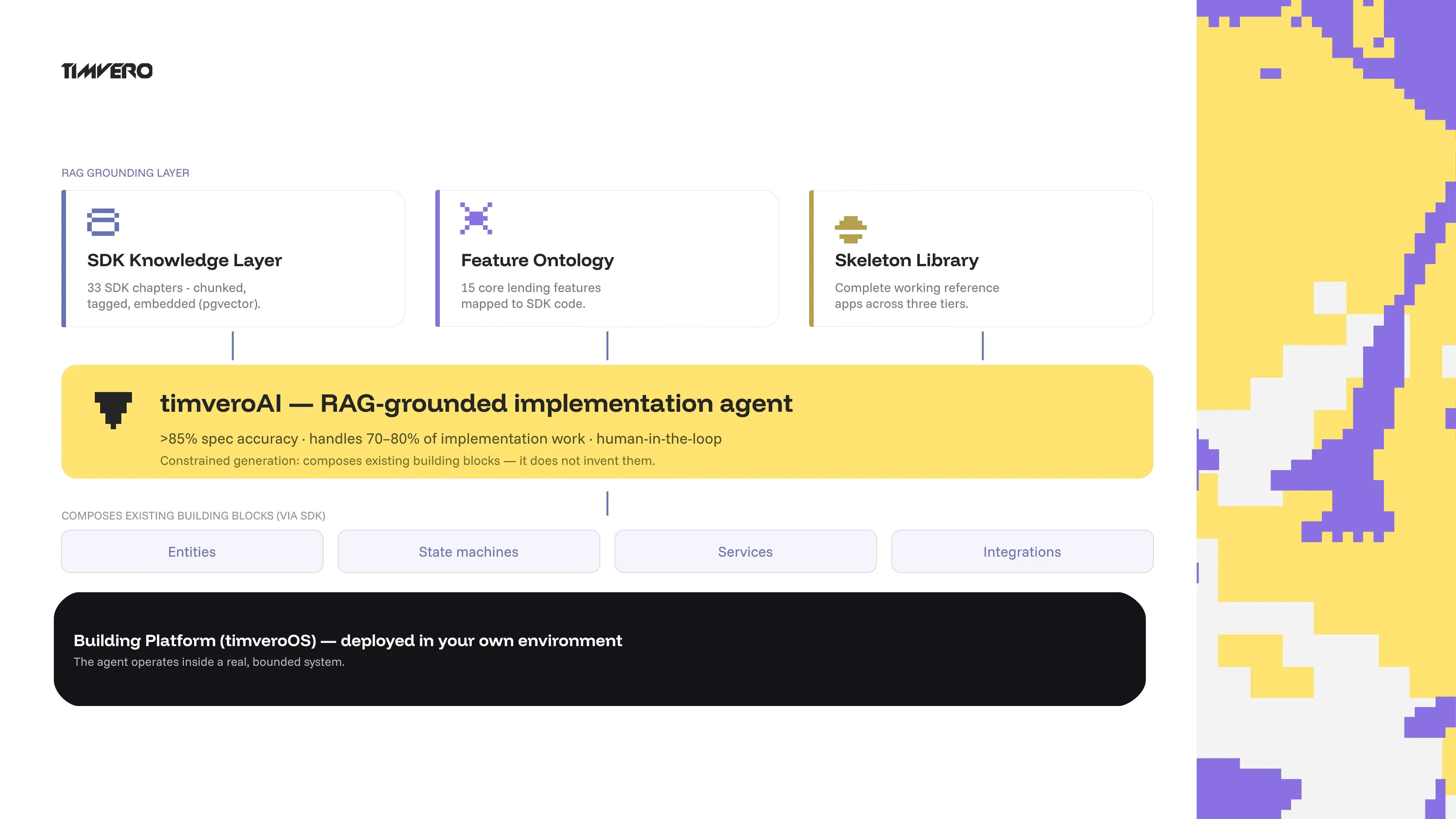
timveroAI is a RAG-grounded implementation and configuration agent — an acceleration layer that sits on top of the Building Platform. It is not a chatbot, not an autocomplete tool, and not a decision-maker. Its job is to compress the implementation work of building a bespoke lending product, and it does that by being grounded in three assets that generic copilots simply do not have.
RAG over the actual source code, ontology, and reference library
timveroAI retrieves from the system it is building on, not the open web. Three grounding assets make that possible:
The knowledge layer embeds 33 SDK documentation chapters — chunked, tagged, and stored in a vector database for retrieval — so the agent answers from your platform’s real patterns. The feature ontology encodes more than a decade of lending expertise as machine-readable data: 15 core lending features mapped to their SDK implementations, so the agent understands leasing, factoring, and covenant tracking as structured domain knowledge rather than guessing. And the skeleton library is a set of complete, battle-tested reference applications the agent matches against — it deploys a working starting point, then explains exactly what to adapt.
Because retrieval is bound to real SDK patterns and working code, the agent’s output is anchored to what the platform can actually do. The result shows up in the numbers: timveroAI generates specifications with greater than 85% accuracy and handles 70–80% of implementation work, while engineers own the business logic that requires judgment.
Constrained generation: composing blocks, not inventing them
The deepest defense against hallucination is architectural. timveroAI does not write a lending system from a blank page — it composes the Building Platform’s existing building blocks: entities, state machines, services, and integrations. When a developer opens a task, four Model Context Protocol servers load the live context — the specification, the relevant SDK pattern, and a matching skeleton example — directly into the IDE (the agent runs on Claude Code or any MCP-enabled environment).
This is code-level access to the architectural layer, the differentiator that separates a Building Platform from configuration-only SaaS. The agent operates inside a real, bounded system, so “invent a plausible field” is replaced with “retrieve the field that exists.” Grounding stops most hallucinations before they are ever generated.
When grounding isn’t enough: shadow-run and human-in-the-loop
No responsible lender should rely on grounding alone — the Stanford RAG findings prove that even good retrieval leaves residual error. The Building Platform assumes some output will still be wrong and puts two safety mechanisms in the path of every AI-generated change.
Shadow-run mode
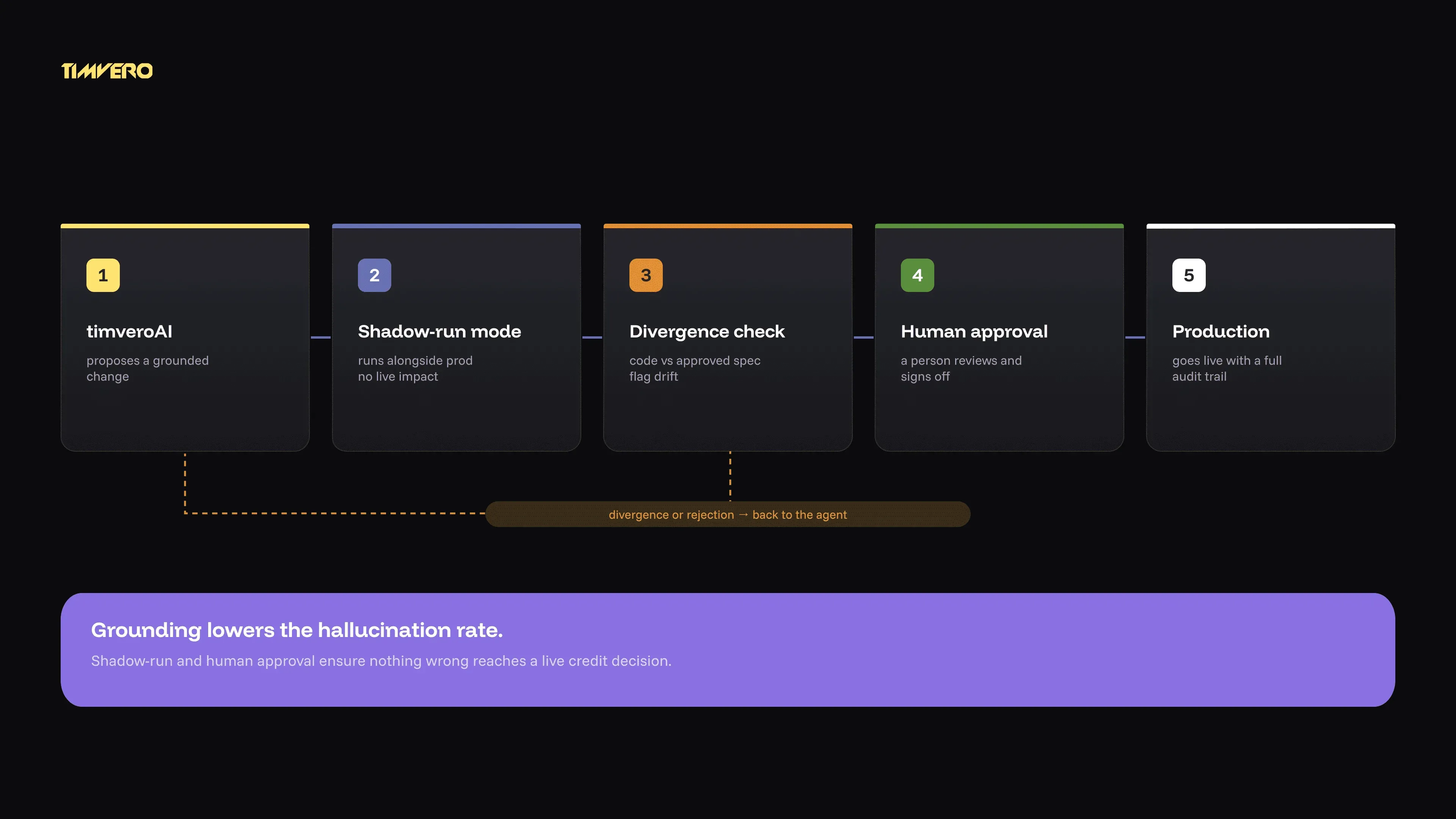
timveroAI-generated changes run in shadow-run mode before they go live: the new logic executes alongside production without affecting real decisions or customers, so the team can compare behavior and catch divergence in a safe environment. Shadow-run is the mechanism that turns “the AI proposed this” into “we verified this against real behavior before trusting it.” Generic AI copilots have no equivalent, because they do not operate inside a lending system’s architectural layer.
Human-in-the-loop gates and divergence detection
Every change passes through human-in-the-loop approval gates — a person reviews and approves before anything reaches production. The agent reinforces this with divergence detection: when the implemented code drifts from the approved specification, it raises a warning rather than silently accepting the gap. The full decision history stays in context, so the audit trail of what changed, why, and who approved it is a byproduct of the workflow, not an afterthought.
Grounding reduces the hallucination rate; shadow-run and human approval ensure that whatever slips through never reaches a live credit decision unreviewed.
One clarification: timveroAI does not make credit decisions
Because this article is about AI accuracy, it is worth being precise about scope. timveroAI is the implementation agent — it helps engineering and business-analyst teams configure and build the platform. It does not make credit decisions. Runtime lending decisions are handled by a separate component, the XAI scoring engine, which produces explainable decisions with transparent reason codes at origination and servicing. The two must never be conflated: timveroAI hallucinating a field during a build and a scoring model making a lending decision are entirely different systems with entirely different controls. This article concerns the first.
What this looks like in production
The grounding-plus-gates approach is not theoretical. It is how bespoke products already run on timveroOS across $5.5B+ in assets under management in 13+ countries, processing 7,000+ daily loan applications.
Cartiga, a litigation-finance lender, replaced a Salesforce build with timveroOS at 10–12% of the cost and reached an MVP in eight weeks — for a product with non-standard repayment schedules and balloon logic that no SaaS platform could support.
“timveroOS has become the core engine behind our law firm lending business. Its framework allowed us to build sophisticated workflows, pricing, and collateral logic per our bespoke structures — something no SaaS or traditional LMS could offer.”
— Noah Cutler, Senior Vice President, Cartiga
Cartiga’s leadership describes the platform in their own words — and the word “framework” is theirs — but the mechanism underneath is the Building Platform: real building blocks the team could extend, with AI-generated work constrained to what those blocks support. Finom saw the same pattern building a proactive SME credit line across five EU markets, reaching 98% process automation with banking-grade origination live in four months.
“What impressed me most was their ability to work at our pace, absorbing requirements on the fly, proposing solutions proactively, and adapting as our needs evolved. Today, we’re running proactive credit campaigns and sophisticated servicing operations on a single platform. timveroOS delivered a competitive advantage under impossible deadlines.”
— Alex Goncharenko, Head of Credit, Finom
Speed and correctness are not in tension here. Grounding is what lets timveroAI move fast — compressing bespoke launches from 4–6 months to 3–6 weeks — without the from-scratch build’s exposure to human error, and without the generic copilot’s exposure to invention.
Frequently Asked Questions
What is an AI hallucination in lending software?
An AI hallucination is confident, fluent output that is factually wrong — an invented field, a fabricated rule, or a non-existent code pattern. In lending software it is a control failure, because the generated logic affects money movement, servicing, and regulatory reporting rather than just text.
Does RAG eliminate AI hallucinations?
No. RAG reduces hallucinations by grounding output in retrieved information, but it does not eliminate them. A Stanford study found leading RAG-based tools still hallucinated 17–33% of the time. Grounding must be on the actual system, and paired with pre-production checks and human review.
How does timveroAI avoid hallucinating on a lending platform?
timveroAI retrieves from the Building Platform’s real assets — 33 SDK chapters, a lending feature ontology, and a skeleton library of working applications — and composes existing building blocks rather than inventing logic. Its specifications reach greater than 85% accuracy, with humans owning business logic.
What is shadow-run mode?
Shadow-run mode executes an AI-generated change alongside production without affecting real decisions or customers. The team compares behavior and catches errors in a safe environment before anything goes live. It is a pre-production safety check that generic AI copilots cannot provide.
Does timveroAI make credit decisions?
No. timveroAI is an implementation and configuration agent for building and maintaining the platform. Runtime credit decisions are handled by a separate XAI scoring engine that produces explainable, transparent decisions. The two systems are distinct and must not be conflated.
Is AI safe to use in regulated lending?
It can be, when its output is constrained, inspectable, and reversible. That means grounding the AI in the real system, running changes in shadow mode, requiring human-in-the-loop approval, and keeping a full audit trail — the kind of controls responsible-AI practice calls for in regulated environments.
See How Grounded AI Works on Your Product
If you’re evaluating AI for a lending build, the question that matters is what stops it from being confidently wrong — grounding, shadow-run, and human approval, not model hype.
Request a demo → (opens in new tab) to see timveroAI configure a bespoke lending product on the Building Platform, or explore timveroAI (opens in new tab) and the timveroOS loan management platform (opens in new tab) in more depth.

Head of Marketing
Ivan Halynkin leads Growth & Marketing at TIMVERO, the company behind timveroOS and timveroAI. He works across the seam between product and demand — translating composable lending infrastructure into positioning, content, and demos that resonate with banks, credit unions, and fintechs. His writing focuses on what actually moves the needle for digital lenders: origination economics, AI in credit decisioning, and the trade-offs between SaaS lending boxes and building-platform thinking.
LinkedinLatest News
Generative AI in Banking: Where It Works and Where It Can’t
How AI Is Transforming Lending in 2026: Platforms, Automation, and What Actually Works
AI Agent vs Credit Scoring: The Two Layers of Lending AI
The 2–3 Year Window: What Banks Lose by Waiting on AI
The AI Banking Efficiency Gap: Why It Compounds and Who Wins

Fraud Prevention in Digital Lending: How AI Is Reshaping the Battle in 2025–2026
Conversational AI in Banking: What It Should Answer

AI in Banking: A 2026 Guide to Value, Risk, and Scale

Launch a Loan Product Fast: What AI Actually Changes