



Shadow-Run Mode: How AI Changes a Live Lending System Safely
By now the argument for AI at build-time is mostly won. An implementation agent that assembles and changes a lending system in days instead of quarters is no longer a curiosity — it is the reason implementation timelines are collapsing across the industry. The question we hear next is the right one, and it is operational, not philosophical: what happens when the AI changes something on a system with money in flight?

A lending platform is not a website you can quietly redeploy. Every configuration change touches repayment schedules, accruals, and ledger postings that are live right now. Shadow-run mode is how a programmable Building Platform like timveroOS answers that question — and this article explains the mechanics: what a shadow run actually executes, what it compares, what counts as a divergence, and why nothing reaches production without a named human signing off. The rule we hold to across this series stays unchanged: AI for speed, deterministic logic for the decision. Shadow-run mode is what makes the speed part safe.
Executive summary
- A lending system is always live. Every change touches money in flight — which is why under-tested change, not AI, is the original sin. TSB’s 2018 migration of a live banking system ended in a £48.65M regulatory fine and 225,000 customer complaints, and AI raises the stakes by multiplying how often the system changes.
- Shadow-run mode is a control, not a feature. An AI-generated change is executed against real data flows and observed — schedules, accruals, GL postings, state transitions compared against current system behaviour — while production remains untouched.
- It is the lending version of a pattern engineering already trusts. Shadow deployments in machine learning, parallel runs in system migrations, champion–challenger in credit strategy: the practice is proven; applying it to AI-generated configuration is the new part.
- Do not confuse it with “shadow AI.” Shadow AI is ungoverned AI use inside an organization — the disease. Shadow-run mode is governance by construction — the cure. The names collide; the concepts are opposites.
- It is also your audit answer. With agentic AI now outside US model-risk scope, examiners ask how you govern it instead. A divergence-test → shadow-run → human-approval trail is a demonstrable answer, produced as a by-product of normal operation.
A lending system is always live
The reason “just deploy it” is not a strategy in lending has nothing to do with AI. A lending system is a live financial machine: at any moment it is accruing interest, collecting payments, posting to the general ledger, and moving loans through delinquency states. A change that would be routine in most software — a new parameter, an adjusted schedule rule, a rewired integration — lands on top of contracts that are executing while you deploy.
The cost of getting this wrong is not hypothetical. When TSB migrated its live banking platform in April 2018, the under-tested change disrupted branch, telephone, online and mobile banking for a significant share of its 5.2 million customers. The regulators’ post-mortem found testing that was cut short and infrastructure that was never exercised at load before go-live. The bill: a combined £48.65 million fine from the FCA and PRA, more than 225,000 customer complaints, and £32.7 million in redress (FCA, 2022 (opens in new tab)). That was one change, made once, by humans.
Now put an implementation agent into the picture. The whole point of build-time AI is that the system changes far more often — timveroAI (opens in new tab) turns work that sat in an engineering backlog for months into changes proposed in minutes. That is the value, and it is also the new risk profile: change velocity goes up by an order of magnitude, so the control around change has to scale with it. A manual test cycle that took six weeks per release cannot govern an agent that proposes six changes a day. The control has to be structural.
What shadow-run mode is — and what it is not
Shadow-run mode (definition). Shadow-run mode is a deployment control in which an AI-generated system change is executed against real data flows in parallel with the current system, without affecting production. Its outputs are compared against current behaviour, divergences are flagged and resolved, and the change reaches production only after human approval.
The concept deserves a precise definition because the words around it are getting crowded — and one collision in particular is worth clearing up immediately.
Shadow-run mode is not “shadow AI”
If you search for “shadow” and “AI” in banking, almost everything you find describes shadow AI: employees and teams using AI tools without approval, evaluation, or supervision — models quietly summarising customer data, unapproved copilots writing code that ships. It is one of the fastest-growing governance headaches in financial services.
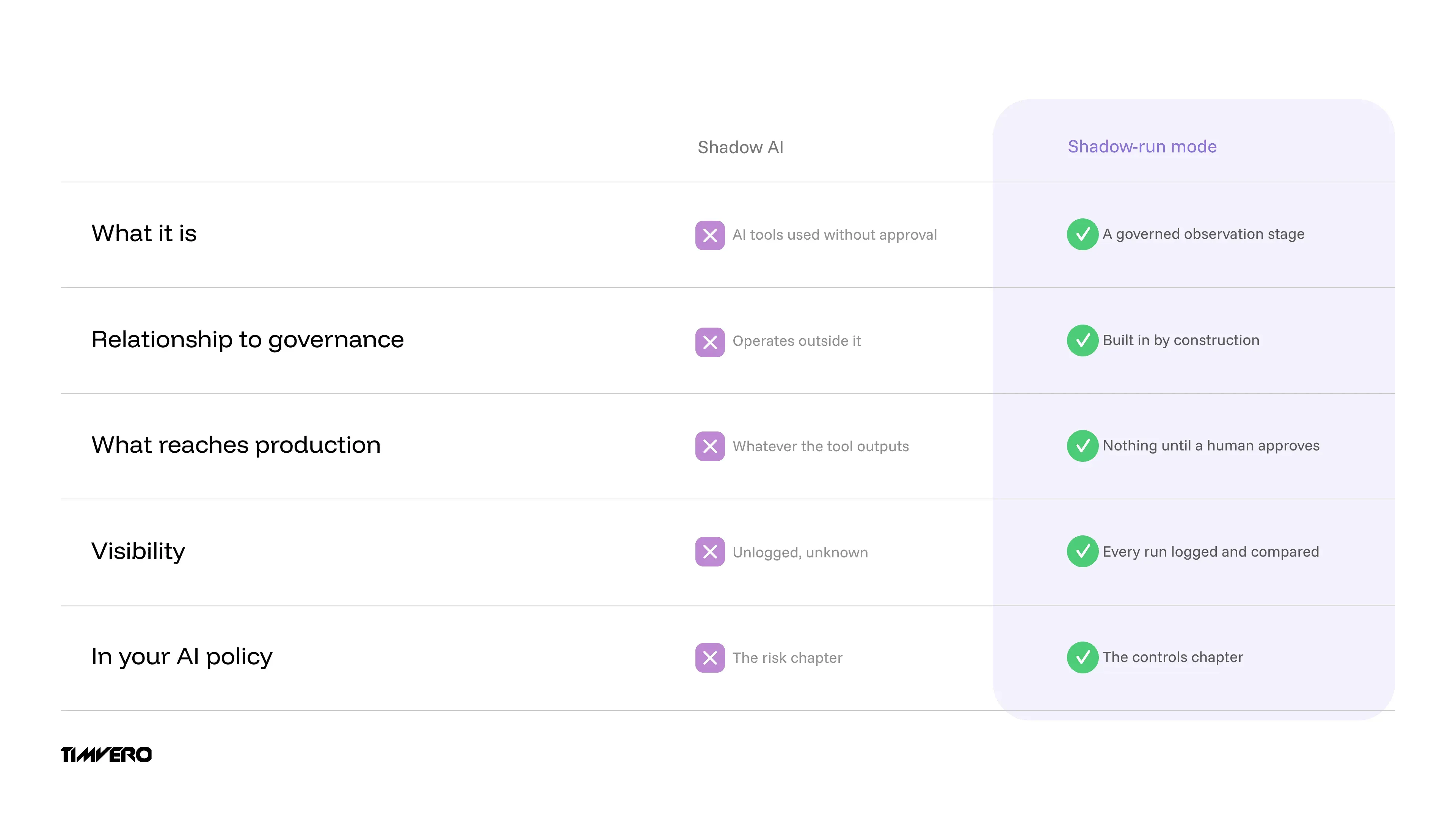
Shadow-run mode is the opposite concept wearing a similar name. Shadow AI is what happens when AI operates outside governance. A shadow run is governance by construction: the AI’s output is forced through an observation stage where it can be watched, measured, and rejected before it acts on anything real. One is the disease; the other is part of the cure. If your institution is drafting an AI policy, the two belong in different chapters.
Engineering already trusts this pattern
The second thing shadow-run mode is not: exotic. Running a new system in parallel with the old one and comparing outputs is one of the most trusted patterns in engineering. Machine-learning teams call it a shadow deployment — the challenger model receives production traffic and its predictions are logged but never acted on; AWS ships this as a named capability, shadow testing, in SageMaker (AWS, 2022 (opens in new tab)). Bank migration programmes have run old and new platforms side by side — the parallel run — for decades. And credit teams have used champion–challenger to trial a new decision strategy against the incumbent on live volume since long before anyone said “agentic.”
What is new is the object being shadowed. In those established patterns, the thing under observation is a model or a whole platform. In shadow-run mode on a Building Platform, the thing under observation is an AI-generated configuration change — a new product’s repayment logic, an adjusted grace period, a rewired data integration. The pattern is inherited; the application to build-time AI is the part the market has not caught up with yet.
How a shadow run works on a Building Platform
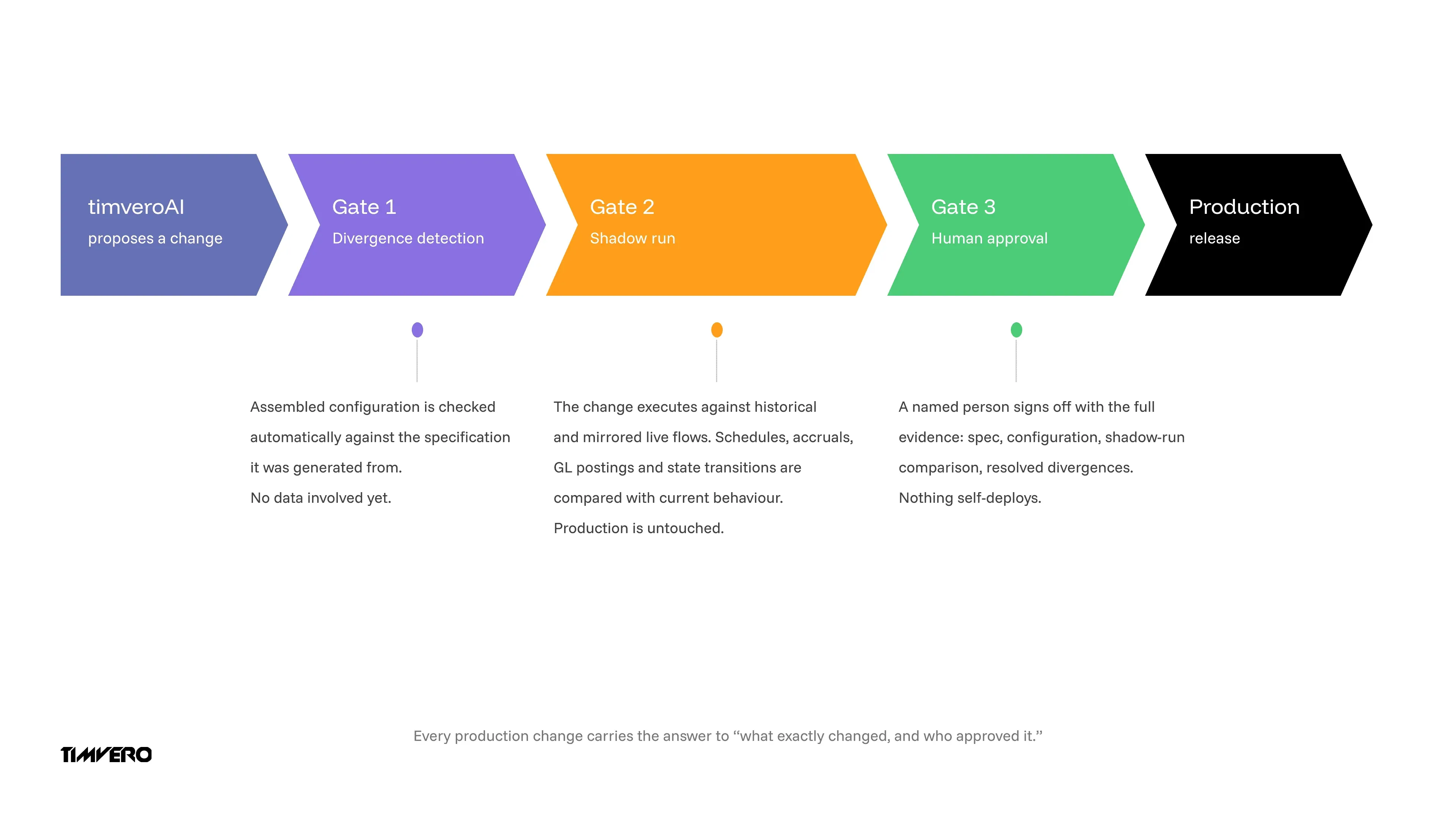
On timveroOS, shadow-run mode is the middle of three gates that every timveroAI-generated change passes before production. We introduced the gates in our piece on the two layers of lending AI (opens in new tab); here is the machinery in full.
Gate one: divergence detection. Before anything runs, the assembled configuration is checked automatically against the specification it was generated from. If the analyst asked for a 12-month installment product with a 30-day grace period and the assembled state machine says otherwise, the discrepancy is flagged here — spec versus configuration, no data involved yet.
Gate two: the shadow run. The generated configuration is then executed against real flows — historical portfolio data and mirrored live activity — in parallel with the current system. This is the stage that answers the question a sandbox cannot: not “does it work on the cases we thought to write,” but “what does it do with the cases this portfolio actually produces.” The comparison is concrete: payment schedules the new configuration generates versus the schedules the current system generates; accrual calculations; GL postings; state-machine transitions on delinquency and restructuring paths. Production is untouched — borrowers, balances, and ledgers never see the shadow system’s output.
What counts as a divergence, and what happens to it. Any place the shadow output differs from current behaviour — a schedule that shifts by a day, an accrual that rounds differently, a posting that lands in another account — is logged and classified. Intended differences (the change is supposed to alter behaviour) are confirmed against the spec. Unintended ones go back to the agent or an engineer to resolve, and the shadow run repeats. Nothing self-approves.
Gate three: the human approval gate. Only after the shadow run is clean does the change reach a named person for sign-off, with the full evidence in front of them: the spec, the generated configuration, the shadow-run comparison, the resolved divergences. Explainability at this layer means something different from the decision layer — not “why was this borrower declined,” but “what exactly changed, and who approved it.” Every production change on the platform has that answer attached.
Two architectural details make this trail worth more than a process diagram. Because timveroAI is a RAG-grounded implementation agent operating on a pre-validated framework, the shadow run is comparing configurations of known building blocks — not auditing novel machine-written code. And because the timveroOS platform (opens in new tab) deploys in your own environment, the shadow-run logs and approval records live where you can produce them on your own schedule — yours to inspect, not a vendor’s to summarise.
What shadow-run mode answers for the regulator
We covered the 2026 regulatory reset in depth in our audit-survival guide (opens in new tab); the short version matters here. When US supervisors rescinded SR 11–7 in April 2026, they explicitly carved generative and agentic AI out of model-risk scope and pointed institutions toward alternative governance frameworks. That is not a free pass — it moves the examiner’s question from “show me your model validation” to “show me how you govern this, then.”
Shadow-run mode is a demonstrable answer. An agent whose every change passes divergence testing, a recorded shadow run against real flows, and a named human approval is an agent governed as software change — the framework regulators can recognise and inspect. The evidence is not assembled for the exam; it accumulates as a by-product of how changes ship. In the EU, where creditworthiness AI remains high-risk under the AI Act (with the standalone deadline now moved to December 2027), the same trail feeds the human-oversight and logging obligations. No regulator mandates a shadow run by name. What they require is that you can explain and control your AI — and this is what that looks like in practice, at build-time.
What this unlocks: change velocity without change risk
The point of all this machinery is not caution for its own sake. It is that safety is the precondition for speed. The reason most lenders change their systems slowly is not that engineering is slow — it is that every change carries live-book risk, so process grows around change like scar tissue. Remove the risk structurally and the process can shrink.
That is exactly the effect the platform’s numbers describe: 80% reduced time-to-change and 5x lower cost-to-change, with 100% explainability on what changed and who approved it (timveroAI (opens in new tab)). Work that waited in a development backlog because engineering would not pick it up gets proposed by the agent in minutes, shadow-tested against the real portfolio, and approved the same day. Product owners and analysts test new credit-product concepts themselves — configured, shadow-run, and handed to the business for a decision — instead of writing requirements documents that queue for a quarter.
For proof that the pattern holds at production scale: Finom runs a banking-grade lending operation on timveroOS that launched in four months and reaches 98% process automation — build-time speed on a live system whose changes stay observed and approved (Finom case study (opens in new tab)). For a bank weighing the same move, this is the operating model that makes AI on a live lending stack (opens in new tab) survivable: velocity where it pays, control where it counts.
“Nobody’s real fear is that AI writes a bad configuration — drafts are cheap to fix. The fear is that a bad configuration reaches a live loan book. Shadow-run mode is our answer to that fear: the change proves itself against your real flows, next to your real system, and a person you trust signs the release. Once that control is structural, speed stops being a risk decision.”
— Dmitriy Wolkenstein, CEO, TIMVERO (quote pending approval)
How the agent’s output stays grounded in the first place — why a RAG-grounded agent does not hallucinate a product structure that never existed — is the other half of the safety story, and it is the subject of our next piece.
Frequently asked questions
What is shadow-run mode in lending AI?
Shadow-run mode is a deployment control for AI-generated system changes. The change is executed against real data flows — payment schedules, accruals, ledger postings — in parallel with the current system, without affecting production. Divergences are flagged and resolved, and the change goes live only after a named human approves it.
How is shadow-run mode different from shadow AI?
They are opposites sharing a word. Shadow AI means AI tools used inside an organization without approval or oversight — a governance failure. Shadow-run mode is a governance mechanism: it forces an AI’s output through an observed, non-production run and a human approval gate before anything real is touched.
How is a shadow run different from testing in a sandbox?
A sandbox runs synthetic cases someone thought to write; a shadow run executes against the flows your portfolio actually produces, including the edge cases nobody scripted. Comparing the new configuration’s schedules, accruals, and postings against current system behaviour on real data is what surfaces the divergences synthetic tests miss.
Does shadow-run mode slow down releases?
No — it replaces slower controls rather than adding to them. The shadow run and divergence checks are automated, so observation happens in hours, not test-cycle weeks. The result on timveroOS is 80% reduced time-to-change: changes ship faster precisely because the safety argument is produced mechanically instead of manually.
Do regulators require shadow testing for AI-generated changes?
Not by name. US supervisors moved generative and agentic AI outside model-risk scope in 2026 and expect institutions to govern it through alternative frameworks; the EU AI Act requires human oversight and logging for high-risk credit AI. A divergence-test, shadow-run, and approval trail is a concrete way to demonstrate exactly that.
Can timveroAI change a production system without human approval?
No — by construction. Every timveroAI-generated change passes three gates before production: automated divergence detection against the specification, a shadow run against real data flows, and a human-in-the-loop approval by a named person. The agent proposes and proves; a human releases. Nothing self-deploys.
See a shadow run in action
The fastest way to trust the mechanism is to watch it: a change proposed in plain language, shadow-tested against a real portfolio, and approved — while production never blinks. Request a demo → (opens in new tab)
-rsbxq-400x250.webp)
CEO at TIMVERO
Dmitriy Wolkenstein is the CEO of TIMVERO, leading the team building timveroOS and timveroAI. He writes about why the next generation of lending will be won at the infrastructure layer — and what it takes to get there.
LinkedinLatest News

Launch a Loan Product Fast: What AI Actually Changes
AI Hallucinations in Lending Software: How to Stop Them
Agentic AI in Banking: What It Can and Cannot Decide
Generative AI in Banking: Where It Works and Where It Can’t
Bank Efficiency Ratio: What It Is and How to Improve It
How to Implement AI in Lending and Pass a Regulatory Audit
Loan Origination Software: The Entity-Centric Architecture Explained

Lending Software Beyond SaaS vs Build: The Third Path
How AI Is Transforming Lending in 2026: Platforms, Automation, and What Actually Works