











Book a Demo
For Payment Companies

Embedded Lending Platform for Payment Companies and Platforms

timveroOS lets payment companies and platforms run merchant financing on their own payment data, with their own offers, pricing and margin. Your first product goes live in 3 weeks, each next credit product in 1 week, and changes to an existing product take days.

Embedded Lending Platform
  • 20 lending products live
  • 13+ countries
  • 3 wks to the first product live
  • 5.0 ★ rating on Capterra
1 Basics

What Embedded Lending Is and How It Works

Embedded lending puts credit directly inside the platforms merchants already use, turning daily payment flows into instant financing and automated repayments. The underlying software manages data, decisions, contracts, and servicing across four core roles:

  • The Platform

    Owns the merchant relationship and the data, and places the offer in its product.

  • The Lending Software

    Runs the credit process from application to repayment.

  • The Capital

    Comes from the platform’s balance sheet, a funding facility or a capital partner.

  • The Licence Holder

    Extends the credit: the platform itself, a partner bank or a lender of record.

2 Models

Embedded Lending, White Label Lending and Capital Partners: What You Control in Each

A capital partner program starts quickly and suits a test. Once financing becomes a revenue line, control over offers, data and margin decides the economics. Compare the technical options in our guide to embedded lending APIs.

Capital Partner ProgramVendor-Hosted White Label PlatformEmbedded Lending on timveroOS
Who Sets Offers and Pricing The partnerYou, within the vendor’s product options
Whose Data Drives Decisions Mostly the partner’s modelYour data, mapped to the vendor’s schema
Who Keeps the Margin Shared, partner-ledYou, minus platform fees
Where the Software Runs Partner systemsVendor cloud
Who Owns the Code and Configuration The partnerThe vendor
Capital Partner balance sheetYours or a funder’s
3 Control

Why Payment Companies Take Merchant Financing In-House

  • Partners Dictate Terms and Keep the Margin

    Partner programs enforce third-party credit rules and take the upside. On timveroOS, your team sets eligibility, pricing, and limits directly.

  • Sales Drop and Operations Hear Late

    When merchant processing volume falls, repayments shrink unnoticed. timveroOS recalculates loans nightly and flags metric breaches automatically.

  • Lending Drains Core Engineering Capacity

    Building in-house diverts developers from payments. timveroOS provides pre-built logic, while timveroAI drafts custom rules for your team to approve.

4 Origination

Merchant Financing on Your Own Payment Data

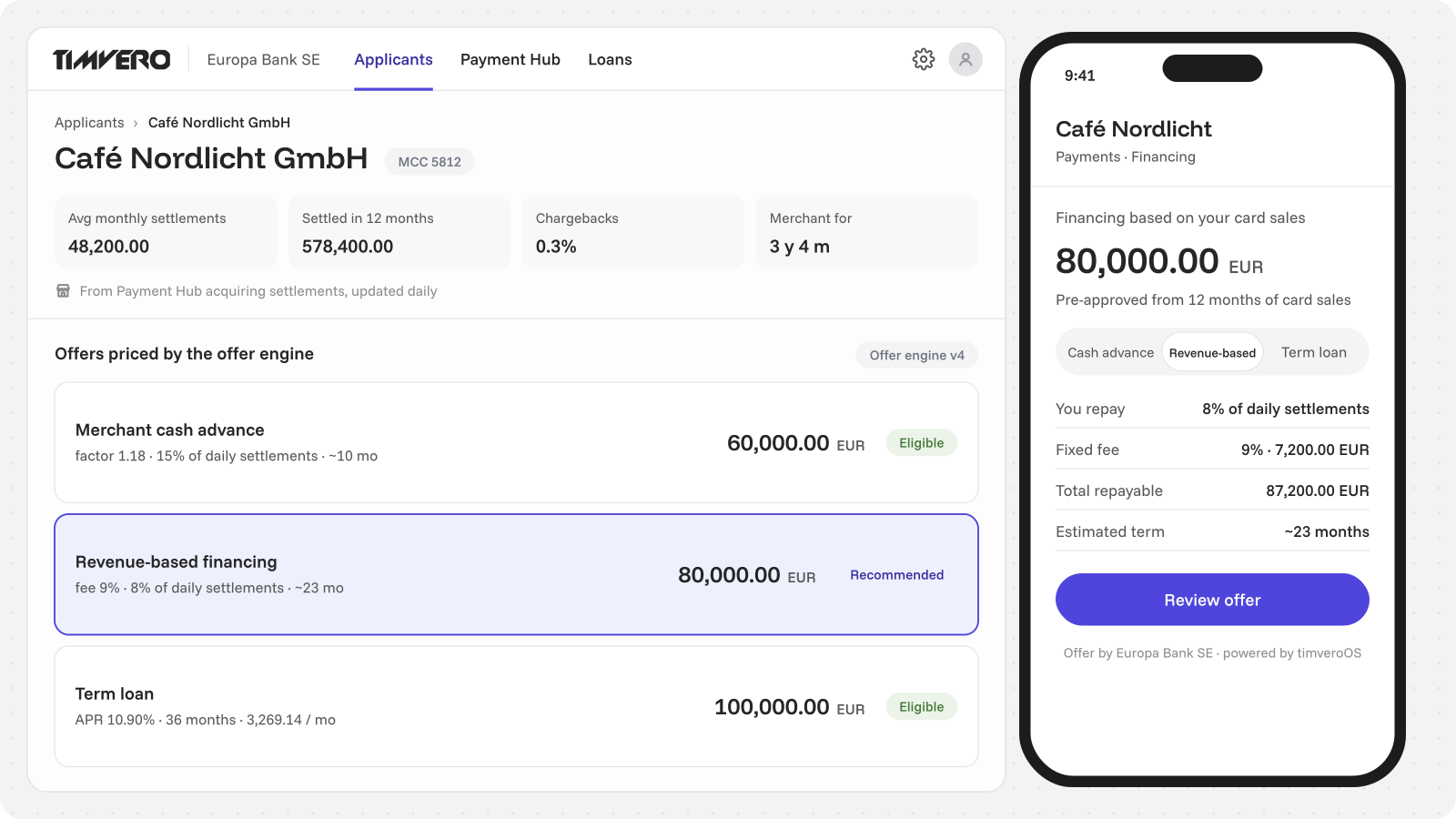
Your processing and settlement history shows how each merchant trades, day by day. timveroOS turns it into decisions and offers.

Typical products: merchant cash advances, revenue-based financing, short-term working capital loans and B2B pay-later for your merchants’ buyers.

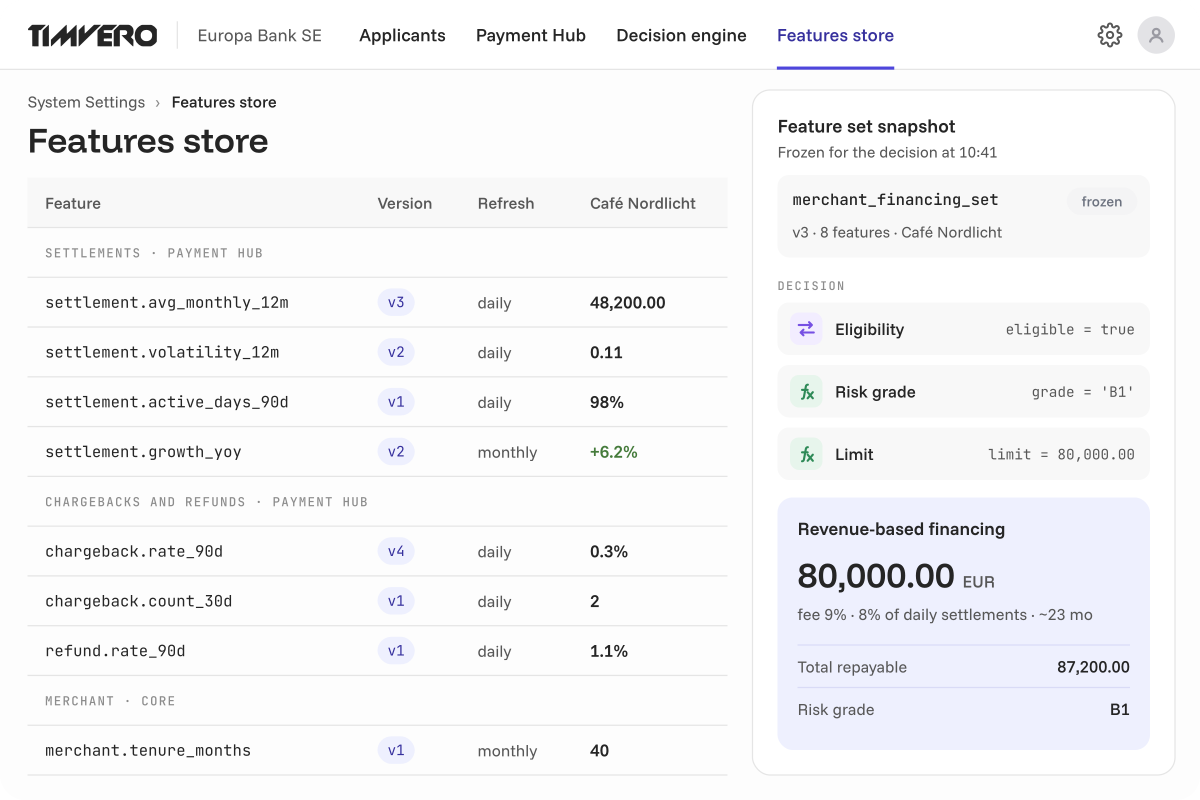
timveroOS Features Store with settlement and chargeback features for one merchant, frozen into a decision snapshot with eligibility, risk grade, limit and a priced revenue-based financing offer
  • 1. Data

    Settlement, chargeback and account data from your systems flows in through the API or an external call, together with KYB, bureau and open-banking data. The Feature Store maps it into named, versioned features.

  • 2. Decisions

    Eligibility, limits and risk grades run as approved rules in the Decision Engine. Your risk team changes them and activates a new version without a software release. See credit decisioning.

  • 3. Offers

    An offer engine prices each product variant against the merchant’s profile, so merchants can see offers based on their own payment history before they apply. Offer scripts are versioned and can be dry-run before a change goes live.

  • 4. Your Channel

    timveroOS is headless. Your merchant dashboard or app calls the API, shows the steps available right now and keeps your brand on every screen. The same process runs in the back office for your credit team.

5 Servicing

Repayment From Card Sales and Servicing

  • Repayment Rules per Product

    Each product declares how it is repaid, such as a share of each settlement or fixed daily or weekly debits, and the order in which payments cover fees, interest and principal.

  • Payments With a Full State History

    Every money movement passes through the payment framework with its own status, from submitted to succeeded, failed or returned, and lands on the loan ledger.

  • Nightly Recalculation

    The servicing engine replays each loan’s operations into dated balances, so every balance can be traced to the payments behind it.

  • Early Warning

    Scheduled metrics and checks run on each loan and merchant, and a breach of the thresholds you set opens a case for your team.

  • Collections

    Past-due rules, notifications and collection cadences are configured per product. Read more about loan servicing.

6 Funder Reporting

Loan-Level Data for Funders and Warehouse Lines

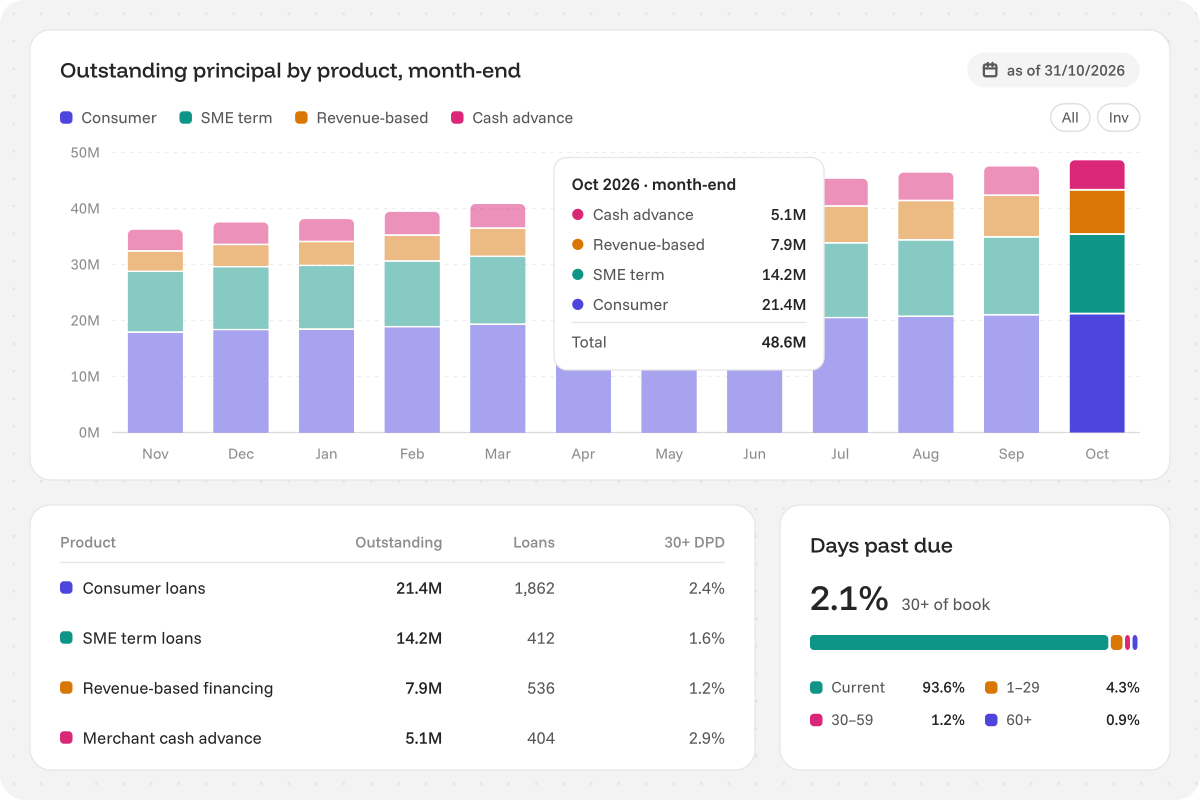
A growing book needs funding, and funders ask for loan-level data. Every loan in timveroOS keeps an append-only ledger of operations and dated balances, so the numbers in a funder report trace back to individual payments. Embedded BI dashboards are set up per role, including one for your capital and treasury team.

timveroOS BI dashboard with month-end outstanding principal by product, a portfolio table with outstanding balance, loan count and 30+ DPD per product, and a days-past-due breakdown
7 Launch

Launch Your Capital Program in Weeks

Tested building blocks handle accruals, schedules, and accounting, while timveroAI drafts custom logic for your team to approve. Extend timveroOS via the Java SDK or let our team build for you, keeping full code and configuration in your own repository.

  • 3 wksFirst Credit Product Live
  • 1 wkEach Next Credit Product
  • DaysTo Change an Existing Product
8 Licensing

Licensing Models and Where timveroOS Runs

Payment companies launch merchant financing under one of three models. TIMVERO provides the software layer in each model. TIMVERO is neither the lender nor the capital provider, and the licensing choice stays with you and your legal advisers.

  • Your Own Licence

    You lend from your balance sheet or a funding facility under a lending licence, or a payment licence where local rules allow credit linked to payment services.

  • A Partner Bank

    The bank extends the credit and you run the program and the merchant relationship.

  • A Lender of Record

    A licensed lender holds the loans and you originate and service them on its behalf.

9 Results

Embedded Credit Already Running on timveroOS

Finom: a European fintech launched a multi-country SME credit product with 80% of the lending infrastructure ready to use.

80% Of Lending Infrastructure Ready to Use

Finom: Multi-Country SME Credit Inside a European Fintech

Today, we’re running proactive credit campaigns and sophisticated servicing operations on a single platform. timveroOS delivered a competitive advantage under impossible deadlines.

Alex Goncharenko

Head of Credit, Finom

Read the Finom Story
10 Get Started

Pricing and a Pilot on Your Own Settlement Data

Pricing That Grows With Your Portfolio

From $5,900/month

Subscription tiered to the size of your loan portfolio, unlimited users.

See Pricing

Test a Merchant Financing Offer on Your Own Data

timveroProof, live in 1–2 weeks

Configure your lending logic and test your KPIs on real products using historical settlement data before committing to a contract.

Start a timveroProof Pilot
11 FAQ

Frequently Asked Questions About Embedded Lending

Talk to Us
  • What is an embedded lending platform?

    An embedded lending platform is software that lets a payment company or platform offer credit inside its own product. It collects the data, decides, prices offers, issues contracts, takes repayments and runs collections. timveroOS does this in the platform’s own environment, with offers, pricing and margin set by the platform.

  • What is the difference between embedded lending and embedded finance?

    Embedded finance covers any financial service inside a non-financial product: payments, accounts, cards, insurance and credit. Embedded lending is the credit part of it. A payment company already runs embedded payments, so embedded lending adds financing for the merchants it already serves.

  • Do we need a lending licence to offer merchant financing?

    It depends on the market and the product. Payment companies lend under their own licence, through a partner bank or through a lender of record. timveroOS runs the program in all three models. TIMVERO is the software provider, so the licensing decision stays with you and your legal advisers.

  • Can we use our own settlement data to decide and price offers?

    Yes. Settlement, chargeback and account data from your systems is mapped into versioned features that the Decision Engine and offer engine use directly. Your risk team sets eligibility, limits and pricing as rules and changes them in days without a software release.

  • How is repayment from card sales handled?

    Each product declares its repayment rules, such as a share of each settlement or fixed daily or weekly debits. Every payment passes through the payment framework and lands on the loan ledger, loans are recalculated nightly, and scheduled checks flag merchants whose payments fall below the thresholds you set.

  • How long does it take to launch a merchant financing program?

    Your first product goes live in 3 weeks, each next credit product in 1 week, and changes to an existing product take days. A timveroProof pilot can run your merchant offers on historical data within 1–2 weeks before you commit.

  • White label lending platform or capital partner: which fits a payment company?

    A capital partner suits a quick test, because the partner brings the credit model and the money. A program you run yourself suits a payment company that wants to set its own offers, keep the margin and use its own data. timveroOS supports the second model with your own capital, a funding facility or a partner bank.

  • Is timveroOS a lending-as-a-service provider?

    timveroOS is lending software you license and run in your own environment. TIMVERO does not lend or provide capital. You get the full lending lifecycle, from origination and decisioning to servicing and collections, with the code and configuration in your own repository.

Plan Your Capital Program With Us

Tell us about your merchants, your data and your licensing model, and we will show how the first financing product runs on timveroOS.