











Book a Demo
Decision Engine

Credit Decisioning Software With Rules Your Risk Team Owns

The Decision Engine in timveroOS runs your credit policy as versioned, deterministic decision logic inside the full lending lifecycle. Your first product goes live in 3 weeks, each next credit product in 1 week, and changes to an existing product take days.

Credit Decisioning Software
  • 20 lending products live
  • 13+ countries
  • 3 wks to the first product live
  • 5.0 ★ rating on Capterra
1 Platform Scope

Credit Decisioning Software at the Core of timveroOS

Run automated underwriting across your credit policies in seconds. Built natively into timveroOS, decisions trigger loan offers and servicing workflows without third-party integration glue.

  • Loan Origination

    Application capture, document collection, and e-signatures.

  • Credit Decisioning

    Automated data ingestion, no-code rule engines, scorecards, and audit trails.

  • Loan Servicing & Collections

    Schedules, automated repayments, fees, and arrears management.

  • Portfolio Analytics

    Real-time risk reporting, cohort tracking, and portfolio performance dashboards.

2 Process
  • Bureau, open banking, KYC, AML, fraud and internal data are mapped into named, versioned features in the Feature Store. A new version stays a draft until someone makes it live.

    Several data sources feeding one record

    Data Comes In

  • Bank and financial statements are read against a template per document type, and the figures are approved before scoring starts.

    A document turned into structured fields

    Documents Become Data

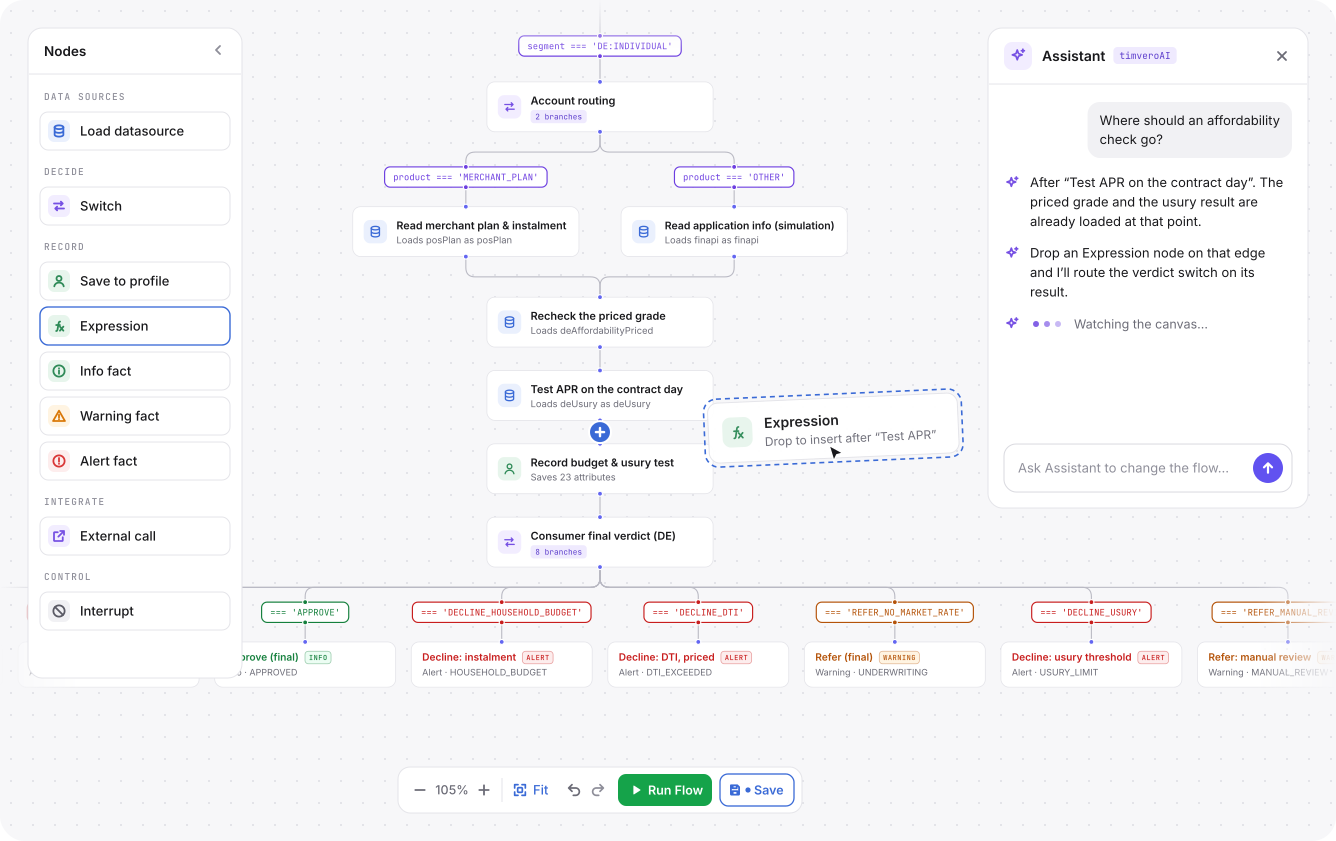
  • A decision tree in the Decision Engine runs knock-out and eligibility rules, decision tables, scorecards and calls to your own models. A model’s output is a recorded value that the rules act on.

    A branching rule switch

    Approved Rules Decide

  • The tree returns the outcome and raises decision facts. A fact that needs a person becomes a pending decision for the right department, such as underwriting, AML or legal, with decline reasons attached.

    A person reviewing a referred case

    People Take the Referrals

  • Each execution is stored with its status and outcome, and the application shows the path the decision took with the values behind it, such as debt-service coverage and risk grade.

    An archive box of stored decision records

    Every Decision Is Recorded

3 Policy Changes

Change Credit Policy in Days

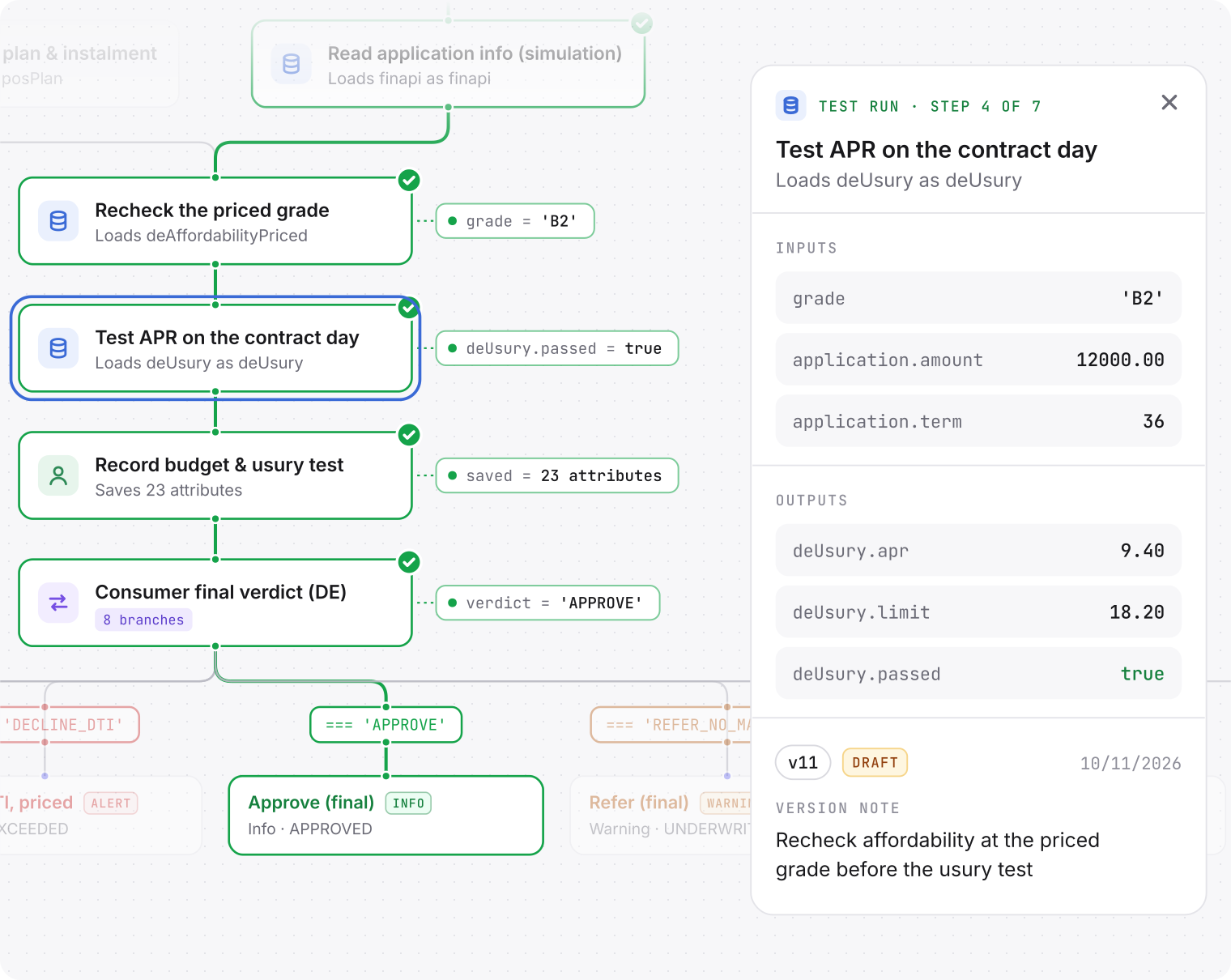
Credit and risk analysts build and change decision trees in the Decision Engine modeler. Conditions are built in forms, with a code view for analysts who prefer it. A test run highlights the path an application takes and shows the value at each step before anything goes live.

  • Versioned, With Rollback

    Every saved version carries a note on what changed. Activating a new version needs no software release, and rolling back means activating the previous one.

  • Drafted From a Written Policy

    To start from a written credit policy, attach the policy or scoring grid as a Word, Excel, Markdown or text file, and the assistant in the modeler drafts the tree. Anything it cannot settle becomes an open point that cites the place in the file it came from, and the tree cannot be saved until each point is resolved.

  • Process Changes Through timveroAI Studio

    Changes to the process itself, such as a new data source, a new step or a new product, go through timveroAI Studio. timveroAI drafts the change, people approve it, and the approved logic runs deterministically.

Decision Engine modeler test run with the highlighted decision path, the inputs and outputs of each step and the version note
4 Explainability

Deterministic and Explainable: The Same Inputs Give the Same Decision

Everything that executes in production runs as approved deterministic logic. A decision made today can be reconstructed 18 months later, in front of an examiner, from the records timveroOS keeps.

  • Decision Tree Version

    The version of the decision tree that ran, and the path it took.

  • Inputs and Features

    The input values and the feature versions that produced them.

  • Decline Reasons

    The decline reasons and the decision facts raised.

  • Referral Outcomes

    Who took each referral, when, and with what outcome.

  • Rule History

    The full change history of every rule, with author and time.

5 Underwriting

Automate the Standard Cases, Route the Exceptions

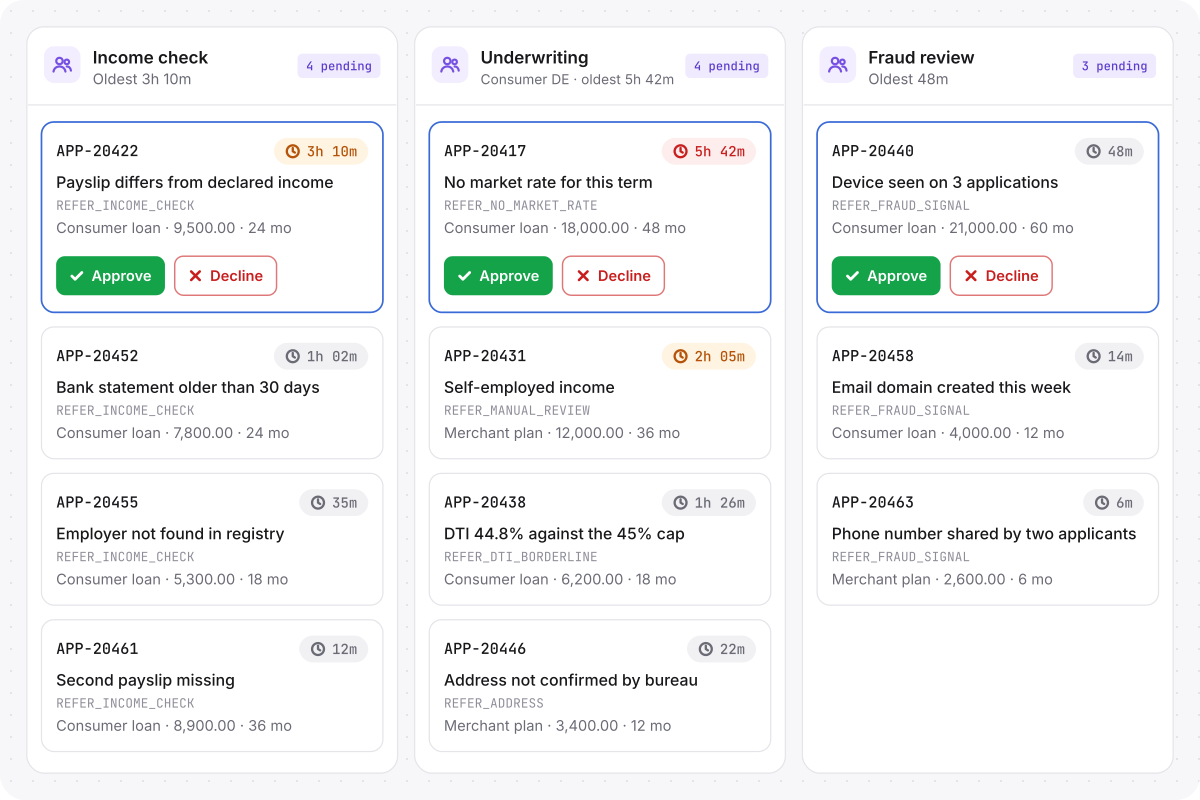
Underwriting automation in timveroOS clears the standard cases on approved rules and sends each exception to the right team’s decision queue. The queue shows how long each item has waited and why it is pending, and the underwriter approves or declines in place, with the data, rule outcomes and document figures already on the application.

Underwriting decision queue with exceptions routed to team queues, their wait time and the reason each is pending
  • 70%Of Applications Are Standard Cases
  • ~28%Of Underwriting Time Goes to Them
  • ~72%Of Underwriting Time Goes to Exceptions
6 Loan Types

Underwriting Automation for Consumer, SME and Commercial Loans

  • Consumer Loans

    Evaluate affordability and risk instantly using credit bureau and open-banking data. Decisions and audit logs are recorded automatically for every applicant.

    Explore Consumer Lending
  • SME and Commercial Loans

    Automate cash-flow, DSCR, and P&L analysis for complex corporate files. Easily evaluate co-borrowers, directors, and guarantors within a single application.

    Explore Commercial Lending
  • Instant Prequalification

    Filter out non-qualifying leads early with soft credit checks and campaign knock-out rules, routing pre-approved borrowers straight into full applications.

7 Lifecycle

Part of the Full Lending Lifecycle

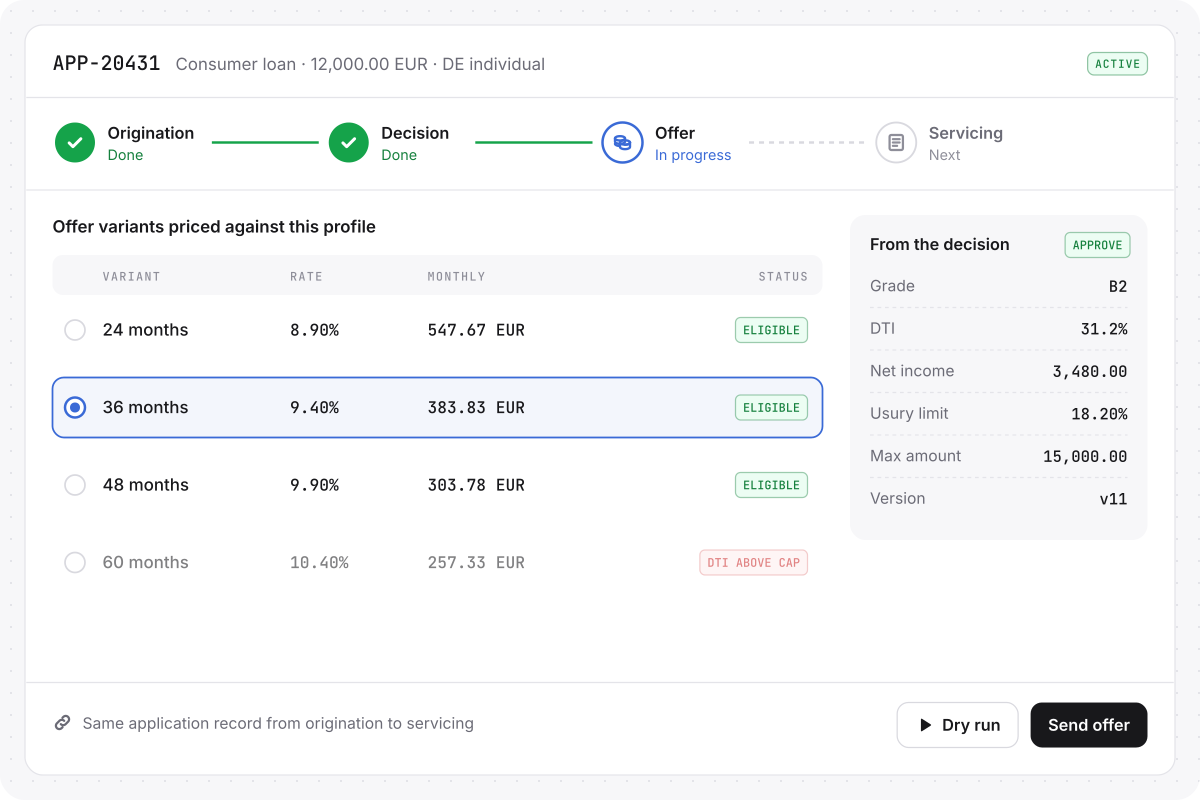
A decision in timveroOS feeds the next step directly. Offer engines price each product variant against the applicant’s profile and can be dry-run before a change goes live. An approved loan moves into loan servicing on the same data model, without re-keying.

Integration categories for decisioning: credit bureaus, KYC and AML, fraud signals, open banking, core banking and internal data.

Loan application in timveroOS with the credit decision step leading into the offer step
8 Deployment

Deployed in Your Environment, Owned by You

ISO 27001 and SOC 2 certification are in progress. See security at TIMVERO.

  • Single-Tenant in Your Cloud

    Single-tenant timveroOS in your own cloud (AWS, Azure or Google Cloud) or on premises, with an isolated database.

  • Upgrades on Your Schedule

    You choose when each upgrade goes live.

  • Code in Your Repository

    Decision definitions, configuration and code in your own repository.

  • Data in Your Jurisdiction

    Applicant data stays in your jurisdiction.

9 Segments

Built for Lenders Whose Credit Policy Keeps Changing

  • Small Banks

    SME decisions take weeks, and supervisors expect explainable automated decisions. Financial statements feed the rules, and every decision keeps its path.

    Explore Solution for Banks
  • Credit Unions

    Member loans underwritten by hand and rules locked inside the LOS. Your lending team changes the rules and tests them before they go live.

    Explore Solution for Credit Unions
  • Neobanks and Fintech Lenders

    Policy changes that wait for an engineering sprint. Analysts publish a new decision version without a release.

    Explore Solution for Fintechs
  • BNPL and POS Lenders

    Affordability checks under the UK BNPL rules and CCD2. Each application records the rules and values behind its outcome.

    Explore BNPL Software
  • Payment Companies

    Merchant financing where a partner sets the offers. Decide on your own settlement data with your own rules and offers.

    Explore Merchant Cash Advance
10 Results

Results From Lenders on timveroOS

Across lenders on timveroOS: 7,000+ loan applications processed daily and a 15–20% approval-rate lift.

100% Bespoke Requirements Covered
95% Process Automation

AMIO Bank: 100% of Bespoke Origination Requirements, 95% Automation

We had failed three implementation attempts with two different vendors before TIMVERO. Six months later we had a fully automated, production-ready lending product live: 95% automation, 8x faster time-to-yes, 60% lower cost-per-loan.

Head of Digital Lending

AMIO Bank

Read the AMIO Bank Story
11 Get Started

Pricing and a Pilot on Your Own Credit Policy

Pricing

From $5,900/month

Subscription tiered to your active loan portfolio size, with unlimited users and full platform access.

See Pricing

Test It on Your Own Credit Policy

timveroProof, live in 1–2 weeks

Put timveroProof to the test with your own rules and historical data. Measure approval rates and decision speed against agreed KPIs, with zero commitment if we don’t hit them.

Start a timveroProof Pilot
12 FAQ

Frequently Asked Questions About Credit Decisioning Software

Book a Demo
  • What is credit decisioning software?

    Credit decisioning software applies a lender’s credit policy to each application automatically. It gathers bureau, banking, identity and document data, runs eligibility rules, scorecards and decision tables, and returns an approval, decline or referral with the reasons recorded. In timveroOS it runs inside origination, so each decision flows straight into the offer and the loan.

  • What is the difference between a credit decision engine and a loan origination system?

    A loan origination system runs the whole application: intake, participants, documents, checks, offers, signing and booking. A credit decision engine is the part that applies the credit policy and returns the outcome. In timveroOS both run in one installation on the same data.

  • Does AI make the credit decision in timveroOS?

    No. Approved deterministic logic makes the decision. timveroAI and the assistant in the modeler draft rules and changes, people review and approve them, and only the approved version runs in production. Where a model reads a document or produces a score, its output is a recorded value that the rules or an underwriter then act on.

  • How fast can the risk team change a credit rule?

    A rule change in an existing decision tree takes days. Analysts edit the tree in the modeler, check it with a test run and activate the new version without a software release. Changes to the process itself, such as a new data source or a new product, follow the five-gate change process through timveroAI Studio.

  • Which data sources can the decision engine use?

    The Decision Engine works with credit bureaus, open banking, KYC and AML providers, fraud signals, your internal history and data extracted from applicants’ documents. Each source is mapped into versioned features, and an external call step can reach any other service over HTTP.

  • How are credit decisions explained to auditors and applicants?

    Each application records the decision tree version, the path taken, the input values, the feature versions and the decline reasons, so auditors can reconstruct a decision months later. Your team can use the recorded reasons for US adverse action notices and CCD2 explanations in the EU.

  • Can timveroOS automate underwriting for SME and commercial loans?

    Yes. Figures from profit and loss and bank statements are extracted, checked and fed into rules on revenue, net operating income and debt-service coverage. Guarantors and co-applicants are assessed as participants of the same application, and cases outside policy go to the underwriting queue.

  • Can timveroOS run loan prequalification?

    Yes. Knock-out and eligibility rules can run as a pre-check before a full application, configured per channel or campaign. Applicants who cannot qualify get an early answer, and those who pass continue into the full application with the data already collected.

  • Can we keep our existing scoring model or decision engine?

    Yes. An external call step can call your scoring service or run an uploaded model file and use the result in the decision tree. timveroOS can also consume decisions from your own engine and move to its Decision Engine later.

See Your Credit Policy Run in timveroOS

Bring a credit policy and a sample of applications, and we will show the decision tree, test run and decision record on your data.