



Automated Loan Underwriting: How It Works, What Data It Uses and How to Audit It
Automated underwriting decides the clear applications in seconds and sends the rest to an underwriter with the reason attached. This guide covers the steps, the data, the role of rules and models, and the records that let you audit every decision.
Automated loan underwriting applies a lender’s credit policy to application data and returns a decision without anyone retyping a figure. Set up well, it decides the clear cases in seconds and hands the rest to an underwriter with the data and the reason already on screen. This guide explains how automated underwriting works step by step, what data it uses, where rules and models fit, and how to audit every decision it makes.
If you are reviewing the system that would run your credit policy, see how timveroOS handles credit decisioning for consumer, SME and commercial lending.
Key Takeaways
- Definition: automated underwriting applies a lender’s credit policy through rules, scorecards and models, and returns approve, decline, counteroffer or refer to an underwriter.
- The data step decides the quality of the decision. Bureau reports, bank transactions, verified income, KYC and fraud signals and figures read from documents become named features that the policy reads. An error there flows into every decision.
- Automate the standard path and prepare the exceptions. In a model of 100 applications, the 30 exceptions take about 72% of underwriting time, so referrals that arrive with their reason and data save the most hours.
- Production decisions should be deterministic. The same inputs and the same policy version give the same outcome. That is what lets a lender give specific reasons for a decline and reproduce the decision for an examiner. Models can feed the decision as inputs.
- Auditability is a design requirement. US Regulation B, the EU Consumer Credit Directive, the GDPR and, from 2 December 2027, the EU AI Act all set rules for explaining or governing automated credit decisions.
What Is Automated Underwriting?
Automated underwriting is the use of software to assess a loan application against a lender’s credit policy and return a decision: approve, decline, counteroffer or refer to an underwriter. An automated underwriting system pulls the data, calculates the decision inputs, applies rules, scorecards or models, and records why it reached each outcome.
Lenders also call it automated credit decisioning or digital underwriting. In US mortgage lending, “automated underwriting system” usually means the agency systems, Fannie Mae’s Desktop Underwriter (DU) and Freddie Mac’s Loan Product Advisor (LPA), which check a loan against the agencies’ eligibility guidelines. This guide covers the wider case: banks, credit unions and fintech lenders automating underwriting for their own consumer, SME and commercial products under their own credit policy.
Automated vs Manual Underwriting
Manual underwriting puts an underwriter between the file and the decision. Automated underwriting puts the policy into the system and keeps the underwriter for the cases that need judgement. Many lenders run both: the system decides the standard applications and refers the rest.
| Manual underwriting | Automated underwriting | |
|---|---|---|
| Who applies the policy | An underwriter reads the file and applies the policy document | The system applies the policy as configured rules, scorecards and models |
| Time to decision | Hours to weeks, depending on the queue and the product | Seconds for standard applications; referrals follow the review queue |
| Consistency | Varies with the underwriter and the workload | The same inputs and the same policy version give the same outcome |
| Data handling | Figures read from reports and documents and retyped | Data pulled through integrations and read from documents, then checked |
| Record of the decision | Notes in the file, detail varies | A decision record with the data, the policy version, the path and the reasons |
| Changing the policy | Update the document and retrain the team | Change the configured logic, test it on past applications, approve and activate it |
| Fit | Large, complex or unusual cases | High-volume products with a clear policy |
How Automated Loan Underwriting Works: The Process Step by Step
The loan underwriting process follows the same seven steps whether an underwriter or a system does the work. Automation changes who does each step and how fast. Underwriting is one stage of the wider loan origination process, which runs from the application to disbursement.
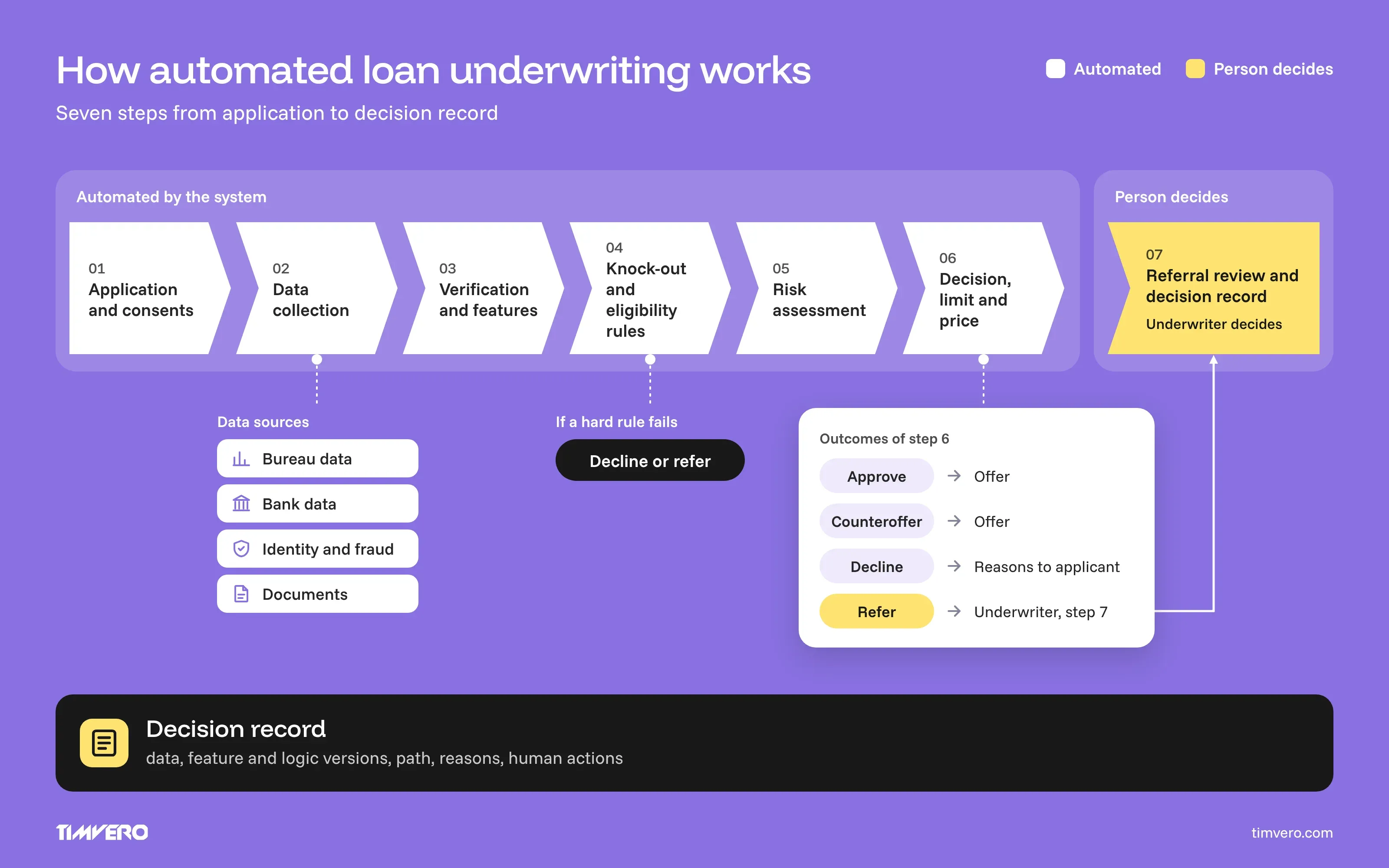
1. Application, Consents and Pre-Checks
The applicant submits the application and gives consent for bureau checks and, where used, access to bank transactions. Pre-checks stop applications that cannot qualify: wrong country, age below the minimum, a product the applicant already holds, an amount outside the product range.
2. Data Collection
The system calls the data sources the policy needs, usually in parallel: credit bureaus, open banking, identity and fraud providers, the lender’s own customer data. For business loans it collects bank and financial statements and company registry data. Documents uploaded by the applicant are read, and the extracted figures wait for review where the policy requires it.
3. Verification and Feature Calculation
Raw data becomes the figures the policy uses, called features: debt-to-income, average monthly inflow, months since the last missed payment, debt service coverage. The system checks that sources agree, that no response is older than the policy allows, and that nothing required is missing.
4. Knock-Out and Eligibility Rules
Hard rules run first: sanctions or fraud hits, recent defaults or insolvency, income below the product minimum, a policy exclusion. A failed knock-out rule declines the application or refers it, and the record keeps which rule fired and on which value.
5. Risk Assessment: Affordability, Scorecards and Models
The system assesses whether the applicant can repay and how likely they are to. Affordability compares income with existing commitments and the new payment. A scorecard or model ranks the risk and assigns a grade. Each input and its value go into the decision record.
6. Decision, Limit and Price
The policy combines the results into an outcome: approve, decline, counteroffer a lower amount or a different term, or refer to an underwriter. Approved applications get a limit and a risk-based price from the lender’s pricing rules.
7. Referral Review and the Decision Record
Referred applications go to a queue with the reason they were referred, the data and the path the application took. The underwriter decides, and the record adds who decided, when and why. Declined applicants receive the reasons the law in their market requires.
What Data Automated Underwriting Uses
Automated underwriting is only as good as the data it reads. Each source answers a different question, and each has a weak spot to plan for.
| Data source | What it gives the decision | Typical use | Watch for |
|---|---|---|---|
| Credit bureau reports | Payment history, existing debt, recent applications, defaults, bureau scores | Consumer and small business loans | Thin files; reports that age while the application waits |
| Bank transactions (open banking or statements) | Income, spending, balances, cash-flow stability | Affordability, thin-file applicants, SME loans | Consent scope and expiry; quality of transaction categories |
| Income and employment verification | Verified income, employer, length of employment | Consumer loans | Self-employed and variable income |
| KYC, KYB and fraud signals | Identity, sanctions and PEP screening, company ownership, device and behaviour signals | Every product | Possible matches that need a person |
| Financial statements and tax returns | Revenue, profit, debt service, leverage | SME and commercial loans | Retyping errors; the period a statement covers |
| Internal customer history | Existing loans, repayment behaviour, deposits | Existing customers | Data held in another system |
| Collateral and valuation | Asset value, loan-to-value, lien position | Secured and commercial loans | Age of the valuation |
| Platform and merchant data | Sales volumes, settlement history, refunds | Merchant financing and embedded lending | Data-sharing terms with the platform |
From Raw Data to Features
Rules and models read features, so features deserve the same control as the rules. Give each feature a name, a definition and an owner. Version it, test a changed definition on real records before it goes live, and keep the earlier versions. When a data source is requested again, compare the new response with the previous one so the underwriter sees which values changed.
Bank-transaction data is what makes cash-flow underwriting possible for applicants with a thin credit file: the policy reads income regularity, balance trends and existing payments straight from the account.
Rules, Scorecards and Models: What Makes the Decision
Three kinds of logic make the decision in automated underwriting, and lenders often combine them.
- Rules and decision trees. Explicit conditions and thresholds: for example, decline if debt-to-income is above the product limit, refer if the amount is above the delegated limit. They map directly to the written credit policy and are the easiest to explain.
- Scorecards. Points for each attribute, added into a score that ranks risk. A scorecard is transparent: each point can be traced to an attribute and a value.
- Statistical and machine learning models. They can find more signal in more data, and they are harder to explain. Banks manage them under model risk guidance, and lenders still have to give applicants specific reasons for adverse action.
The production decision is safest when it is deterministic: approved logic, with a version, that gives the same outcome on the same inputs. A model’s score can be one input that the rules read, with the model version recorded next to it. The rules then decide what the score means for this product.
AI earns its place around the decision. It can draft a rule change from a written policy, read figures off borrower documents and prepare a referral file for the underwriter. Each of these produces a draft or a value that a person approves before it affects an applicant. Some vendors now describe agents that make or adapt credit decisions on their own. Before adopting that design, ask how you would give an applicant the specific reasons for a decline and reproduce the decision for an examiner a year later.
Consumer, SME and Commercial Underwriting: What Changes
The steps stay the same across products. The speed, the data and the share of decisions that need a person change.
| Product | Decision speed the market expects | Main data | What is automated | Where people decide |
|---|---|---|---|---|
| BNPL and point-of-sale credit | Seconds, inside the checkout | Bureau, affordability, device and fraud signals | Almost every decision | Fraud hits; hardship cases after funding |
| Consumer instalment and personal loans | Minutes to the same day | Bureau, bank transactions, income | The standard path | Applications near cut-offs, missing documents |
| SME loans | The same day to a few days | Bank and financial statements, KYB, business and guarantor bureau data | Data extraction, ratios, standard rules up to a set amount | Amounts above the limit, unusual businesses |
| Commercial and secured loans | Days to weeks | Financial statements, collateral, covenants, ownership | Spreading financials, ratios, policy checks, the credit memo draft | Structure, covenants, credit committee |
Commercial loan underwriting automates differently. The system rarely makes the final call on a large exposure. It prepares the credit file: financial statements spread into a standard format, debt service coverage and leverage calculated, policy exceptions listed, and a draft memo ready for the credit officer. The time saved is in preparation, and the decision stays with the people who hold the authority.
Where Underwriters Stay in the Loop
Automation pays where work repeats on every application. Judgement, authority and accountability stay with people, and the split between the standard path and the exceptions decides where the hours go.
Here is a model with its arithmetic. Take 100 applications: 70 standard cases at about 15 minutes each take 1,050 minutes, and 30 exceptions at about 90 minutes each take 2,700 minutes. The standard cases carry about 28% of the paid minutes and the exceptions about 72%. Deciding the standard cases automatically is the first step. The larger saving comes from making each exception faster to resolve.
Four practices make the exceptions faster and keep them under control:
- Every referral carries its reason. The underwriter sees which rule referred the application, the values involved and the path it took.
- Authority levels live in the system. Who can approve which amount and override which rule is configuration, enforced and logged.
- Every override has a reason code. Overrides show where the policy and the underwriters disagree, which is the first place to look when tuning the rules.
- The queue shows age and owner. Pending decisions are visible by who holds them and how long they have waited.
How to Audit Automated Underwriting
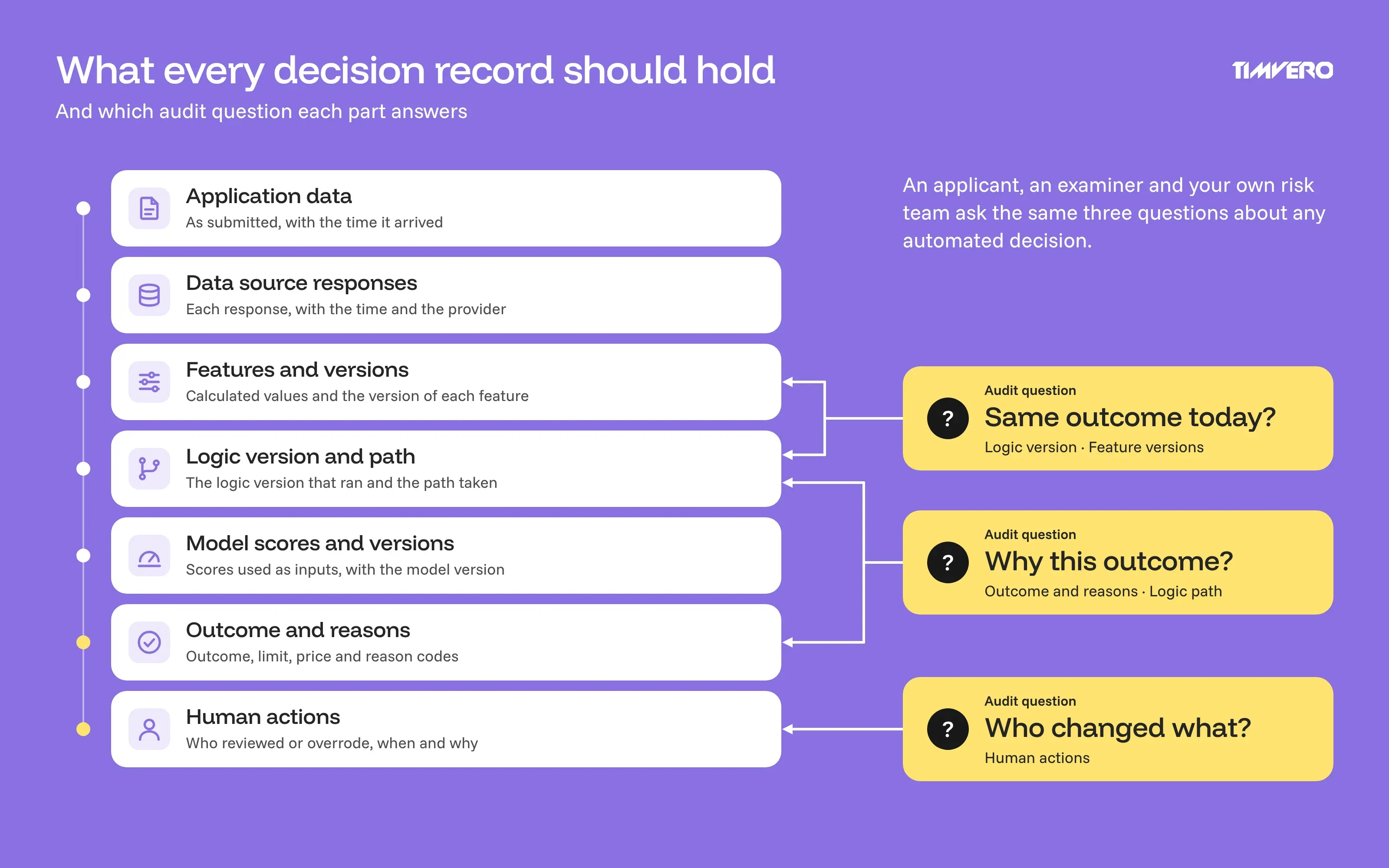
An applicant, an examiner and your own risk team ask the same three questions about any automated decision: why this outcome, would the system decide the same way today, and who changed the logic and when. An audit checks that the system can answer all three for any application.
What Every Decision Record Should Hold
- The application data as submitted, with the time it arrived.
- Each data source response, with the time it was received and the provider.
- The features calculated and their values, with the version of each feature.
- The version of the decision logic that ran, and the path the application took through it.
- Model scores used as inputs, with the model version.
- The outcome, the limit and price offered, and the reason codes behind a decline or a referral.
- Every human action: who reviewed, who overrode, when and with which reason.
Reproduce Past Decisions
Pick a sample of past applications, including declines and referrals. Run each through the policy version that was live at the time, on the data it had at the time. The outcome should match the record exactly. A mismatch means the logic, the features or the data are not versioned well enough to defend a decision.
Control Every Change to the Policy
- Draft the change in the form the system runs.
- Test it on past applications and compare outcomes with the live version: how many approvals, declines and referrals change, and in which segments.
- Approve it by a person with the authority to change that policy.
- Activate it at a set time, with the previous version kept for rollback.
- Record who changed what, when and why.
Monitor Outcomes
| Metric | What it shows |
|---|---|
| Automated decision rate | Share of applications decided with no manual touch |
| Referral rate and referral age | How much reaches underwriters and how long it waits |
| Override rate by rule | Where underwriters reverse the system, a sign that a rule needs tuning |
| Approval rate by segment and channel | Shifts after a policy change, and outcomes to review for fair lending |
| Time to decision | Speed from a completed application to an outcome |
| Early delinquency by policy version | Whether a policy change approved riskier loans |
| Decline reasons by frequency | Which rules drive declines, and whether the reasons given are specific |
| Data source failures and timeouts | Applications referred because a provider did not answer |
What Regulators Expect
Rules on automated credit decisions differ by market, and several of them changed in 2026. Here is a summary for orientation; your compliance team should map each rule to your products.
| Market | Reference | What it means for automated underwriting |
|---|---|---|
| US | Regulation B, 12 CFR 1002.9 (opens in new tab) | The creditor notifies the applicant within 30 days of a completed application and gives the specific reasons for adverse action. Stating that the applicant did not meet internal standards or failed to reach a qualifying score is insufficient. The official interpretation notes that more than four reasons is not likely to be helpful. |
| US | SR 26–2 (opens in new tab), Revised Guidance on Model Risk Management (Federal Reserve, OCC and FDIC, 17 April 2026) | Replaces SR 11–7 with a risk-based approach to model risk, tailored to the size and complexity of the bank. Expected to be most relevant to banking organisations with over $30 billion in total assets. |
| EU | Consumer Credit Directive (EU) 2023/2225, Article 18 (opens in new tab) | Applies from 20 November 2026. Where the creditworthiness assessment involves automated processing, the consumer can ask for human intervention and an explanation of the assessment. |
| EU | GDPR Article 22 (opens in new tab) and CJEU case C-634/21 SCHUFA (opens in new tab) (7 December 2023) | A decision based solely on automated processing with legal or similarly significant effects needs a legal basis and safeguards, including the right to human intervention and to contest the decision. The court held that a credit score can itself be such a decision when it plays a determining role in the lender’s decision. |
| EU | EBA Guidelines on loan origination and monitoring (opens in new tab), applied from 30 June 2021 | Banks that use automated models for creditworthiness assessment and credit decisions need governance over them, including an understanding of how the model works, controls on input data and the ability to explain its outcomes. |
| EU | AI Act, Regulation (EU) 2024/1689 (opens in new tab), Annex III point 5(b), with dates set by Regulation (EU) 2026/1744 (opens in new tab) | AI systems that evaluate the creditworthiness of natural persons or establish their credit score are high-risk, except systems used to detect financial fraud. The high-risk obligations for Annex III systems apply from 2 December 2027. Whether a given underwriting system counts as an AI system depends on how it works. |
References checked 17 November 2026. This summary is for orientation and is not legal advice.
How to Choose Automated Underwriting Software
Any automated underwriting software you shortlist will run rules on bureau data. The differences show when the policy changes, when a case does not fit and when someone asks for evidence. Seven questions separate the options:
- Who changes the credit policy, and how long does it take? Ask for the path from a written policy change to live logic, and who on your side can make it.
- Can you test a change on past applications before it goes live? You should see which outcomes would change, and for which applicants.
- What does the decision record hold? Check it against the list above, and ask for a reproduction of a past decision during the demo.
- How are features defined, versioned and tested? Data logic changes as often as rules, and needs the same control.
- How are referrals worked? Look for queues with reasons, owners, ages and authority levels.
- Can your own models feed the decision? A model should plug in as an input, with its version recorded.
- Where does the system run, and what else does it cover? Data residency, deployment in your own environment, and whether origination, servicing and collections run in the same system or need integration.
To see how timveroOS answers these questions, read about credit decisioning in timveroOS.
How timveroOS Automates Underwriting
timveroOS is a lending solution that covers the full lending lifecycle, origination through servicing and collections, so an approved loan moves into servicing in the same system. It is headless: your app calls the API and keeps your brand on every screen, while your credit team works the same applications in the back office. It runs in your own cloud or on-premise. Here is how the underwriting steps above run on it:
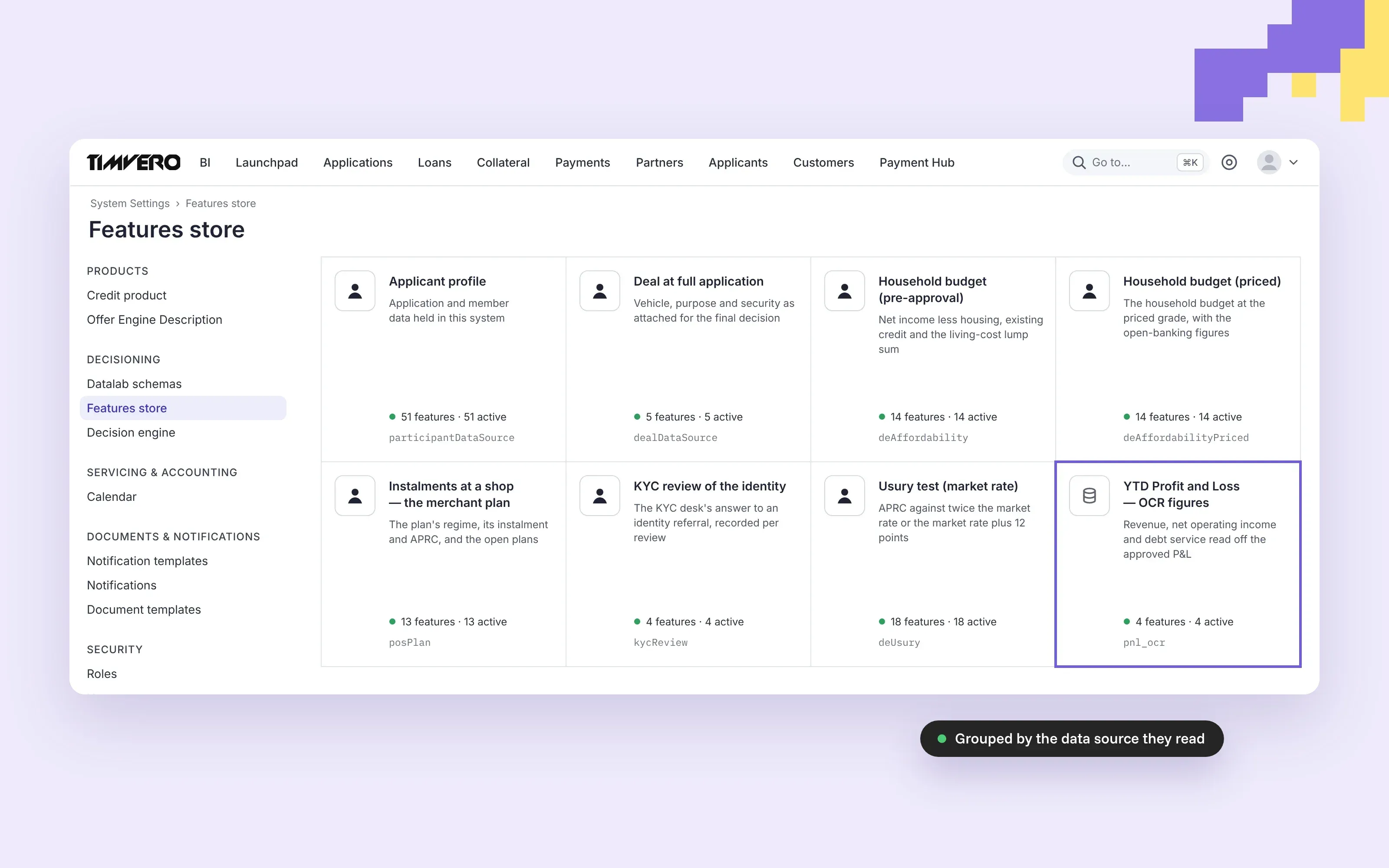
- Features: the Feature Store maps bureau, open banking, KYC and internal data into named features with their own version history; a new version stays a draft until someone activates it. When a data source is requested again, the changed values are listed first.
- Documents: figures are read off borrowers’ documents, staff check and approve them, and scoring waits for the approval.
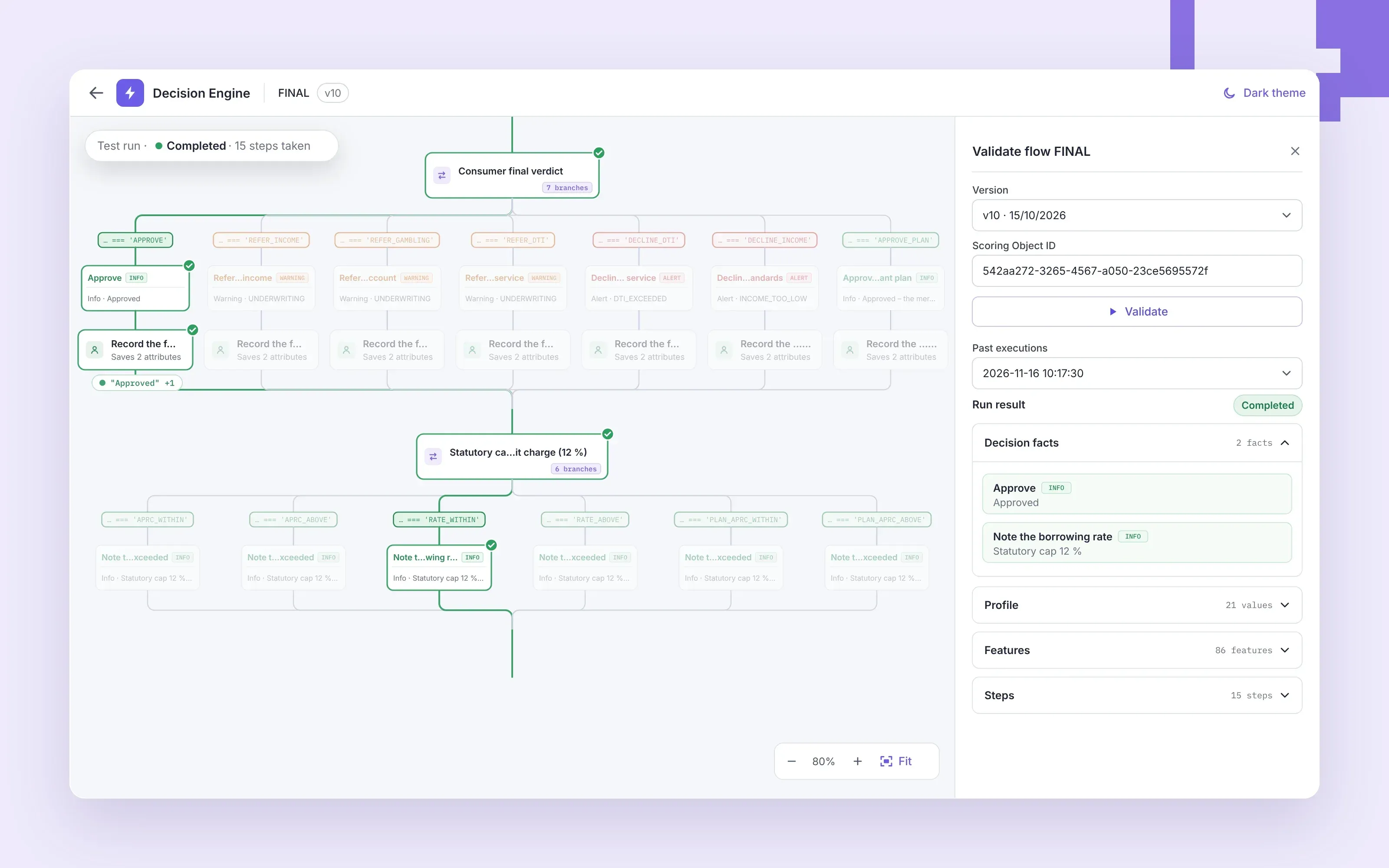
- Decision logic: the Decision Engine runs the credit policy as decision trees. An Assistant in the modeler can turn a written scoring policy into a tree, and every point it cannot settle from the document waits for an analyst’s answer before the tree can be saved. A test run highlights the path taken and the value computed at each step. Each saved version carries a “what changed” note, and the live version is marked.
- Models and outside services: an External call step calls an outside service or runs an uploaded model file, and passes the answer to the steps that follow.
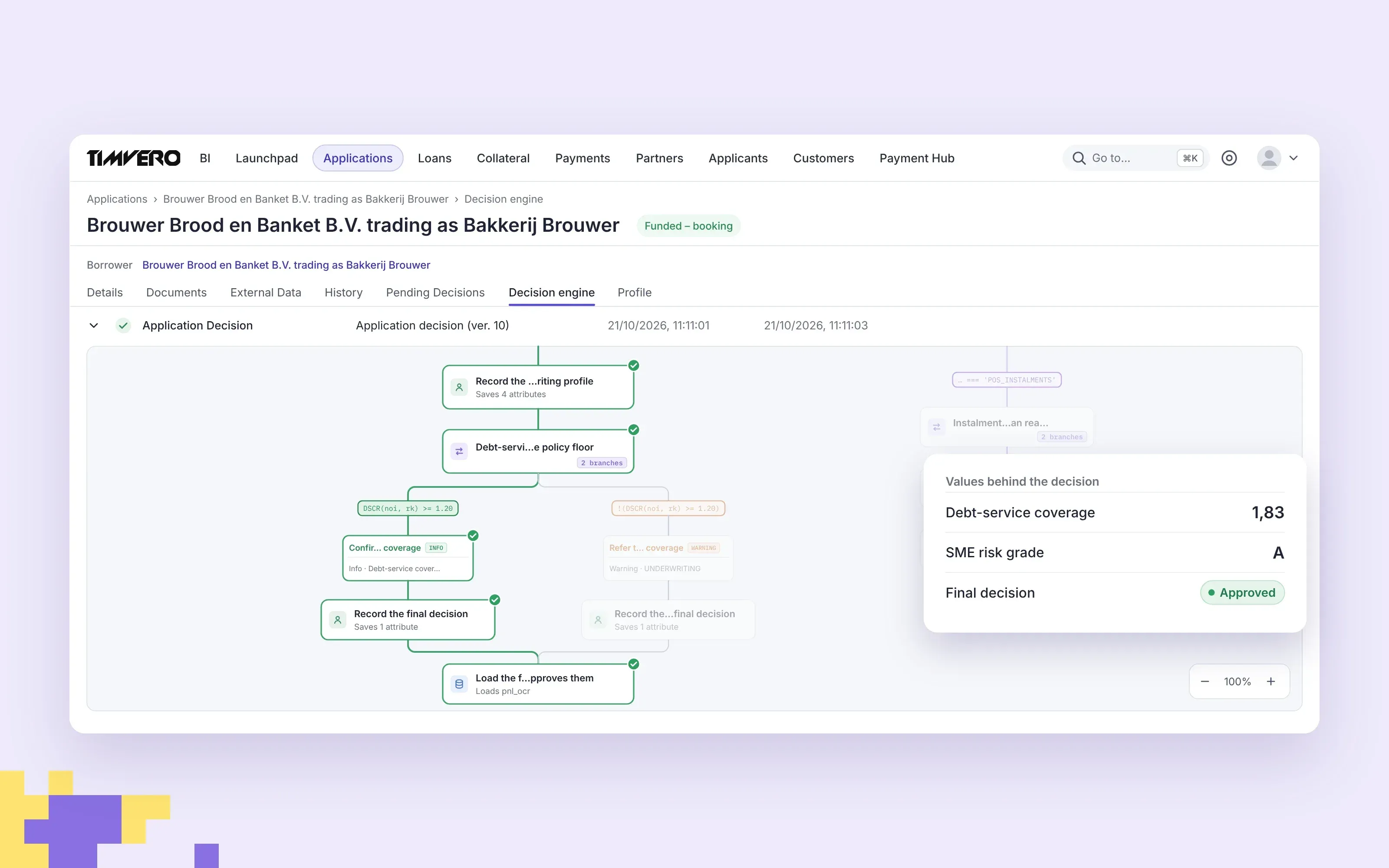
- Decision record: each application shows the tree it went through, with the path highlighted and the values behind the decision.
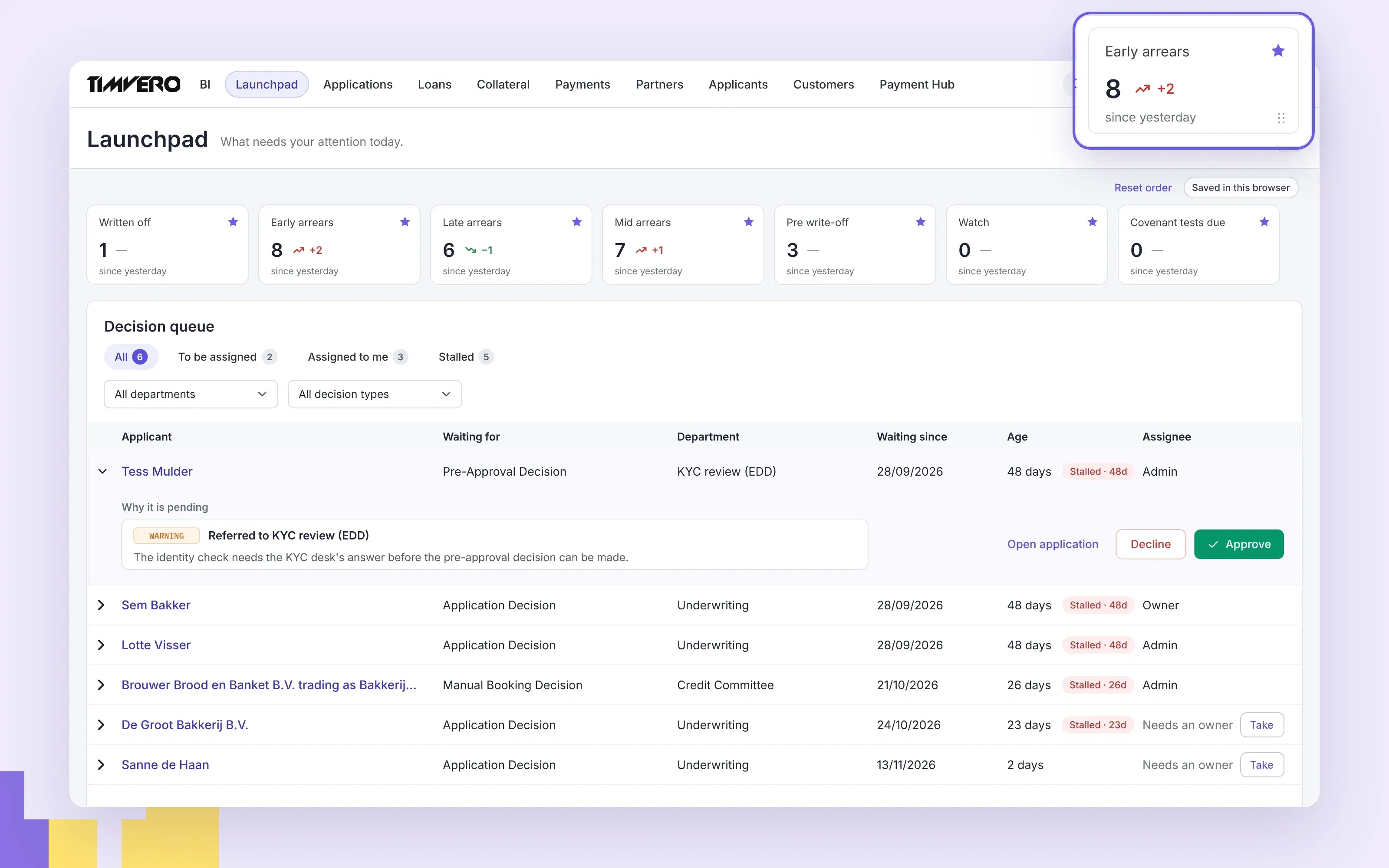
- Exceptions: the decision queue shows pending decisions by owner and age and why each one is pending.
Changes to underwriting rules follow the path described in the audit section. In timveroAI Studio, the credit team describes the change in plain language; timveroAI drafts the change, people approve it, and the approved logic runs deterministically. Every change passes five gates and ends in your own repository with the requirement, the architecture, the solution, the code and the test results. The first product goes live in 3 weeks, each next credit product in 1 week, and changes to an existing product take days.
AMIO Bank, an Armenian bank, covered 100% of its bespoke origination requirements on timveroOS and reached 95% automation.
Frequently Asked Questions
What is automated underwriting?
Automated underwriting is software that assesses a loan application against the lender’s credit policy and returns approve, decline, counteroffer or refer to an underwriter, with the reasons recorded for each outcome.
What is an automated underwriting system?
An automated underwriting system (AUS) is the software that runs automated underwriting. In US mortgage lending the term usually refers to Fannie Mae’s Desktop Underwriter and Freddie Mac’s Loan Product Advisor. Banks and fintech lenders also run their own automated underwriting systems for consumer, SME and commercial loans, usually as the decision engine inside a loan origination system.
How does automated loan underwriting work?
It follows seven steps: application and consents, data collection, verification and feature calculation, knock-out and eligibility rules, risk assessment through affordability checks and scorecards or models, the decision with a limit and price, and referral review with a decision record. Clear cases finish in seconds; the rest go to an underwriter with the reason attached.
How do fintech lenders automate credit decisioning?
Fintech lenders connect bureau, open banking, identity and fraud data through APIs, turn the responses into features, and run their credit policy as rules and scorecards that decide the standard applications in seconds. Applications that fail a rule or fall near a cut-off go to an underwriter, and policy changes are tested on past applications before they go live.
What is the difference between automated and manual underwriting?
In manual underwriting a person reads the file and applies the credit policy. In automated underwriting the system applies the policy as configured logic and refers the cases it cannot decide. Many lenders combine the two: the system decides standard cases and people handle complex ones.
Does AI make the credit decision in automated underwriting?
It depends on the system. A common design keeps the production decision in approved, versioned rules that give the same outcome on the same inputs, with model scores as inputs. AI then helps the people around the decision: drafting rule changes, reading documents and preparing referral files. In timveroOS, timveroAI drafts changes, people approve them, and the approved logic runs deterministically.
Can commercial loan underwriting be automated?
Partly. Data collection, spreading of financial statements, ratio calculations, policy checks and the draft credit memo can be automated. Final decisions on large or complex exposures usually stay with a credit officer or a credit committee, who now start from a prepared file.
How do you audit an automated underwriting system?
Check three things. Every decision record should hold the data, the feature and logic versions, the path taken, the reasons and every human action. A sample of past decisions should reproduce exactly on the policy version that was live at the time. Every policy change should be drafted, tested on past applications, approved, activated at a set time and logged.

Head of Marketing
Ivan Halynkin is Head of Marketing at TIMVERO, the company behind timveroOS and timveroAI. He connects product and demand, turning the Building Platform into positioning, content and demos for small banks, credit unions, neobanks and fintech lenders. He writes about origination economics, governed AI in credit decisioning, and how lenders choose between SaaS, a custom build and a Building Platform.
LinkedinLatest News
Generative AI in Banking: Where It Works and Where It Can’t
Conversational AI in Banking: What It Should Answer
Launch a Loan Product Fast: What AI Actually Changes
AI Agent vs Credit Scoring: The Two Layers of Lending AI
AI in Banking: A 2026 Guide to Value, Risk, and Scale
AI Hallucinations in Lending Software: How to Stop Them
The 2–3 Year Window: What Banks Lose by Waiting on AI
The AI Banking Efficiency Gap: Why It Compounds and Who Wins
How AI Is Transforming Lending in 2026: Platforms, Automation, and What Actually Works