



Launch a Loan Product Fast: What AI Actually Changes
The person who runs lending at your institution knows exactly which change would lift approval rates in the segment she is watching this quarter. She cannot make it. The change becomes a ticket, the ticket becomes a prioritization meeting, the meeting becomes a vendor queue, and the queue becomes a quarter. By the time her risk-based pricing adjustment goes live, the market condition that justified it has passed.

That gap between decision and deployment is the real constraint on how fast a lender can launch a loan product — and it is architectural, not procedural. You cannot fix a quarter-long change cycle with a better intake form. This article covers what actually compresses the timeline, what does not, and how the Building Platform beneath timveroOS — with timveroAI as its acceleration layer — moves the change cycle from quarters to weeks.
Why launching a lending product takes quarters, not weeks
The honest starting point is that nobody in the process is being slow on purpose. The delay is a property of how lending change requests travel.
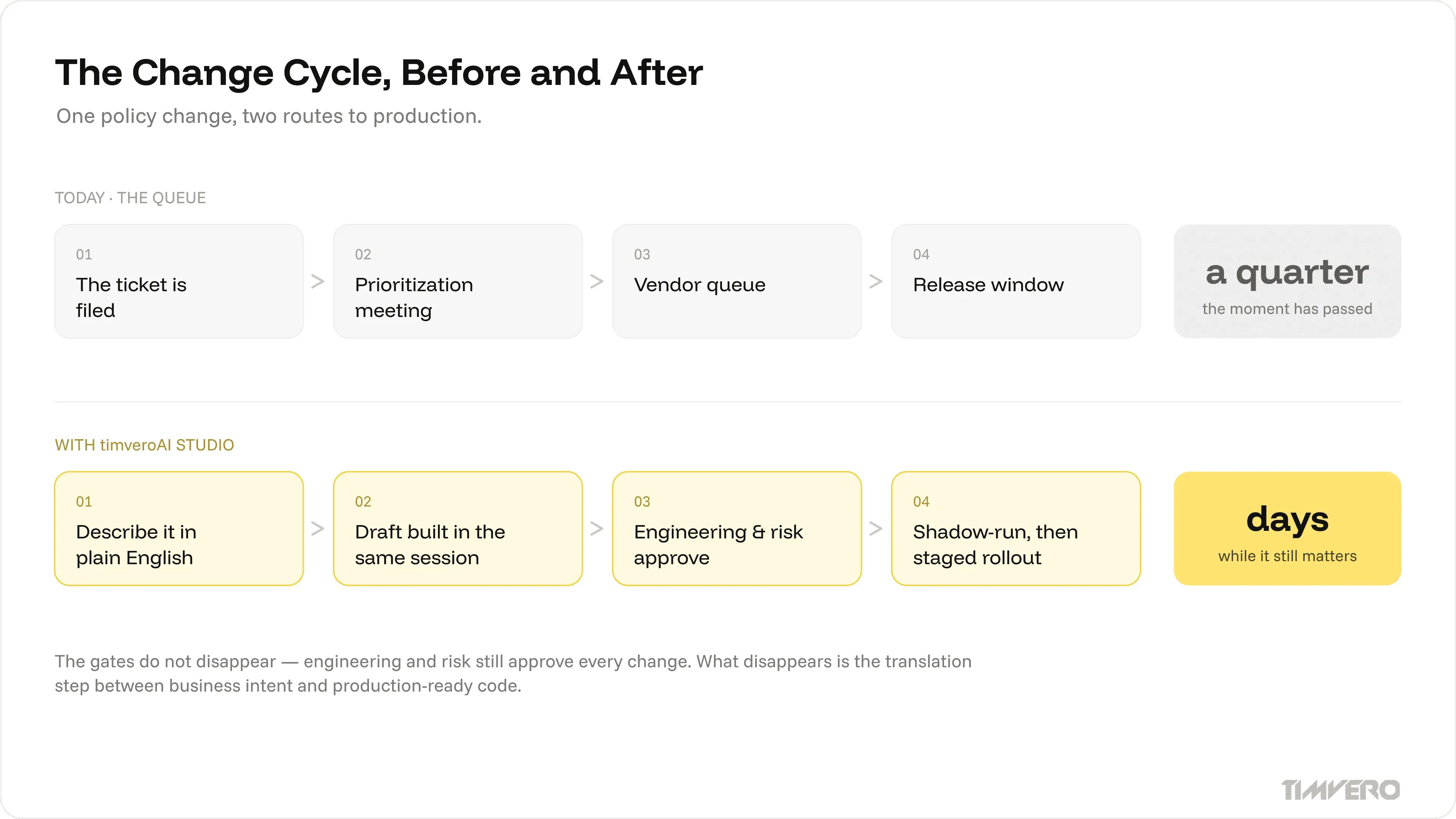
The change your P&L owner cannot make
Product logic in most lending stacks lives behind a change process the business does not control. A pricing tweak, an eligibility rule, a new document requirement — each requires someone else’s calendar. The result is measurable in the decision layer: McKinsey put the industry-standard timeline for implementing a new credit-decisioning model at 12 to 24 months, with an agile approach compressing it to under six months (McKinsey, 2021). That is the model, not the product wrapped around it.
The downstream effect shows in cycle times customers feel. Traditional banks average three to five weeks to a credit decision in SME lending and close to three months to cash, while best-in-class digital lenders reach time-to-yes in minutes (McKinsey, 2018). The distance between those two numbers is not underwriting talent. It is how quickly each institution can change its own process.
What the queue is actually protecting
Nobody in IT wakes up wanting to slow the business down. They have watched what a well-meant small tweak does to production: decisioning is interdependent, and automation is fragile at the seams. Guarding the merge gate is the correct instinct.
The evidence backs the caution. Around 68% of bank leaders say legacy technology architecture slowed their modernization efforts (Baringa via Banking Dive, 2025), and the ECB’s supervisory priorities note that the primary root cause of unplanned downtime in banks often lies in ICT system changes (ECB Banking Supervision, 2025). Change is genuinely where things break.
So the queue is a rational answer to business intent arriving in a form production cannot safely absorb. It is just not a fast one, and both sides end up paying for safety in the currency the market counts. What needs fixing is the interface between business intent and production-ready change — not either team’s discipline.
The cost of paying in speed
Meanwhile the comparison set moved. Fintech lenders took roughly 42% of unsecured personal loan originations in 2025, up from about 33% a year earlier (TransUnion, Q4 2025). They did not win on cheaper capital or looser credit. They won on the ability to change a product on a weekly cadence while an incumbent files a change request.
Dissatisfaction with the underlying stack is now openly measured: 35% of banks report being dissatisfied with their core processor, and core providers rate their own effectiveness at 4.31 out of 5 against bankers’ 2.78 (American Bankers Association, 2025).
The dependency underneath that number has become a supervisory topic rather than a vendor-relations one. In November 2025 the OCC issued a request for information on how community banks engage with their core and other essential third-party service providers (OCC Bulletin 2025–39, 2025). Speaking at an industry summit the following spring, Comptroller Jonathan Gould said he had heard “loud and clear” concerns about the relationship, including a “very uneven” commercial negotiating dynamic between smaller banks and certain service providers (reported by Banking Dive, 2026). When a regulator starts asking who controls the change queue, it has stopped being a matter of procurement preference.
The two speed paths lenders already tried — and where each stalls
Before AI enters the conversation, it is worth being precise about why the two existing options both cap out. This is the setup for the third path.
Configured platforms: fast on the easy part of the work
A configured lending platform automates the applications that follow the script. That is real value, and it arrives quickly. The ceiling is structural, and it has two mechanisms.
First, the architecture is fixed at design time. A prebuilt application ships with its data model, workflows, and extension points already decided — designed for the average lender before your institution appeared. Anything inside those extension points is a setting. Anything outside them is a change to the product’s core, which a vendor will not make for one customer.
Second, one codebase serves every customer. That is what makes multi-tenant economics work. Your special case would either have to ship to every other client or fork the codebase for you alone. So “configure anything” means: choose anything from the list of switches we pre-built — a list that covers what is generic across all lenders.
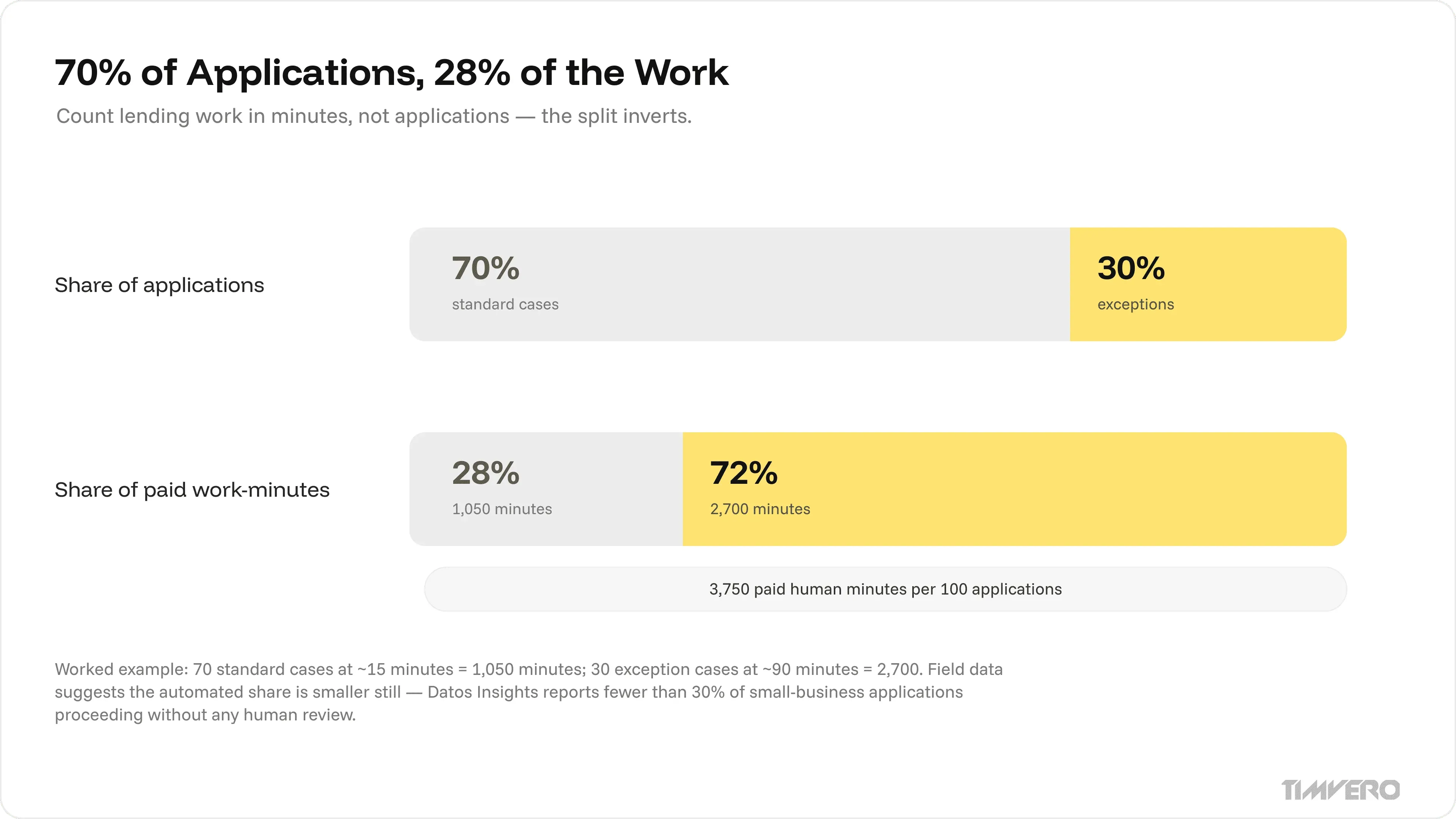
Count the work in minutes rather than applications and the ceiling becomes visible. If roughly 70 of every 100 applications follow the script at about 15 minutes of human touch, and 30 are exceptions at about 90 minutes, the easy majority is 1,050 minutes and the hard minority is 2,700. The straightforward 70% of applications is only 28% of the paid work. The exceptions carry the other 72% — and they are also where your underwriting edge lives.
That distribution is worth checking against field data, including where the data cuts against the assumption. McKinsey reports 70–80% of SME credit decisions fully automated at best-in-class digital lenders, with complex cases averaging roughly 90 minutes — but the same study records one Northern European bank that opened its fully automated “swim lane” for fewer than 15% of applications, mainly the less complex ones (McKinsey, 2018). More recently, Datos Insights described a small-business lending workflow with fewer than 30% of applications proceeding without any human review (Datos Insights, 2026).
That makes the split above conservative rather than flattering. If the genuinely automated share sits closer to 30% than to 70%, the manual residue is larger than assumed and the exception cases carry even more of the paid work, not less. The question worth asking any vendor is therefore not “how fast are you?” but “what share of my work-minutes can you actually reach?”
Custom build: a calendar you cannot compress
The alternative is to build the architecture yourself. The track record is unforgiving. McKinsey found only about 30% of core banking transformations over the previous decade succeeded in fully migrating ledgers and products, with planning taking up to three years and implementation running more than four; where scope crept, banks overspent by 100% and timelines stretched 50–100% (McKinsey, 2022). Large IT programs more broadly run 45% over budget and deliver 56% less value than predicted (McKinsey/University of Oxford, 2012 — dated, but the pattern has not reversed: independent meta-analysis of 2020–2024 project data still finds 31% success, 50% challenged, 19% failed, essentially flat against 2015–2017).
And it is not a budget problem. More than 80% of banks and credit unions planned to increase technology spending in 2026, yet many continue to fall short on planned system deployments — an ongoing disconnect between strategy and implementation (Cornerstone Advisors, 2026). Spending more does not compress a timeline that architecture has already set.
Neither path is a mistake by the people who chose it. They are two different ways to hit the same wall: a launch timeline set by architecture decided before your product existed.
The three-path comparison
| Building the first lending product | Build in-house | Assemble multiple vendors | timveroOS + timveroAI |
|---|---|---|---|
| Time to launch | 24 months | 9+ months | 3 months |
| Engineering team required | ~16.5 people | ~8 people | ~2.6 people |
| Indicative cost | ~$8M | ~$2.3M | ~$0.3M |
| Architectural control | Full | Fragmented across vendors | Full — code-level access to building blocks |
| Deployment | Self-hosted | Mostly multi-tenant | Self-hosted or private cloud |
| Each product after the first | Cheaper, slowly | Near full price every time | 6 weeks, then 4 — one system, one integration set |
Cost and duration figures are TIMVERO build-rate estimates at US mid-market rates for a first lending product; the ratios hold across regions but the absolute numbers depend on product complexity and integration scope. Treat them as a worked example to test against your own inputs, not a quote. These are product-launch timelines on a platform, not core-replacement timelines — see what this does not solve.
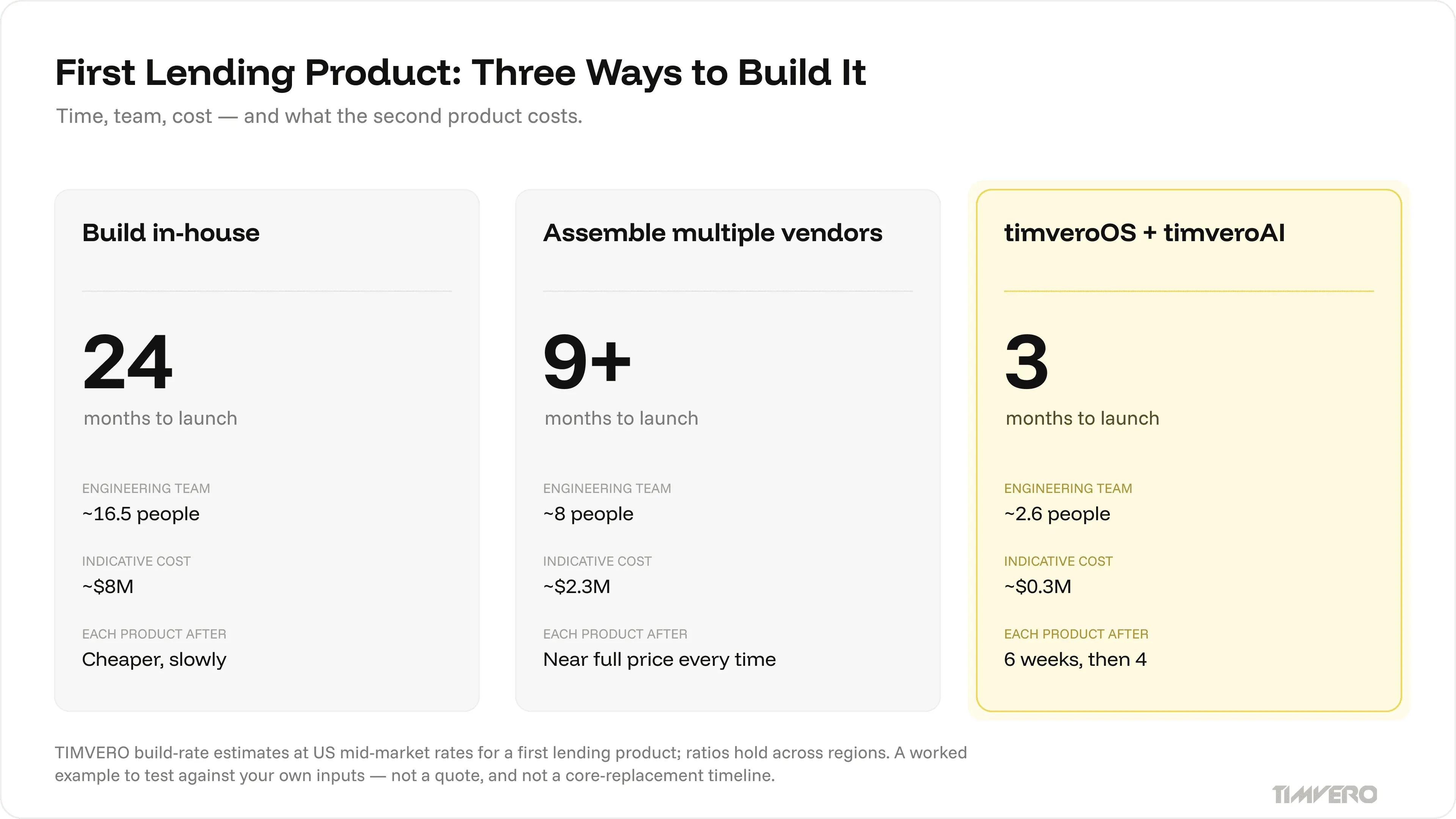
The last row is the one that compounds. A first launch is a project. The second, third, and fourth are the actual business case — and they only get cheaper if they run on the same architecture rather than on a new integration each time.
What “AI makes it fast” actually has to mean in lending
Every vendor in this market now claims AI speed. The claims are not equivalent, because they describe different things happening in different places.
Three ways AI can work — and why only one survives an audit
| Pattern | Plain name | Strong at | The problem in lending |
|---|---|---|---|
| AI answers live, on every case | AI as the worker | Reading documents, extracting data, classifying messy input | Cannot repeat itself exactly; cannot show a regulator 18 months later why a specific applicant was declined |
| AI writes the logic once, humans approve, the system repeats it | AI as the builder | Anything that must be repeatable and auditable | Needs something safe for the AI to build from |
| Both, each where it belongs | The workable answer | The whole lending lifecycle | — |
The distinction matters because of what supervisors require — and the binding requirement is not the one vendors usually cite. US model risk guidance was rewritten in 2026: SR 26–2, issued jointly by the Federal Reserve, OCC and FDIC on 17 April 2026, supersedes and replaces both SR 11–7 (2011) and SR 21–8 (2021), and is expected to be most relevant to banking organizations above $30 billion in total assets (Federal Reserve/OCC/FDIC, 2026). It keeps validation, ongoing monitoring, third-party model oversight and a maintained model inventory, and the agencies have signalled a separate request for information on how banks use AI.
The sharper obligation for lenders sits with the CFPB. Circulars 2022–03 and 2023–03 establish that an adverse-action notice must give specific, accurate reasons for a denial even when the decision relies on complex algorithms, and that generic reason codes do not satisfy it (CFPB, 2022; CFPB, 2023). Announcing the 2023 circular, then-Director Rohit Chopra left no room in it: “Creditors must be able to specifically explain their reasons for denial. There is no special exemption for artificial intelligence.”
In the EU, credit scoring for natural persons is high-risk under Annex III of the AI Act. Regulation (EU) 2026/1744 — the Digital Omnibus on AI, in force since 27 July 2026 — moved the application date for standalone high-risk obligations to 2 December 2027, while the Article 50 transparency obligations applied from 2 August 2026 as originally scheduled. The EBA’s November 2025 mapping exercise makes the practical point: the AI Act does not grant derogations or regulatory synergies for high-risk requirements such as human oversight, data governance and cybersecurity where EU financial services law already imposes its own, so the obligations stack rather than substitute.
Read together, that is a reconstruction requirement, not an accuracy requirement. A 99.9% accurate answer that cannot be reconstructed 18 months later still fails. Which is why production should never run a live model call for decision logic — it should run the approved, deterministic version, with the audit trail attached.
An AI that builds must build from something
Here is the part most AI-speed claims skip. What you hand the AI determines whether its output is safe.
| Give the AI… | What happens | Result |
|---|---|---|
| A blank codebase | It writes anything. Unlimited ways to be wrong; every review starts from zero | Agent-written code without boundaries is faster technical debt |
| A configured multi-tenant product | It can only recombine what the vendor pre-built — the same easy share of the work | Same ceiling, now with AI on the label |
| ~200 pre-verified lending building blocks | It composes only from tested parts. Mistakes are bounded and testable; reviews are quick | The difference that holds |
The measured evidence on generic AI coding assistance supports exactly this reading. A field experiment across 4,867 developers found a 26% increase in completed tasks with an AI assistant (Cui et al., 2025). But an independent randomized trial with experienced open-source developers found they took 19% longer with AI tools — while believing they had been 20% faster (METR, 2025). And DORA’s 2025 research found that although 90% of developers now use AI at work, 30% have little or no trust in AI-generated code, and higher adoption correlated negatively with delivery stability (Google Cloud/DORA, 2025).
Read together, those results say something specific: AI accelerates work where the target shape is already well defined and verifiable, and destabilizes it where it is not. In lending, the shape has to be supplied by the platform. That is what a verified building-block substrate is for — and it cannot be retrofitted in a quarter.
Lending’s own numbers show the same gap between expectation and outcome. Nearly 60% of bankers expect AI to have a moderate-to-strong impact on underwriting and lending processes while actual adoption remains limited, and more than 70% of institutions report little to no improvement in loan production despite their technology investment (Cornerstone Advisors, 2026 — commissioned by a lending software vendor; treat as directional). Appetite is not the constraint. What the tools are allowed to touch is.
How timveroAI compresses the launch timeline
timveroAI (opens in new tab) is the RAG-grounded implementation agent that sits on top of the Building Platform. It is grounded in the platform’s own source code, its lending ontology, and its skeleton library — not in general internet code. It composes building blocks; it does not invent architecture.
From plain-English intent to a reviewable draft
The old sequence was: the business owner writes requirements, hands them to engineering, waits, and receives something that may or may not match what she meant. Iterating means another trip through the same process.
The new sequence is that she describes the intent, sees the built draft in the same working session, corrects “no, I meant this” immediately, and engineers approve a clean artifact instead of translating a wish. timveroAI Studio is the surface where this happens, and it covers the whole lending business rather than credit decisions alone: pricing and product design, loan origination (opens in new tab) steps and document requirements, underwriting rules, servicing workflows, collections cadences, exception handling, reporting and alerts.
Clients run Studio in one of three modes and most move through them in sequence: TIMVERO drives while the client approves each requirement visually; the client co-refines requirements and signs off before any code while TIMVERO still drives the build; or the client’s own business users drive Studio, with a technical review gate protecting every merge. General rollout to all clients begins in October 2026.
Set the expectation honestly: this shortens buildout by roughly an order of magnitude — months to days on individual features — but not to a single prompt. The path that works is foundation first (the entities and the state machine), then expansion feature by feature.
Why risk and engineering sign off
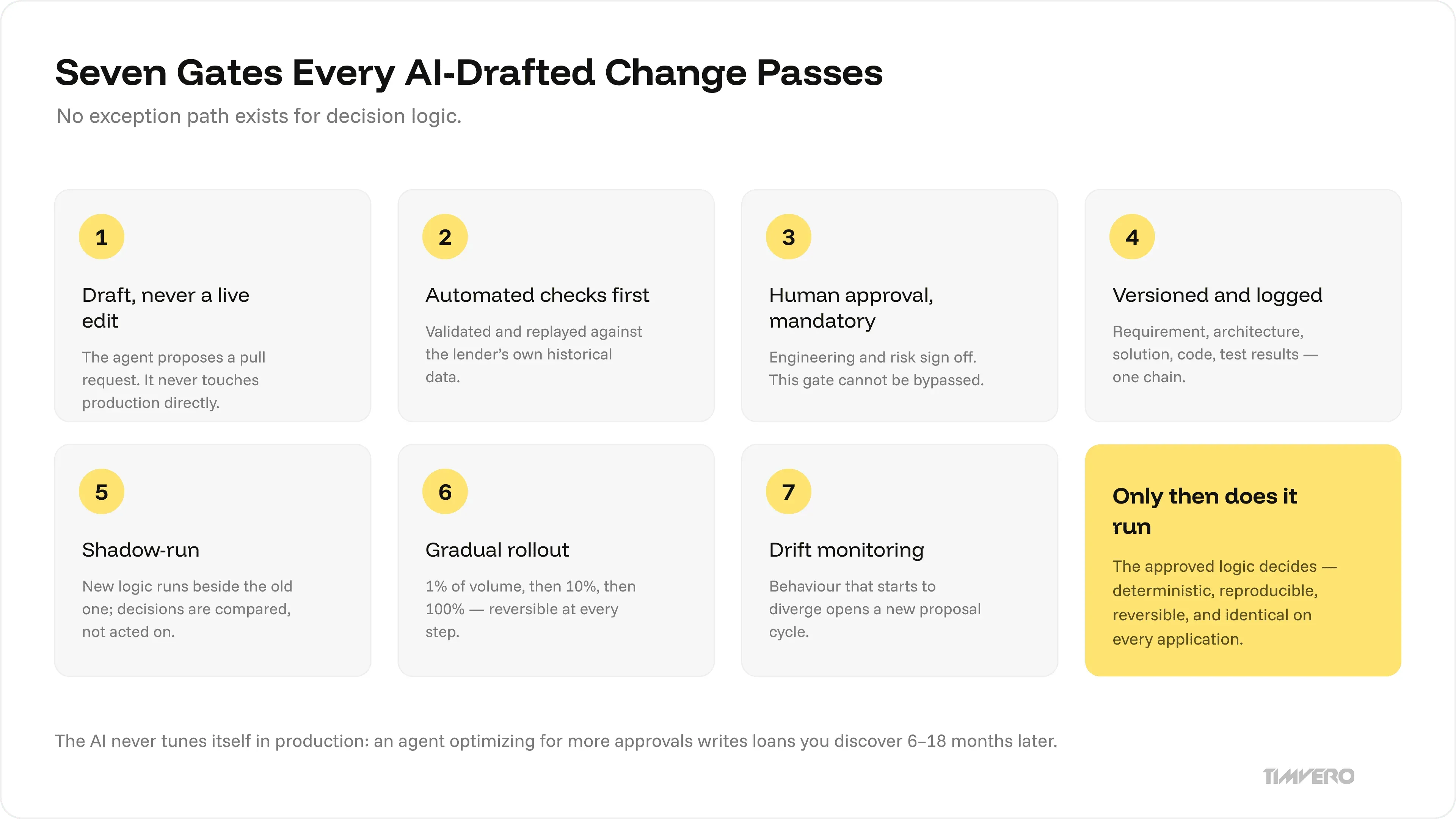
Speed that compliance rejects is not speed. Every change passes the same gates, with no exception path for decision logic:
- The AI proposes a draft. It never touches production directly — changes are pull requests, never live edits.
- Automatic checks run first. The draft is validated and replayed against the institution’s own historical data before a human spends time on it.
- Human approval is mandatory. Engineering and risk sign off. This gate cannot be bypassed for decision logic.
- Everything is versioned and logged. Who, what, when, why, and the prior version. Each feature carries its full chain: approved requirement → architecture → chosen solution → code → test results.
- Shadow-run mode. New logic runs beside the existing logic and decisions are compared, without acting, until the comparison passes.
- Gradual rollout. 1% of volume, then 10%, then 100% — reversible at every step.
- Drift monitoring. If live logic starts behaving differently, that opens a new proposal cycle rather than a silent divergence.
One thing the platform deliberately never does is let AI tune itself in production. An agent optimizing for more approvals and fewer exceptions quietly writes bad loans that surface 6–18 months later when the vintage seasons. The design point is automation, not autonomy: a human decides, once, at review.
timveroAI is not the scoring engine
These are two separate components and conflating them is the most common error in this category. timveroAI is an implementation and configuration agent: it runs during build and maintenance, it is used by the people configuring the platform, and it produces specifications, configurations and code. The explainable AI scoring engine is a runtime decisioning building block: it runs at every credit decision, it is used by the lending product itself, and it produces decisions with explainable reason codes.
If a buyer asks whether the AI makes credit decisions, the accurate answer is no. timveroAI drafts implementation work, humans approve it, and the approved deterministic logic decides — with explainable reason codes coming from the scoring building block, not from a language model.
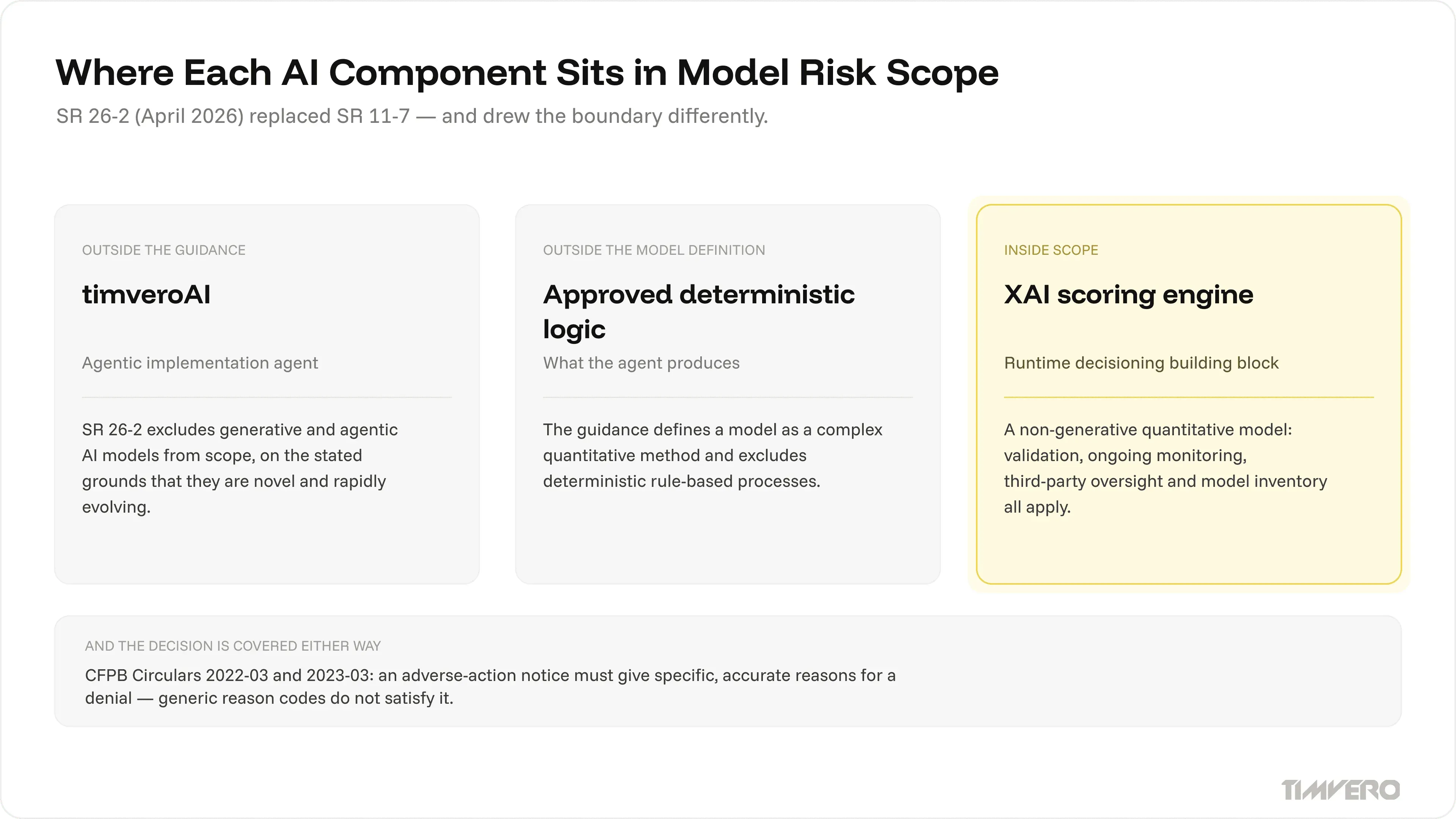
SR 26–2 turns that boundary from a stylistic distinction into a regulatory one. Its scope excludes generative and agentic AI models outright, on the stated grounds that they are novel and rapidly evolving, and its definition of a model excludes deterministic rule-based processes while keeping non-generative quantitative models firmly inside. Mapped onto the three components, they land in three different places: timveroAI is a build-time agent outside the guidance, the approved deterministic logic it produces is not a model under that definition, and the explainable scoring engine is a non-generative quantitative model inside scope — carrying the validation, monitoring and inventory obligations that follow. A platform that blurs the three cannot tell an examiner which is which.
The three questions buyers ask after the speed claim
Speed claims in this category have a credibility problem, and it is earned. Three questions decide whether a fast-launch promise survives contact with a procurement committee.
Does customizing break your upgrade path?
This is the right question, because on most platforms the answer is yes. Practitioner accounts across major lending and core systems describe the same trap: heavy customization makes upgrades difficult, and custom-built objects eventually have to be removed to keep receiving vendor updates. A buyer who has lived through that hears “code-level access” as a warning rather than a feature.
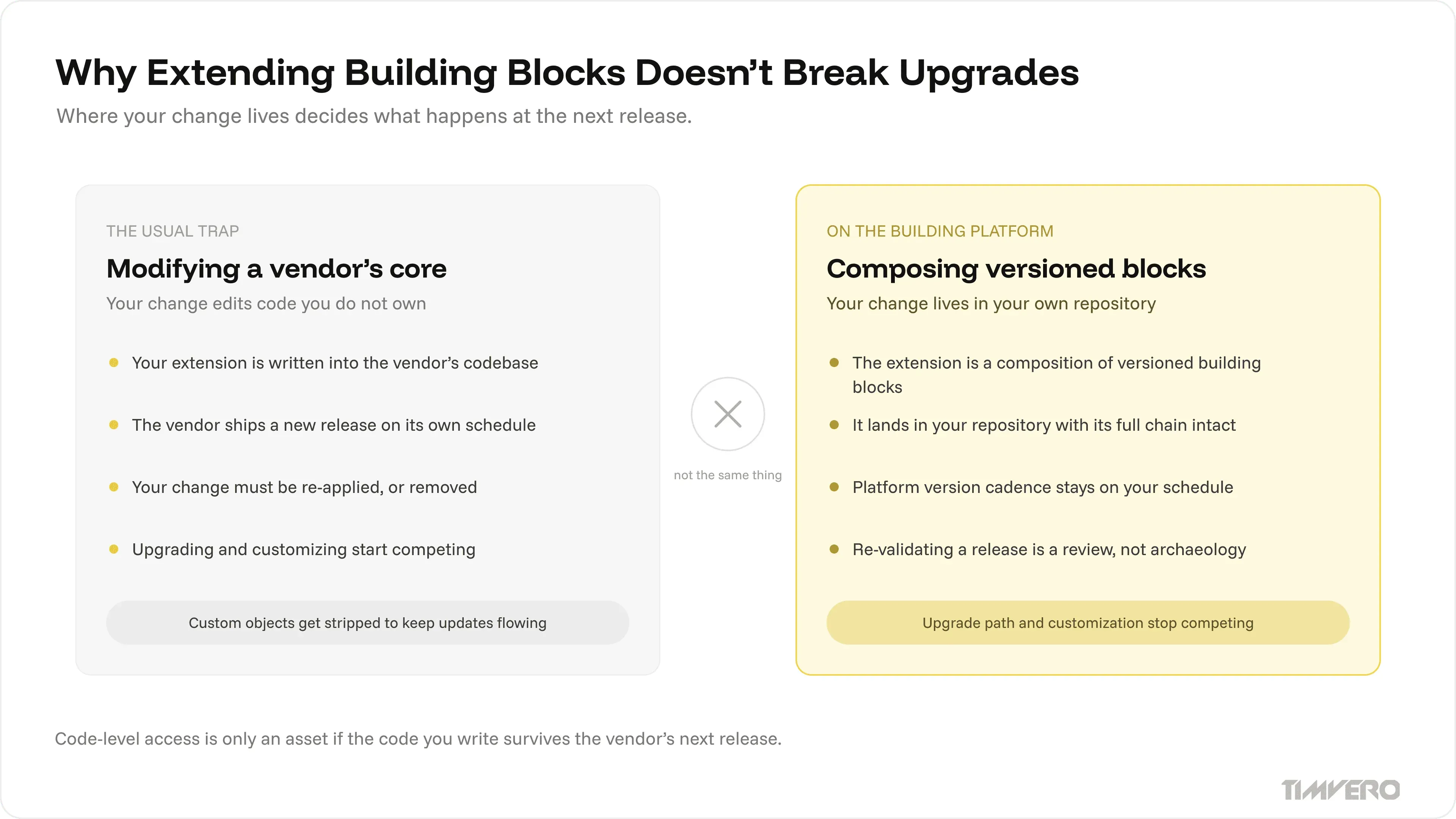
What decides the outcome is where the extension lives. On the Building Platform an extension is a composition of versioned building blocks that lands in your own repository with its full chain intact — approved requirement, architecture, chosen solution, code, test results — rather than a modification of a vendor’s core that has to be re-applied at every release. Platform version cadence stays on your schedule, and the recorded chain makes re-validating against a new release a review task instead of an archaeology project.
What does leaving look like?
Swappable components and freedom from lock-in are marketed by nearly everyone, and buyers have stopped taking either on trust: migration difficulty and historical data portability remain live complaints across the category. So the answer has to be structural rather than contractual.
Deployment in your own environment means the answer is already true before the question is asked. The data sits in your infrastructure, the code sits in your repository, and the platform version is yours. There is no export to negotiate because nothing of yours is being held. The same property settles less abstract problems too — a rural credit union running on a cloud-only platform reported being unable to process loans during internet outages.
What this does not solve
Two boundaries, stated plainly, because overclaiming either is how speed promises lose their credibility.
First, this is a product launch on an existing platform, not a core replacement. Those are different projects on different scales: core banking transformations run to years of planning and implementation, with only about 30% fully succeeding (McKinsey, 2022). Comparing a product-launch timeline against that band is not a like-for-like comparison, and we do not make one.
Second, composing a process is not the same as reading a document. Straight-through processing for document-heavy SME and mortgage lending — stipulations, income and employment verification, document collection — remains the industry’s hardest unsolved gap, and no building-block architecture repeals it. What changes is how quickly you can compose, test and revise the process wrapped around that work, and how much of the exception handling around it you can automate with your own rules.
What the timeline looks like in practice
Approved figures, so you can check them against your own plan: implementation compresses from 4–6 months to 3–6 weeks, timveroAI handles 70–80% of implementation work, and generated specification accuracy runs above 85%. Engineer time spent on boilerplate falls from 60–70% to under 20%. The platform behind these numbers runs $5.5B+ in AUM across 13+ countries and processes 7,000+ daily loan applications.
The client evidence tracks the same shape across very different institutions:
- AMIO Bank reached a production MVP in four months after three failed attempts with other approaches, with 8x faster time-to-yes and a 60% reduction in cost per loan — including 100% coverage of its non-standard product logic. See the AMIO Bank case study (opens in new tab).
- Finom launched banking-grade lending across five European countries in four months, serving 200K+ customers at 98% automation, with ROI from day one.
- Cartiga replaced Salesforce for its litigation finance business at roughly a tenth of the cost, with an 8-week MVP and a 10x faster implementation across a $1.6B+ deployed portfolio.
“What impressed me most was their ability to work at our pace, absorbing requirements on the fly, proposing solutions proactively, and adapting as our needs evolved. Today, we’re running proactive credit campaigns and sophisticated servicing operations on a single platform. timveroOS delivered a competitive advantage under impossible deadlines.”
— Alex Goncharenko, Head of Credit, Finom
“Every lender we meet has a list of changes they have decided not to ask for, because they know what asking costs. That list is the real product roadmap, and it is invisible to the vendor. Our job is to make the cost of asking low enough that the list disappears — which is an architecture problem before it is an AI problem.”
— Dmitriy Wolkenstein, CEO, TIMVERO
Is your launch problem architectural or procedural?
Four questions separate a slow process from a hard ceiling. If the answers point at architecture, no amount of process improvement will move your launch timeline.
| Question | Procedural problem | Architectural ceiling |
|---|---|---|
| When you request a product change, what comes back? | A date | A statement that the platform does not work that way |
| Where does your product logic live? | In configuration you control | In a vendor’s codebase |
| Can you replay a declined application from 18 months ago and reconstruct the exact logic that ran? | Yes, from your own audit trail | Only by asking the vendor |
| What happens to your exception cases? | Automated with your own rules | Routed to your most senior, most expensive people |
Where the answers land in the right-hand column, the third path applies: a Building Platform gives your engineers code-level access to the building blocks, deploys in your own environment, and pairs with timveroAI so a business owner can iterate without a hand-off. This fits lenders who are too specific for a configured product but not prepared to spend two years building architecture — which in practice means most lending software for banks (opens in new tab) buyers in the Tier 3–4 range, growth-stage lending software for fintechs (opens in new tab) buyers past MVP, and lending software for credit unions (opens in new tab) buyers with lean engineering teams. All three run on the same timveroOS loan management platform (opens in new tab) architecture.
Frequently Asked Questions
How long does it take to launch a new loan product with AI assistance?
On the Building Platform, a first lending product typically reaches production in about three months, and each product after it in four to six weeks. Individual features and policy changes compress from months to days. The gating factor is review and approval capacity, not code generation speed.
What is the difference between an AI implementation agent and AI credit scoring?
An implementation agent runs during build and maintenance: it drafts specifications, configurations and code that humans approve before anything ships. AI credit scoring runs at decision time inside the live product, producing decisions with explainable reason codes. Different components, different moments, different governance.
Does AI make the credit decisions in this setup?
No. timveroAI drafts implementation work and engineering and risk approve it; the approved, deterministic logic then makes every decision, and credit scoring comes from a separate explainable building block. A human decides once, at review, rather than an agent deciding continuously and unaccountably in production.
How do compliance and risk teams approve AI-generated changes?
Through seven mandatory gates: draft-only proposals, automated backtesting against the lender’s own history, human sign-off, full versioning, shadow-run comparison against existing logic, staged rollout from 1% of volume, and drift monitoring. The evidence they generate maps to what SR 26–2 and CFPB adverse-action guidance ask for. None can be skipped for decision logic.
Why do configured lending platforms still launch products slowly?
Their architecture and extension points are fixed at design time for an average lender, and one codebase serves every client, so changes outside the pre-built switches would require core modification or a fork. Where deep customization is permitted, it frequently breaks the upgrade path, and custom objects get stripped out to keep vendor updates flowing.
What should you ask a vendor about launch speed?
Ask what share of your work-minutes their platform can reach, not how fast it is. Every platform is quick on the applications it already handles. The exceptions carry most of the labour and all of the differentiation, so coverage of the hard cases is the question that predicts your real timeline.
See What Your Own Launch Timeline Looks Like
Bring one real change from your backlog — a pricing adjustment, an eligibility rule, a document requirement — and we will work through what it takes on the Building Platform with timveroAI, against your product and your constraints rather than a generic demo.
Request a demo → (opens in new tab)
For the engineering view of how the implementation agent works, see the timveroAI implementation agent (opens in new tab) overview.

Head of Marketing
Ivan Halynkin leads Growth & Marketing at TIMVERO, the company behind timveroOS and timveroAI. He works across the seam between product and demand — translating composable lending infrastructure into positioning, content, and demos that resonate with banks, credit unions, and fintechs. His writing focuses on what actually moves the needle for digital lenders: origination economics, AI in credit decisioning, and the trade-offs between SaaS lending boxes and building-platform thinking.
LinkedinLatest News

Agentic AI in Banking: What It Can and Cannot Decide
Bank Efficiency Ratio: What It Is and How to Improve It

Best AI-Powered Lending Platforms in 2026: A Buyer’s Guide

Lending Software Beyond SaaS vs Build: The Third Path

Embedded Lending for Vertical SaaS: Monetize & Own It

Best Loan Origination Software in 2026: 10 Systems Compared
How U.S. Banks Should Rethink Credit Card Strategy in a Potential 10% APR Cap Environment
Automated Loan Origination: How Lenders Cut Abandonment Rates and Speed Up Approvals

What Is Embedded Lending? How It Works and Why It Matters