



Loan Origination Process: Steps, Workflow and Where to Automate
Every loan passes through the same seven steps, from application to disbursement. This guide shows what happens at each step, where applications stall, and which work to automate and which to keep with your credit team.
Every loan, from a point-of-sale instalment to a commercial credit line, passes through the same chain of work between the application and the money leaving the account. This guide breaks the loan origination process into seven steps, shows how a workflow connects them, and maps which work to automate and which to keep with your credit team.
If you are reviewing the system that runs this workflow, see how timveroOS handles loan origination from application to funding.
Key Takeaways
- Seven steps: application, identity and fraud checks, data gathering, underwriting and decision, pricing and offer, documents and signing, disbursement and handover to servicing.
- The workflow matters as much as the steps. Most delay sits between steps: in queues, re-keyed data and referrals that arrive without a reason.
- Automate the standard path and the data work around every decision. Bureau pulls, document extraction, rule checks, offer generation and booking repeat on every application.
- Keep people on judgement and authority. Referrals, policy exceptions, large exposures and reviews that a regulator or an applicant can ask for stay with your credit team.
- Exceptions carry the cost. In a model of 100 applications, 30 exceptions take about 72% of underwriting time, so faster exception handling pays more than shaving seconds off approvals.
What Is the Loan Origination Process?
The loan origination process is the sequence of steps a lender follows from the moment someone applies for credit until the loan is funded and handed to servicing. It covers application intake, identity checks, data gathering, underwriting, pricing, documentation and disbursement. A loan origination system (LOS) runs this process as a workflow.
“Loan processing” is often used for the operational part of the same work: collecting documents, verifying data and preparing the file for a decision. In this guide, loan processing sits inside the origination process.
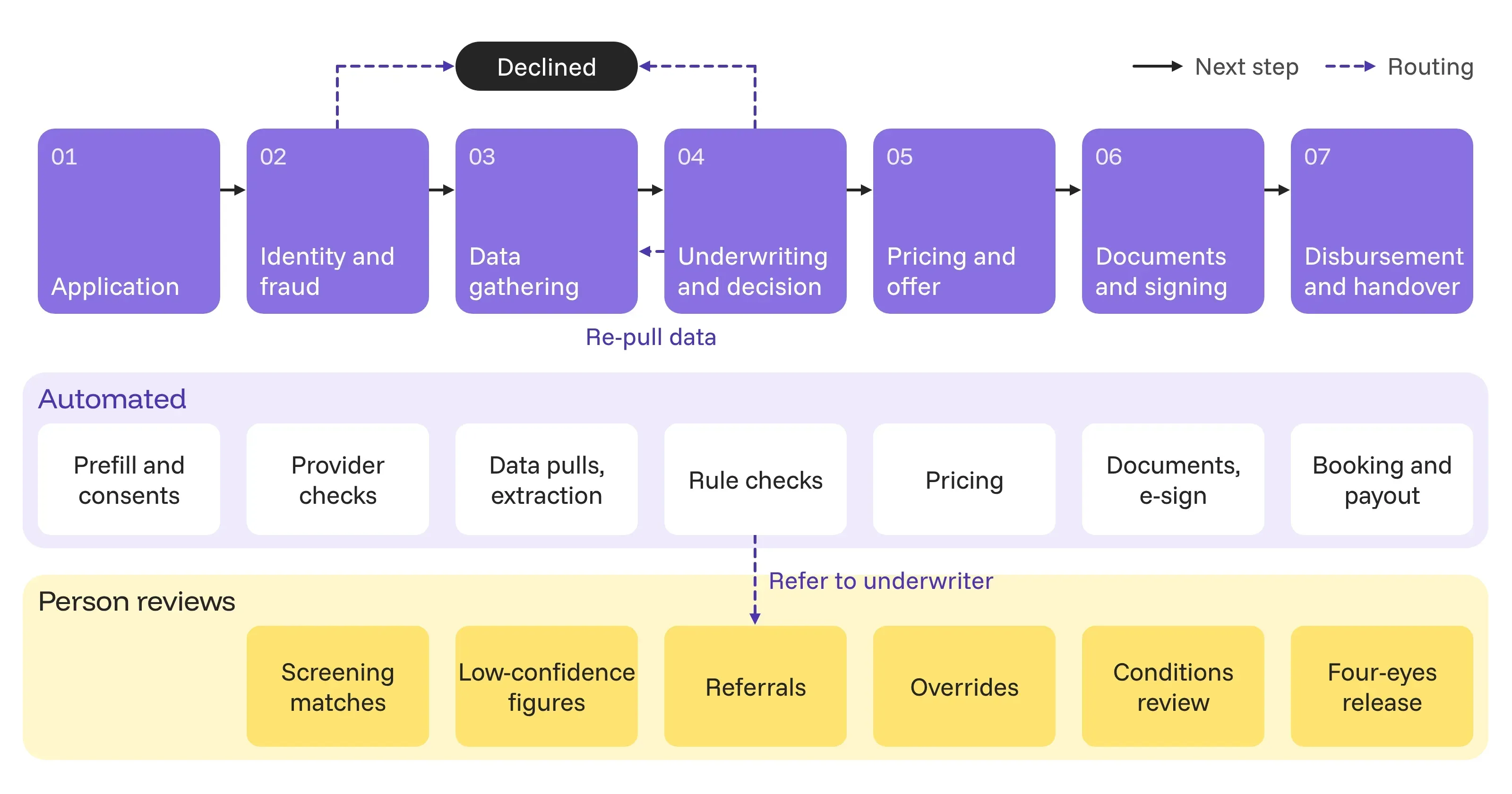
The 7 Steps of the Loan Origination Process
The names vary by lender and product, and some steps run in parallel. The work inside them stays the same.
1. Application and Pre-Qualification
The applicant applies through your app, website, a branch, a broker or a merchant’s checkout. The lender captures consents for bureau and open banking checks and may run a soft check to show what the applicant is likely to qualify for.
- Where it stalls: long forms, questions about data the lender already holds, and no way to save and return. Every extra screen costs completed applications.
- What to automate: prefill from existing customer data, pre-qualification on a soft check, the offers the applicant qualifies for shown before the full application, consent capture and save-and-resume.
- Where a person helps: complex business applications, where a relationship manager or broker gathers the file with the client.
2. Identity, KYC / KYB and Fraud Checks
The lender confirms who the applicant is: identity verification, sanctions and PEP screening, and for business borrowers the company, its directors and its beneficial owners. Device and behaviour signals help catch fraud early.
- Where it stalls: manual document checks and screening hits that sit in a shared inbox.
- What to automate: provider calls in parallel, automatic clearing of clean results, and routing of every hit to a named queue with the reason attached.
- Where a person decides: possible sanctions or PEP matches, enhanced due diligence and suspected fraud.
3. Data Gathering and Verification
The lender collects the data the credit decision needs: bureau reports, open banking transactions, income and employment, and for business lending financial statements, bank statements and collateral details. Raw data becomes the figures the policy uses, such as debt-to-income or debt-service coverage.
- Where it stalls: figures retyped from PDFs, documents chased by email, and data that goes stale while the application waits, so the bureau report has to be pulled again.
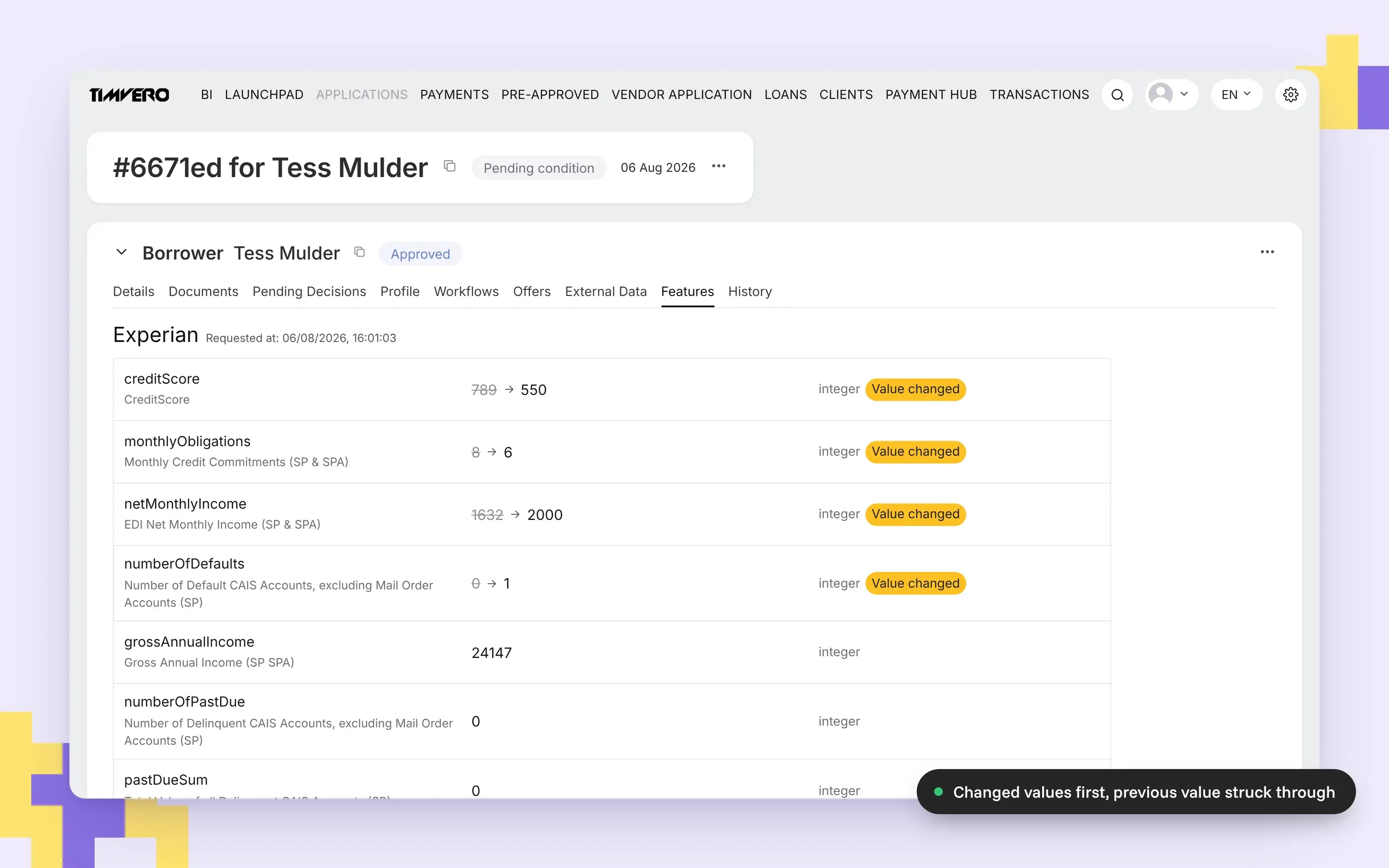
- What to automate: data pulls, extraction of figures from documents, calculation of the decision inputs, and a re-request that shows exactly which values changed since the last response.
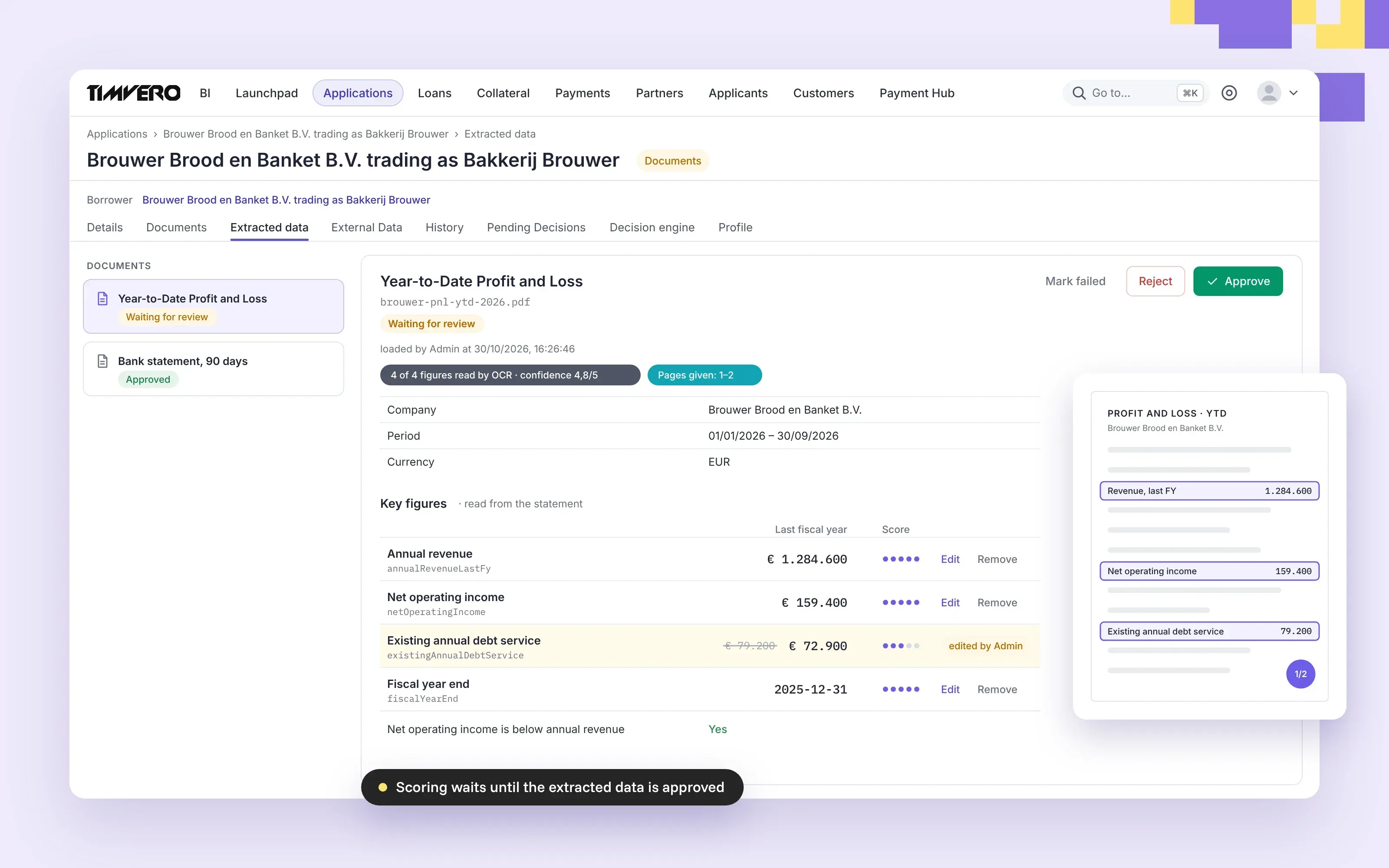
- Where a person checks: extracted figures with low confidence, unusual documents and conflicting sources.
4. Underwriting and Credit Decision
The credit policy runs against the data: eligibility rules, affordability, scorecards or models, and exposure limits. The outcome is approve, decline, counteroffer or refer to an underwriter.
- Where it stalls: a credit policy kept in a document that IT translates into code, referrals that arrive without the reason they were referred, and decisions nobody can explain afterwards.
- What to automate: the rules for the standard path, a decision record that keeps the path taken and the values behind it, and referrals that carry their reason and data to the reviewer.
- Where a person decides: referred applications, exceptions to policy, amounts above a delegated authority, and credit committee cases.
Explaining decisions is a legal duty in the US and the EU. In the US, Regulation B requires a creditor to notify the applicant of its action within 30 days of a completed application and to give specific reasons for adverse action, or disclose the right to receive them (12 CFR 1002.9 (opens in new tab)). In the EU, where a consumer credit assessment uses automated processing, the consumer can ask for human intervention and an explanation of the assessment (Directive (EU) 2023/2225, Article 18 (opens in new tab)). EU banks also follow the EBA Guidelines on loan origination and monitoring (opens in new tab), applied from 30 June 2021, which bring credit decision-making with automated models under internal governance. References checked 17 November 2026.
5. Pricing, Offer and Acceptance
An approved application becomes an offer: amount, term, rate, fees and conditions. Risk-based pricing sets the rate by risk grade, product and channel, and the offer carries the disclosures the market requires.
- Where it stalls: rate cards in spreadsheets, manual counteroffers and disclosures assembled by hand.
- What to automate: pricing from rules by risk grade, counteroffer generation within policy, disclosure documents and offer expiry.
- Where a person decides: negotiated pricing on commercial loans and any price override beyond delegated authority.
6. Documentation, Signing and Pre-Funding Checks
The lender generates the loan agreement, collects signatures and clears the conditions before funding: guarantees, insurance, collateral registration or a final check that nothing changed since approval.
- Where it stalls: agreements edited by hand, conditions tracked in email, and signed documents filed in a separate system.
- What to automate: documents from templates filled with the approved terms, e-signature, a conditions checklist with owners, and a final re-check before funding.
- Where a person decides: conditions that need legal or credit judgement, especially on secured and commercial loans.
7. Disbursement and Handover to Servicing
The lender pays out the funds to the borrower, a merchant or a third party, books the loan and creates the repayment schedule. From here the loan belongs to servicing: billing, payments, arrears and collections.
- Where it stalls: loan terms retyped into a core or servicing system, mismatches between what was approved and what was booked, and manual payment instructions.
- What to automate: payment instructions, booking and schedule creation from the approved terms, in the same system or through an API.
- Where a person decides: four-eyes release of large payments and staged draws, for example on construction loans.
The Loan Origination Workflow: How the Steps Connect
A list of steps describes the work. A workflow describes how an application moves through it: who owns it at each moment, what runs in parallel, and what happens when something does not fit. In a loan origination system the workflow is usually built from four parts.
- Statuses. Each application has one current status, for example submitted, data collection, decision pending, referred, approved, offer accepted, documents signed, funded, declined or withdrawn.
- Automated actions. Calls to data providers, rule checks, calculations and document generation that run when an application enters a status.
- Human tasks. Reviews and approvals assigned to a role, with a queue, an owner and the time the item has waited.
- Routing rules. Conditions that move the application forward, back or sideways: refer if affordability fails, re-pull the bureau report if it is older than the policy allows, request a document if a figure is missing.
The workflow is where time goes. An application that takes two days to decide rarely spends two days being worked on: it waits in queues, for documents, or for someone to notice it. Track time per status and you see where to act first.
Each product needs its own version of the workflow, so the loan origination system has to make product variants cheap to build and change. Here is how the same seven steps change by product.
| Product | Decision speed the market expects | Main data | Where people step in |
|---|---|---|---|
| BNPL and point-of-sale credit | Seconds, inside the checkout | Bureau, affordability check, device and fraud signals | Fraud hits; hardship and arrears after funding |
| Consumer instalment loans | Minutes to the same day | Bureau, open banking, income | Referrals near cut-offs, missing documents |
| SME loans | Days | Financial and bank statements, KYB, bureau | Underwriter review above set amounts |
| Secured and commercial loans | Weeks | Collateral, valuation, covenants, ownership | Credit committee, legal review, staged draws |
Where to Automate Loan Origination and Where to Keep People
Loan origination automation pays where work repeats on every application and follows rules. Judgement, authority and accountability stay with people. The split that decides where to start is between the standard path and the exceptions.
Here is a model with its arithmetic. Take 100 applications: 70 standard cases at about 15 minutes each take 1,050 minutes, and 30 exceptions at about 90 minutes each take 2,700 minutes. The standard cases carry about 28% of the paid minutes and the exceptions about 72%. Automating the standard path is the first step. The larger saving comes from making each exception faster to resolve: the reason, the data and the decision record on one screen, in a queue with an owner.
| Step | Automate | Keep with a person |
|---|---|---|
| 1. Application | Prefill, pre-qualification, offers shown before applying, consents | Complex business applications |
| 2. Identity and fraud | Provider calls, clearing clean results, routing hits with reasons | Possible matches, enhanced due diligence, suspected fraud |
| 3. Data gathering | Bureau and open banking pulls, document extraction, calculated inputs, change detection on re-pulls | Low-confidence figures, conflicting sources |
| 4. Underwriting | Standard-path rules, decision records, referral reasons | Referrals, policy exceptions, amounts above authority |
| 5. Pricing and offer | Risk-based pricing, counteroffers within policy, disclosures | Negotiated pricing, overrides |
| 6. Documents | Agreements from templates, e-signature, conditions tracking | Conditions that need legal or credit judgement |
| 7. Disbursement | Payment instructions, booking, schedule creation | Four-eyes release of large payments, staged draws |
Four rules help automated loan processing hold up under audit and volume:
- Automate the data work before the decision. Retyping and chasing data costs more staff time than the decision itself, and errors made there flow into every later step.
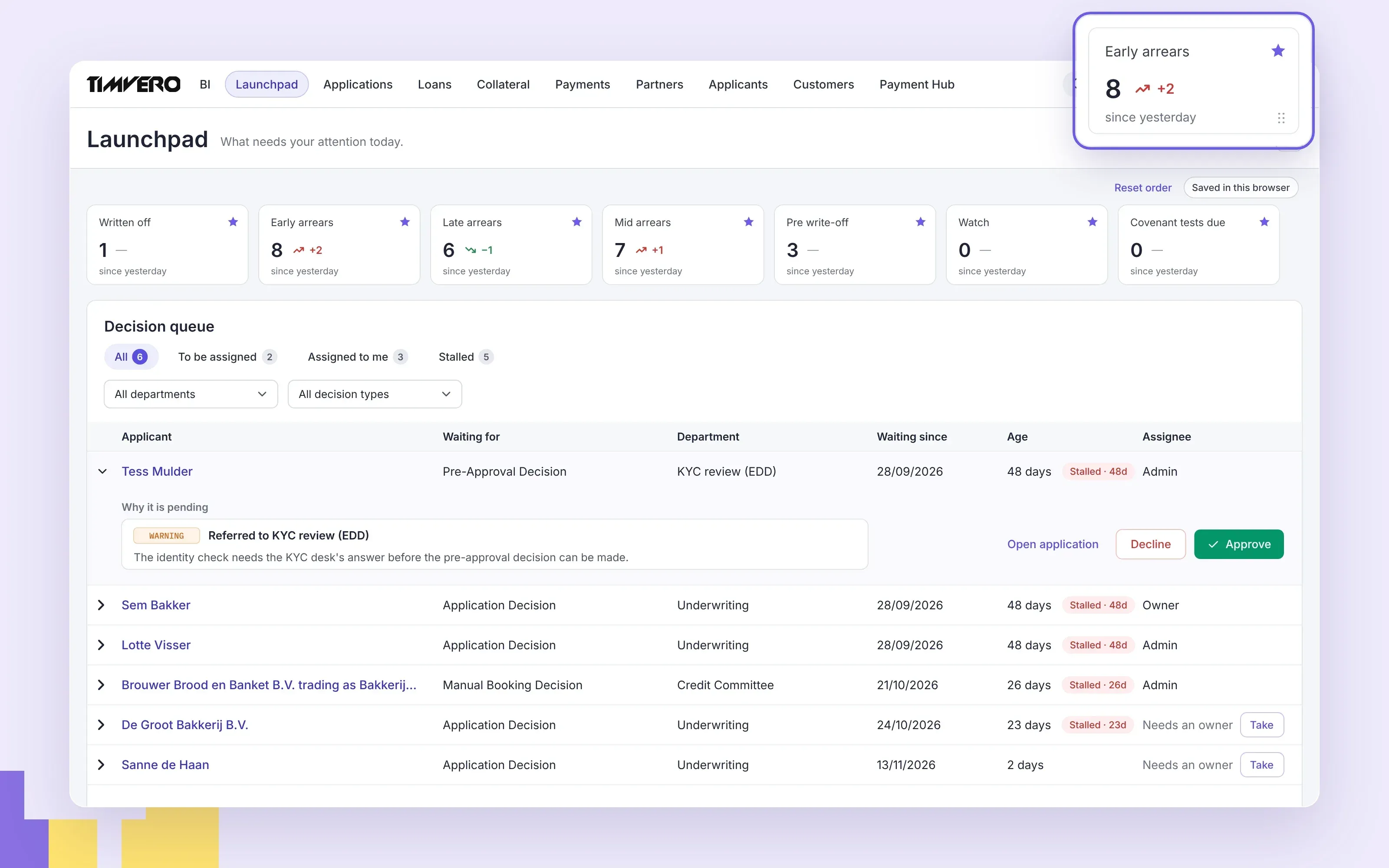
- Give every referral a reason. A reviewer who opens a referred application should see which rule sent it, the values involved and the path the application took.
- Keep a decision record for every application. It answers the applicant who asks why, the examiner who samples files and the analyst who tunes the policy.
- Set authority levels in the system. Who can approve what amount, override which rule and release which payment belongs in configuration, where it is enforced and logged.
Metrics to Track Across the Workflow
Measure the workflow before you change it, then measure each change against the same numbers.
| Metric | What it shows |
|---|---|
| Time to decision | Speed from a completed application to approve, decline or offer |
| Time to fund | Speed from approval to money paid out |
| Straight-through rate | Share of applications decided with no manual touch |
| Referral rate and referral age | How much reaches underwriters and how long it waits |
| Abandonment by step | Where applicants leave before finishing |
| Pull-through rate | Share of approved offers that are accepted and funded |
| Override rate | How often people reverse the automated outcome, a signal that a rule needs tuning |
| Cost per funded loan | Total origination cost divided by loans funded |
Changing the Workflow Safely
The workflow keeps changing. Credit policy tightens or loosens, a new product needs its own steps, a regulator adds a check, a data provider is replaced. In many lenders each of these is a change request to IT or to the vendor, and the queue for changes becomes the real limit on how fast lending can move.
A change to origination logic should follow the same path every time:
- Draft the change in the form the system runs.
- Test it on sample or past applications and compare the outcomes with the current version.
- Approve it by a person with the authority to change that policy.
- Activate it at a set time, with the previous version kept for rollback.
- Record who changed what, when and why.
This path keeps every change auditable and keeps the credit team in charge of its own policy.
How timveroOS Runs the Origination Workflow
timveroOS is a lending solution that covers the full lending lifecycle, origination through servicing and collections, so an approved loan moves into servicing in the same system without re-keying. It is headless: your app calls the API, shows the customer the steps available now and keeps your brand on every screen, while your credit team works the same applications in the back office. Here is how the loan origination steps above run on it:
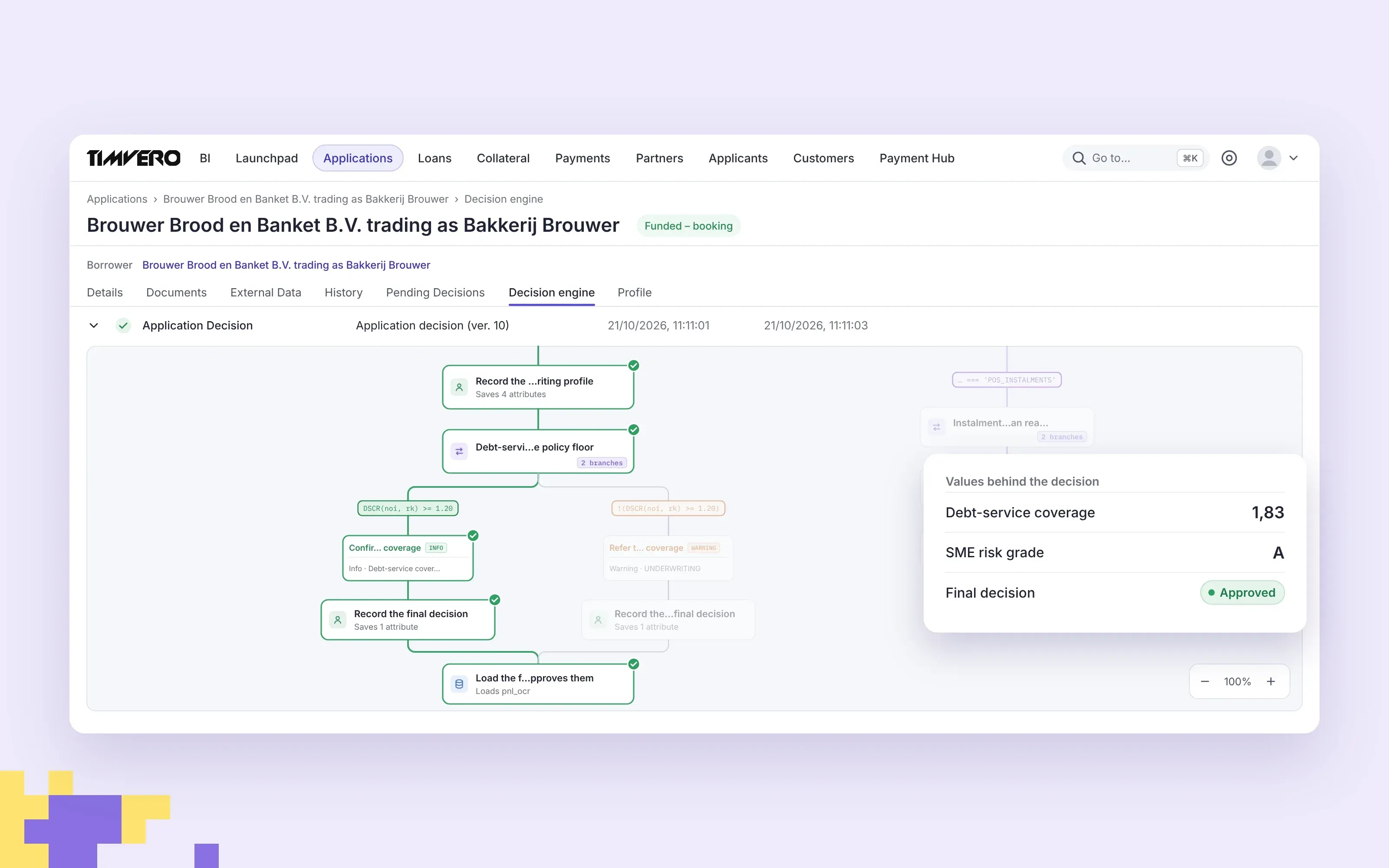
- Data: the Feature Store maps bureau, open banking, KYC and internal data into named, versioned features that rules and decision trees read. When a data source is requested again, the underwriter sees which values changed since the last response.
- Documents: figures are read off borrowers’ documents, staff check and approve them, and scoring waits for the approval.
- Decisions: each application keeps a decision trail with the path it took and the values behind the outcome.
- Exceptions: a decision queue shows pending decisions by owner and age, why each one is pending, and lets the reviewer approve or decline in place.
- Offers and servicing: the offer engine prices each product variant against the applicant’s profile, and the servicing ledger takes over schedules, repayments, fees and arrears after funding.
Changes to origination steps, document requirements and underwriting rules follow the path described above. In timveroAI Studio, the lending team describes the change in plain language; timveroAI drafts the change, people approve it, and the approved logic runs deterministically. The first product goes live in 3 weeks, each next credit product in 1 week, and changes to an existing product take days. See how timveroAI drafts changes for your team to review.
AMIO Bank, an Armenian bank, covered 100% of its bespoke origination requirements on timveroOS and reached 95% automation.
For how automated origination shapes the borrower’s side of the process, read how automated loan origination improves customer satisfaction.
Frequently Asked Questions
What are the steps of the loan origination process?
The loan origination process has seven steps: application and pre-qualification; identity, KYC and fraud checks; data gathering and verification; underwriting and the credit decision; pricing, offer and acceptance; documentation, signing and pre-funding checks; and disbursement with handover to servicing. Some lenders merge or split steps, and several run in parallel, but the work inside them stays the same.
What is a loan origination system workflow?
A loan origination system workflow is the configured path an application follows inside the LOS. It combines statuses, automated actions such as data pulls and rule checks, human tasks such as reviews and approvals, and routing rules that move the application forward, back to an earlier step or to a reviewer. Each product usually has its own workflow.
What is the difference between loan origination and loan processing?
Loan origination is the whole sequence from application to funding. Loan processing usually means the operational part of it: collecting documents, verifying data and preparing the file for underwriting. Automated loan processing therefore covers the data and document work that feeds the credit decision.
Which parts of loan origination can be automated?
Data pulls from bureaus and open banking, document extraction, identity checks, rule-based decisions on the standard path, risk-based pricing, offer and agreement generation, e-signature, booking and payment instructions can all be automated. Referrals, policy exceptions, large exposures and reviews requested by an applicant or a regulator stay with people.
How long does loan origination take?
It depends on the product. Point-of-sale credit is decided in seconds at checkout, consumer instalment loans in minutes to a day, SME loans in days, and secured or commercial loans in weeks. Most of the elapsed time is waiting between steps, so the workflow has more effect on speed than any single check.
Does automated loan processing replace underwriters?
No. Automation takes the repetitive work: pulling data, calculating inputs and deciding the clear cases. Underwriters spend their time on the applications that need judgement, with the reason for each referral, the data and the decision record in front of them.
How is loan origination different from loan servicing?
Origination ends when the loan is funded and booked. Servicing starts there: billing, payment processing, schedule changes, arrears and collections until the loan is repaid. A loan management system (LMS) usually covers servicing, and some platforms, timveroOS among them, run origination and servicing in one system.

Head of Marketing
Ivan Halynkin is Head of Marketing at TIMVERO, the company behind timveroOS and timveroAI. He connects product and demand, turning the Building Platform into positioning, content and demos for small banks, credit unions, neobanks and fintech lenders. He writes about origination economics, governed AI in credit decisioning, and how lenders choose between SaaS, a custom build and a Building Platform.
LinkedinLatest News
Why Digital Banks Keep Taking Share and Why AI Is About to Widen the Gap

Embedded Lending Platform: APIs and Technical Requirements
Digital Transformation in Lending: What Actually Works

Boxed LMS vs SDK-Based Platform: What Will Growing Fintechs Choose in 2025?

How to Build Composable Loan Management Software Using an SDK: A Step-by-Step Guide for Fintech Teams

“We’ll Build Our Own LMS”: Why That Decision Might Cost You More Than You Think

How FinTechs Build Loyalty via Design, Speed & Transparency

BNPL Software in 2026: Build, Buy, or Composable Infrastructure?
The Race to Real-Time Lending: Why Static Loan Systems Are Holding You Back