

Lease Management Software for Asset Finance, Built on a Building Platform
timveroOS lease management software unifies quoting, origination, servicing, and end-of-term across operating, finance, and balloon leases.
Asset-first data models, residual and FMV tracking, and policies-as-code run in your own environment, not on a vendor’s shared schema. Independent lessors, captive finance arms, and Tier 3-4 banks get architectural control without 18 months of custom development.

Request a Custom Demo
Tell us the leasing flow you want to see: operating quote-to-contract, finance lease end-of-term, balloon servicing, or your dealer subvention pattern. We tailor the demo bench to your exact case.
Request a DemoYour Flow. Our Bench.
- $5.5B+ In Loans Managed
- 13+ Regulated Markets Live
- 5.0 ★ Verified Customer Rating
- 2-6 wks From Signing to First Lease
Trusted by banks, independent lessors, and captive finance teams across 13+ regulated markets






Why Leasing Doesn’t Fit Standard Loan Software
Leasing is not a loan with a different label. It carries assets, residual values, vendors, dealers, insurance, telematics, mid-term events, and end-of-term decisions that don’t map onto installment schemas. Teams running operating, finance, and balloon leases across banks, independent lessors, NBFIs, and captive finance arms hit the same architectural ceiling.
-
Asset Structures Don’t Fit Standard Data Models
Generic SaaS LMS platforms were built for a single borrower and a fixed amortization schedule. Leases need VIN- or serial-level asset records, residual-value tracking, FMV updates, warranty and maintenance state, and telematics feeds, none of which is native to a loan schema.
-
Multi-Country Operations Need Real Flexibility
Lessors operating across countries need a multi-country lease compliance platform that handles VAT and sales-tax treatments, regional disclosure rules, and local accounting variations at the architectural level, not as a vendor’s localization toggle.
-
Captive and Vendor Finance Need Dealer-Grade Flows
Quote-to-contract for dealers, subventions, buy-downs, OEM inventory tie-ins: these are first-class workflows in captive finance, not nice-to-haves bolted onto a consumer-loan platform.
-
Compliance Sits Behind Vendor Permissions
Tier 3-4 banks launching leasing products can’t accept “your compliance is in our config”. Regulators want transparent decision logic and audit trails, not vendor black boxes.


Built for Asset Finance, Not Repurposed From Loans
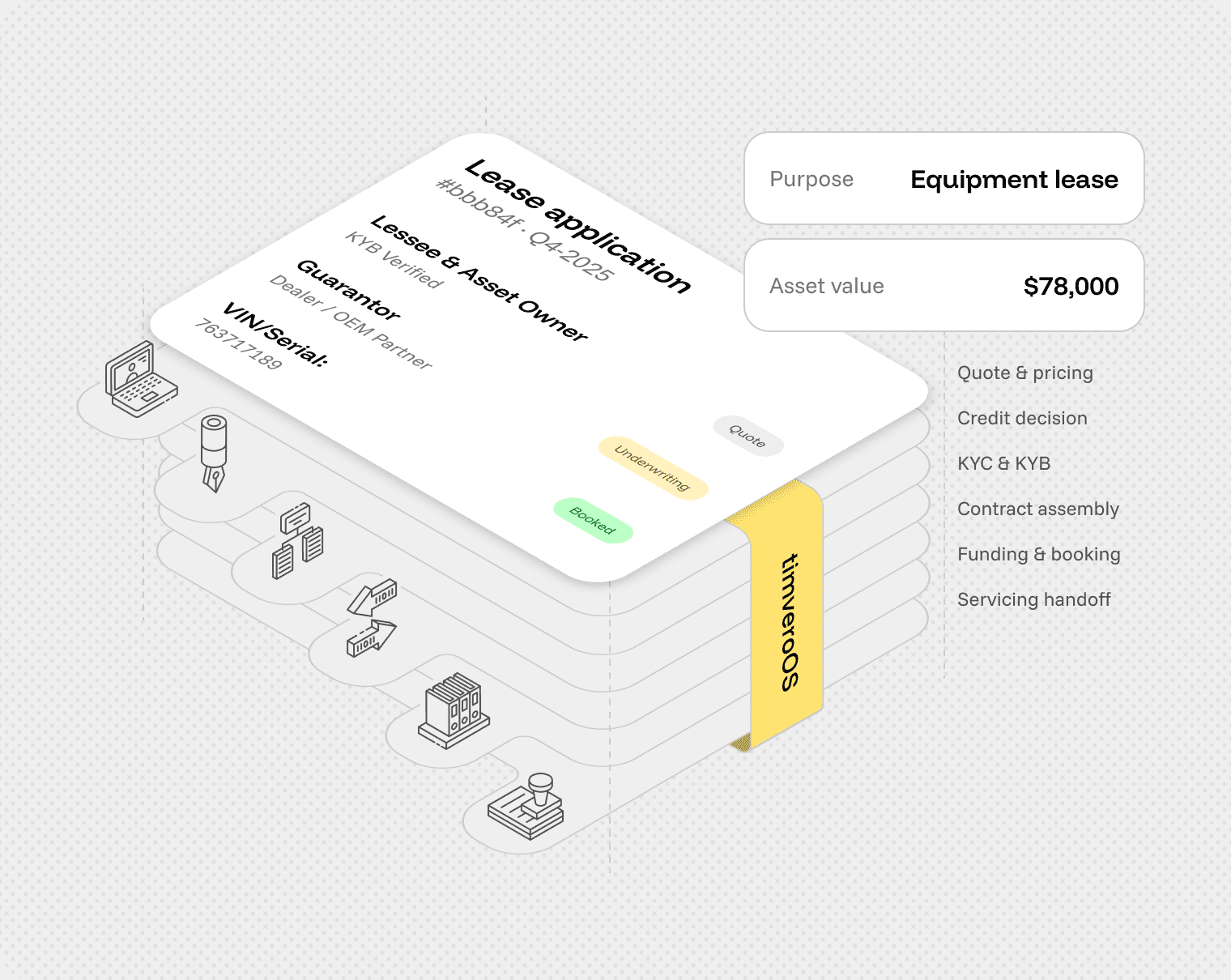
timveroOS lease origination software composes operating, finance, and balloon structures on the same Building Platform. Configurable flows assemble quote, credit decision, KYC, contract, and funding without bolt-on connectors. Dealer and OEM portals plug in as native components.
-
Quote-to-Contract Built for Asset Finance
Operating, finance, and balloon leases composed from the same primitives. Calculators for IRR, residuals, balloon payments, and taxes. KYC and KYB, soft credit pulls, and contract assembly run as governed flows.
-
Lease Servicing With Asset-First Precision
VIN- and serial-level registries, warranty and insurance state, maintenance schedules, and telematics feeds run as first-class entities. AccrualEngine handles indexation, fees, taxes, and GL posting alongside servicing actions.
Asset-First Precision Through to Remarketing
End-of-term workflows run as policies-as-code, not as spreadsheets. Residual value risk lives inside the asset record. Captive finance teams get dealer-facing portals, subvention and buy-down logic, and OEM inventory tie-ins as composed building blocks.
-
End-of-Term Logic and Residual Value Risk Tracking
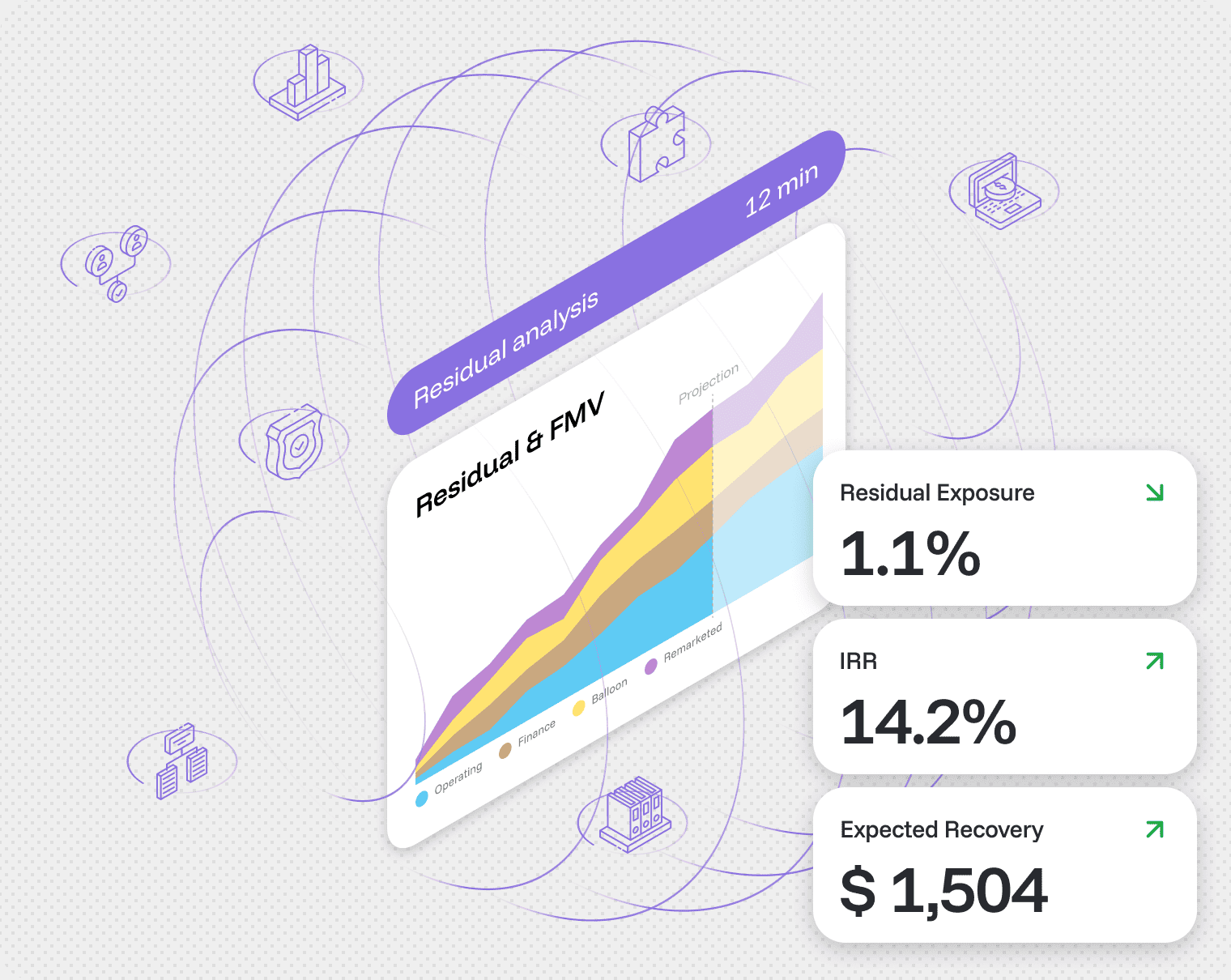
Return, buyout, renewal, and secondary remarketing run as policies-as-code. Residual and FMV updates flow into IRR calculations. The Advanced Analytics layer flags residual exposure anomalies across cohorts before they hit P&L.
-
Captive Finance Software for Dealer and Vendor Programs
Dealer-facing portals, subvention and buy-down logic, OEM inventory tie-ins, and embedded credit decisioning as composed building blocks. The same system powers quote-to-contract and post-delivery servicing without licensing a separate dealer platform.
Serving the Asset Finance Ecosystem
One Building Platform across the bank’s leasing book, the specialty lender’s vendor SLAs, and the captive arm’s dealer programs. Different operating models, same architectural primitives.
-
Banks (Tier 3-4)
Banking lease management software on the same Building Platform as the rest of the bank’s lending operations. Shared servicing, shared GL posting, shared compliance configuration. Leasing products launch alongside loan books, not on a separate vendor stack.
-
Independent Lessors and NBFIs
Leasing business software built for multi-asset contracts, vendor SLAs, and mid-term events on a single governed system. The architectural control of custom build, with the implementation speed of SaaS.
-
Captive and Vendor Finance Arms
Embedded dealer portals, subvention logic, and OEM inventory tie-ins as native components. Iterate on residual policies, partner programs, or new structures without waiting for a vendor roadmap.


How timveroAI Accelerates Your Leasing Build
AI brings the speed. The Building Platform brings the trust.
Standing up a leasing product on a generic SaaS LMS takes the vendor’s roadmap timing. Building from scratch takes 12 to 18 months and 5 to 10 engineers. timveroAI compresses the third path, composing a fully configured leasing system on the Building Platform, from 3 to 6 months down to 2 to 6 weeks from signing to first lease disbursed. RAG-grounded in the platform’s source code and prior leasing deployments, with a human approval gate before any code generation.
Learn About timveroAI-

Requirements Gathering
Natural-language dialog with your product and risk teams about leases, dealers, residuals, and EOT policy. timveroAI asks clarifying questions instead of guessing.
-

Architecture Checkpoint
A plan with atoms (Operating Lease, Residual Tracking, Dealer Subvention) and flows, surfaced for your team to approve before any generation begins.
-

Composition From Building Blocks
Code generation uses actual Building Platform components and prior leasing deployment patterns. No invented APIs, no hallucinated imports, no prototype output.
-

Q&A and Testing
Automated tests run against the original requirements, including residual and EOT scenarios. Documentation updates automatically as the leasing product ships.
Why Leasing Lenders Choose timveroOS
-
Code-Level Control Over Residuals, Fees, and Accounting
Policies-as-code, not vendor config screens. Residual and FMV logic, fee structures, indexation, and GL posting all live in your code, audit-ready and explainable end-to-end.
-
Multi-Country Lease Compliance Without Localization Toggles
Jurisdictional logic (VAT and sales tax, regional disclosure rules, local accounting variations) lives as building blocks, not as an optional module behind vendor permissions.
-
Asset-First Data Model, Not Loan-With-Asset
VIN and serial registries, warranties, insurance, maintenance, and telematics are first-class entities, not custom fields on a generic loan record. Asset leasing software that treats the asset, not the loan, as the system of record.
-
From Signing to First Lease Disbursed in 2 to 6 Weeks
Built on actual Building Platform source code and prior leasing deployments. timveroAI handles 70 to 80% of the implementation work, with a human approval gate between architecture planning and code generation.

Lessors and Specialty Finance Teams in Production on timveroOS
- 80% ready-to-use lending infrastructure supplied

Finom
timveroOS partners with a fast-growing European fintech to launch a multi-country proactive credit product for SMEs delivering full automation, regulatory compliance, and rapid market rollout at a fraction of the cost and time of traditional banking systems.
Read now - 90% cost reduction compare to the previous solution

Cartiga
timveroOS enables a US-based litigation finance company to launch complex working capital products for law firms while achieving full automation, faster time to market, and significantly lowering costs compared to their previous enterprise platform.
Read now - 100% bespoke origination requirements coverage

AMIO Bank
timveroOS enabled a leading Armenian bank to transform a complex lending concept with guarantor support into a fully automated, production-ready solution. The platform ensured full compliance and rapid deployment - bringing the new product to market in just six months.
Read now
SaaS vs Building Platform vs Custom Development for Leasing
Three paths to a leasing product. SaaS launches quickly but caps you at the vendor’s schema. Custom builds give full control with 12 to 18 months of delivery risk. The Building Platform composes operating, finance, and balloon leases from framework-native building blocks in your environment, with policies-as-code for residuals, accounting, and end-of-term.
SaaS Leasing Platforms
Pros
- Fast initial go-live
- Lower upfront cost
- Pre-built workflows
Cons
- Vendor schema limits asset and residual modeling
- Vendor roadmap controls product changes
- Per-seat or per-loan fees escalate TCO at scale
timveroOS
Features
- Modules and SDK in your environment
- Policies-as-code: residuals, fees, EOT, accounting
- Open APIs to core, GL, DMS, telematics, bureaus
- Audit-ready, explainable changes and reversals
- Predictable portfolio-tiered pricing
- From signing to first lease disbursed in 2 to 6 weeks with timveroAI
Custom Development
Pros
- Full control of code and UX
- Tailored data model and integrations
- No vendor lock-in
Cons
- 12 to 18 month delivery risk
- High build and maintenance cost
- Talent and knowledge concentration risk
SaaS Leasing Platforms
Pros
- Fast initial go-live
- Lower upfront cost
- Pre-built workflows
Cons
- Vendor schema limits asset and residual modeling
- Vendor roadmap controls product changes
- Per-seat or per-loan fees escalate TCO at scale
timveroOS
Features
- Modules and SDK in your environment
- Policies-as-code: residuals, fees, EOT, accounting
- Open APIs to core, GL, DMS, telematics, bureaus
- Audit-ready, explainable changes and reversals
- Predictable portfolio-tiered pricing
- From signing to first lease disbursed in 2 to 6 weeks with timveroAI
Custom Development
Pros
- Full control of code and UX
- Tailored data model and integrations
- No vendor lock-in
Cons
- 12 to 18 month delivery risk
- High build and maintenance cost
- Talent and knowledge concentration risk
Integrations for Lease Management
Your leasing stack, integrated as building blocks. Every integration is implemented during deployment and owned in your code, with no marketplace dependency, no per-call surcharges, and no integration partner gatekeeping.
-
Core Stack, Compliance, and Risk
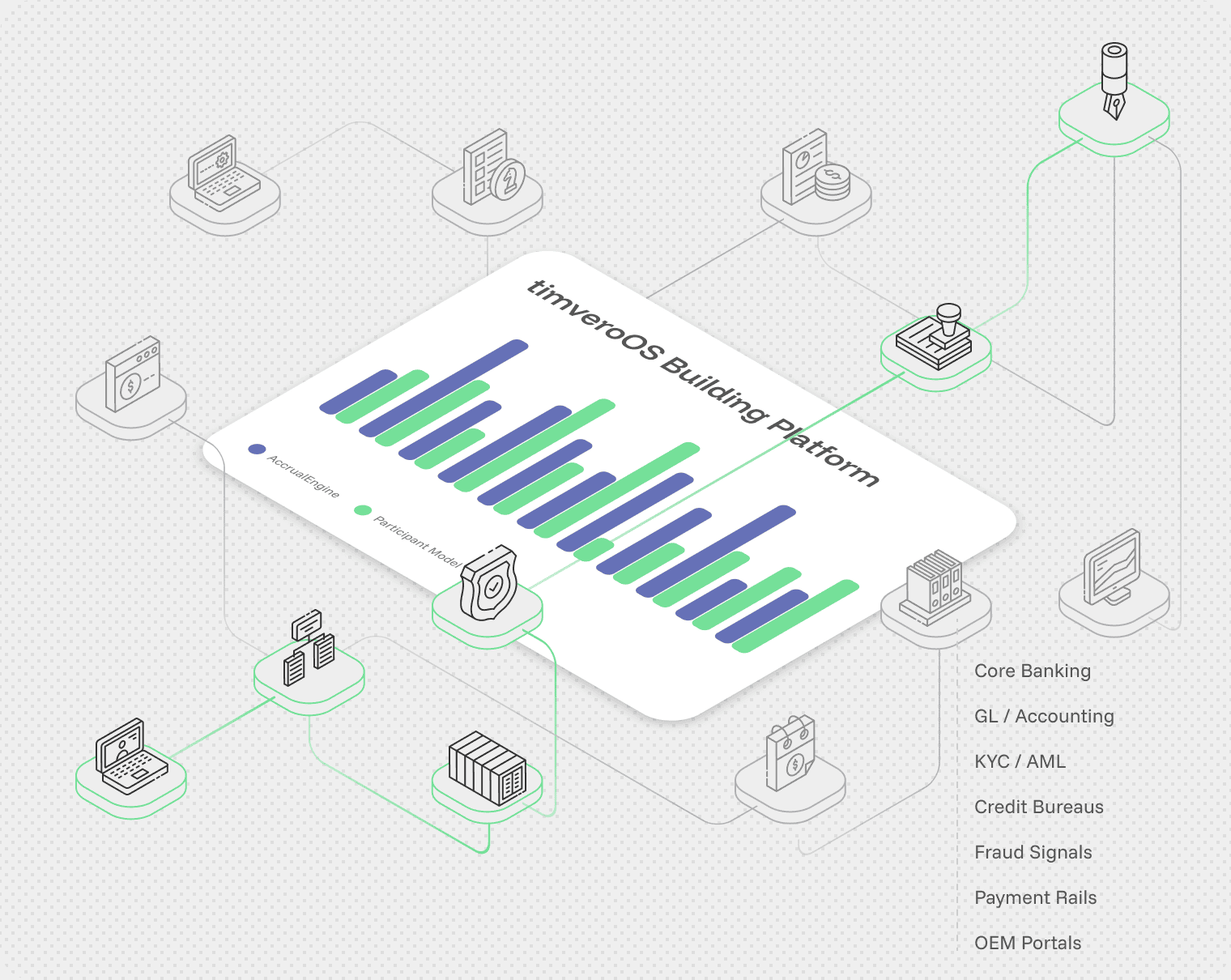
Core banking, general ledger and accounting systems, KYC and AML providers, credit bureaus, and fraud signals connect natively to timveroOS. No per-call surcharges, no marketplace fees.
-
Customer Channel and Dealer Ops
Payment rails, communications, CRM, and dealer management systems run as composed building blocks. Captive finance teams add OEM portals and subvention logic the same way.
-
Asset Telemetry and Valuation
Telematics, insurance feeds, and asset valuation services run as first-class entities on the Building Platform. Add a regional rail or niche provider through the Open SDK, or let timveroAI compose it in days.
Frequently Asked Questions
Common questions from product, risk, and engineering leaders evaluating lease management software on a Building Platform.
-
What is lease management software on a Building Platform?
Lease management software on a Building Platform is lending infrastructure assembled from framework-native building blocks (entities, state machines, AccrualEngine, GL posting, integrations) that you compose into your specific leasing product. Unlike SaaS LMS, you own the configuration and the code; unlike custom build, you don’t write the lending primitives from scratch. timveroOS is built on this approach.
-
What captive finance software handles complex lease structures?
Captive finance arms running operating, finance, balloon, and hybrid lease structures need a data model built for assets, not loans. timveroOS handles multi-participant contracts (lessee, guarantor, dealer, vendor, OEM, insurer), multi-asset structures, subvention and buy-down logic, and dealer portals as first-class building blocks on the Building Platform, not as custom fields on a generic loan record.
-
What is the best software for tracking residual value risk in leases?
Residual value risk tracking needs to live inside the asset record, not in a separate spreadsheet. timveroOS tracks residual and FMV at VIN or serial level, updates exposure as market data and telematics feeds change, and surfaces cohort-level risk through the Advanced Analytics layer of the Building Platform. End-of-term outcomes are tied back to the original residual assumption, so the platform learns from actual remarketing data.
-
How do you find an asset finance platform with lease and loan modules?
Most LMS vendors offer either a loan platform with a leasing bolt-on or a leasing platform without proper loan handling. timveroOS runs lease and loan portfolios on a single Building Platform with shared building blocks (AccrualEngine, Participant data model, GL posting), so a lessor offering working capital alongside equipment leases doesn’t operate two systems. Both portfolios share servicing, reporting, and integrations.
-
How long does it take to launch a leasing product on timveroOS?
From signing the contract to first lease disbursed typically runs 2 to 6 weeks, with timveroAI handling 70 to 80% of the implementation work. Initial up-and-run on the Building Platform skeleton happens in under a week. A Tier 3 bank launching its first balloon lease product, or a captive finance team adding a new vendor program, sees first production traffic in weeks, not the 12 to 18 months a custom build would take.
-
Does timveroOS support auto and vehicle leasing?
Yes. timveroOS handles auto and vehicle leasing through the same asset-first data model, with VIN-level registries, telematics feeds, and dealer integrations native to the Building Platform. For auto lending products specifically (retail auto loans, indirect lending, floorplan financing), see the dedicated auto lending software page.
-
Can timveroOS be deployed on-premises for a regulated lessor?
Yes. timveroOS deploys in your environment: public cloud, private cloud, or on-premises. The Building Platform is built for confidentiality-sensitive operations, which is critical for captive finance arms inside regulated banks, lessors operating under data-residency mandates, and specialty finance teams running private deal books. You own the deployment, the data, and the code.
Related Lending Solutions


Launch Your Leasing Product on timveroOS
$5.5B+ managed across 13+ countries. From signing to first lease disbursed in 2 to 6 weeks with timveroAI. Built on a Building Platform that gives you code-level control over residuals, accounting, and end-of-term.
Request a Demo